
 E-Paper



Voter roll revision SIR begins in 12 states, UTs: Here's a step-by-step guide
As first step that begins immediately voters in these states will be matched against the 2002, 2003 and 2004 voting lists.

 Prefer HTon Google


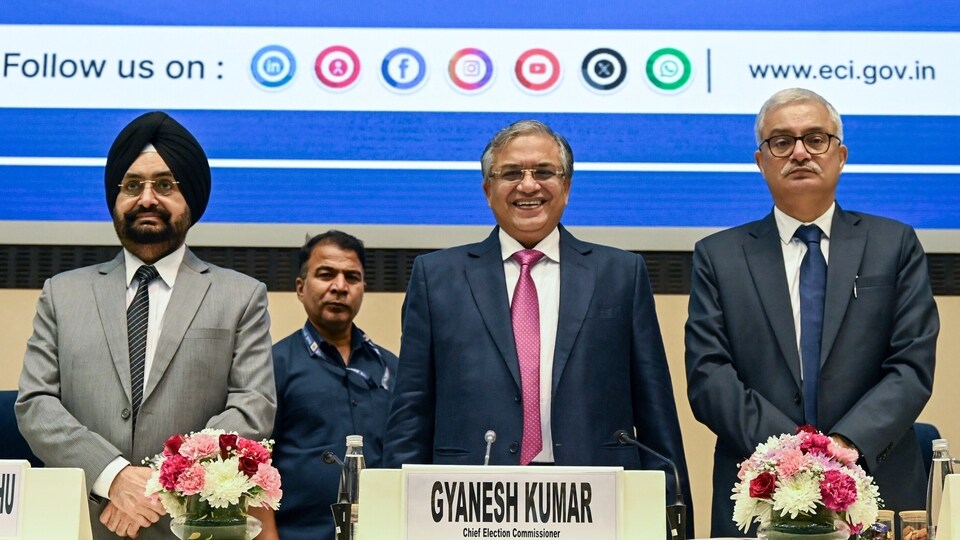
Chief Election Commissioner Gyanesh Kumar on Monday announced that the Election Commission will conduct Phase 2 of the special intensive revision (SIR) of electoral rolls in 12 states and Union Territories.
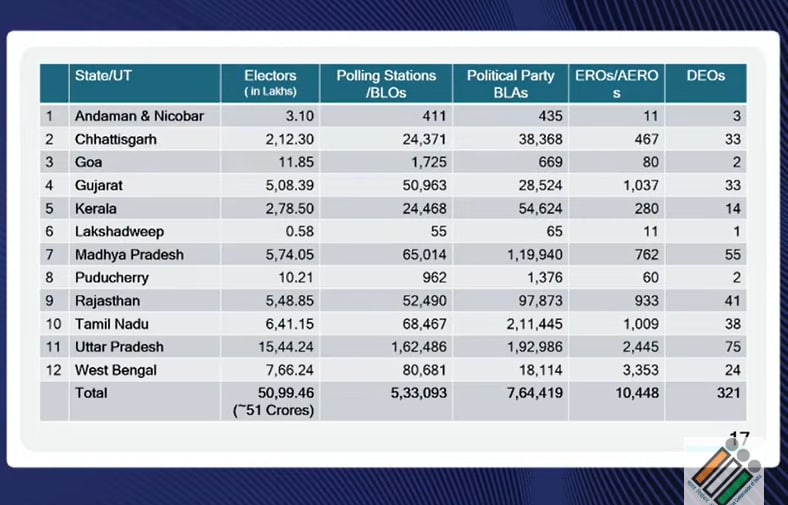
With Bihar done in Phase 1, the states and union territories where SIR will be held include the Andaman and Nicobar Islands, Lakshadweep, Chhattisgarh, Goa, Gujarat, Kerala, Madhya Pradesh, Puducherry, Rajasthan, Tamil Nadu, Uttar Pradesh and West Bengal.
Of these, four — Tamil Nadu, Puducherry, Kerala and West Bengal — are due to go to polls in 2026.
As first step that begins immediately voters in these states will be matched against the 2002, 2003 or 2004 voting lists (depending on the last SIR), the CEC announced. Draft rolls will be published on December 9, and the final electoral rolls on February 7. "The second phase will cover 51 crore voters," he said.
He added that the current voter lists in these 12 states and UTs will be frozen as on October 27.
Here's how the SIR process will be carried out.
- CEC Gyanesh Kumar has said that Electoral Registration Officers (EROs) and Assistant Electoral Registration Officers (AEROs) will print Unique Enumeration forms (EFs) for each elector as of 27 October 2025.

- All voters on this latest list will be given the enumeration forms by the BLOs. These forms will have all the necessary details from the current voter list.
- After that, BLOs will start distributing forms to existing electors. All individuals whose names are on the forms will attempt to verify whether their names appear on the 2003 voter list. If yes, they need not submit any additional documents.
- If their names are not on the list, but the names of their parents are, then they also do not need to submit any additional documents but only proof identity. The voter list of the SIR from 2002/03/04 will be available on the ECI website for people to cross-check their names.
- If their names, or their father's or mother's names, were not available on the older list, the ERO will determine eligibility based on the indicative documents.
- These indicative documents include identity cards issued by the government, PSU, local authorities, banks, post offices, etc; birth certificate; passport; educational certificates; caste certificates, among others.
- The ECI has also included Aadhaar on the list of 12 indicative documents, but clarified that it can only be used as proof of identity, not as proof of date of birth or domicile.

- “If the elector is not available or there is a delay in matching and linking, the BLOs will visit the houses a total of three times. Electors can also fill out the forms online,” Kumar said at the press conference.
- Once a draft electoral roll is published, notices will be sent to voters who could not be matched or linked with the last SIR roll of 2002/03/04. This would be followed by a hearing phase (December 9 to January 31), during which indicative documents will be verified by EROs and AEROs.
- Any elector or BLA of a recognised political party can also file a claim or objection between December 9 and January 8. The final electoral rolls will be published on February 7.


