
 E-Paper



Piyush Goyal was again asked about Trump's no-Russian-oil condition, he cited 'India's own interest' in buying from US
Commerce minister says deal won't discuss who will buy what and from where; “it ensures that the pathway to trade is smooth; ensures preferential access"

 Prefer HTon Google


India's commerce minister Piyush Goyal, speaking some more on Sunday about the trade deal framework with the US, again sidestepped a direct answer about US President's Donald Trump's condition that India will not buy Russian oil or he will re-impose tariffs.
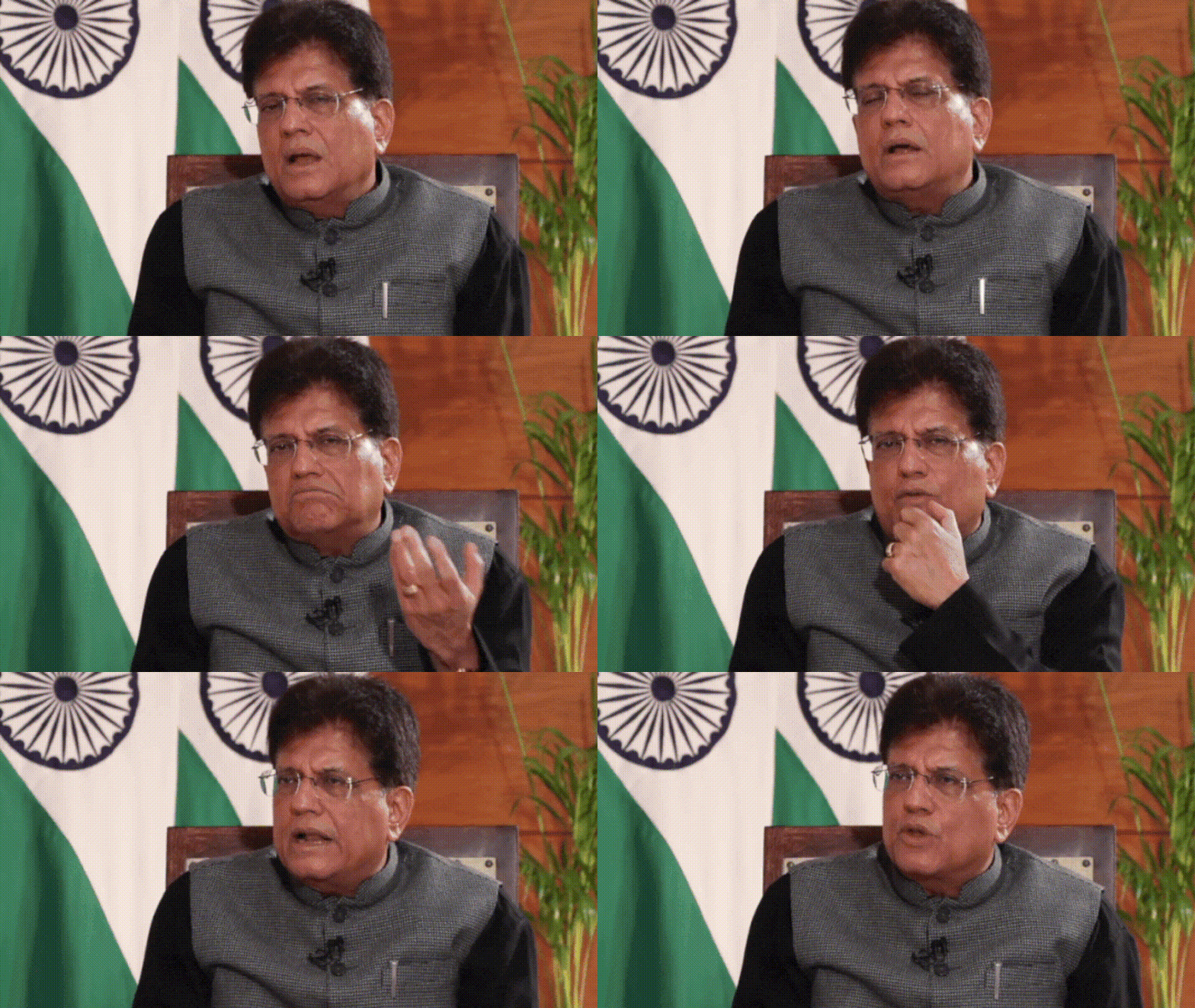
“The buying of crude oil or LNG, LPG from the US is in India's own strategic interests as we diversify our oil sources," Goyal said.
Follow updates | What Goyal said on farmers' interests; how Oppn reacted
On the matter of the US making Russian oil an issue — for Delhi's oil dealings with Vladimir Putin's Moscow regime despite a war in Ukraine — Goyal has so far said that's the domain of the Ministry of External Affairs.
In the Sunday interview with ANI, the question was straight. If there is a lack of bilateral consensus on Russian oil or on defence matters, doesn't that impact the trade deal too?
“No, not at all,” Goyal answered. He said the deal anyway won't discuss who will buy what and from where. “The trade deal ensures that the pathway to trade is smooth, ensures preferential access. FTAs (free trade agreements) are all about preferential access… When we've got an 18% reciprocal tariff, we have a preference over other developing nations who are usually our competition,” he added.
The question on Russian oil remains open as Trump — in his executive order by which he has removed 25% “penalty” tariffs on India — said the US commerce secretary should track if India “resumes” such oil imports.
This “monitoring mandate” on Indian oil purchases is the “real sting” in Trump’s executive order, strategic affairs expert Brahma Chellaney has said. “It formally tasks the commerce secretary with tracking Indian oil imports and creates a clear trigger: a finding that India has resumed ‘directly or indirectly’ importing Russian oil could snap the 25% punitive tariff back into place,” Chellaney said on X.
While the 25% penalty is gone for now, the other 25% tariff rate will eventually be cut to 18% once the deal is formally done.
“Donald Trump removes the tariff noose but leaves the rope firmly in place if India resumes buying Russian oil,” wrote Chellaney, professor emeritus at the independent think tank Centre for Policy Research (CPR), New Delhi.
What's MEA stance on Russian oil?
India, as of Sunday, neither confirmed nor denied the Trump administration’s assertion that New Delhi has committed to stop buying Russian oil as part of a trade deal.
The Ministry of External Affairs (MEA) has reiterated that energy purchases will be diversified on the basis of market conditions and international dynamics to ensure the country’s energy security — a diplomatic line that New Delhi has stuck to for months amid Trump's tariff aggression.
People familiar with the matter have told HT that India is diversifying energy purchases for geopolitical reasons, though there were no immediate signs of Russian energy purchases dropping to zero altogether.
Indian refiners are reportedly avoiding Russian oil purchases for delivery in April. They are expected to stay away from such trades for longer, news agency Reuters reported on Sunday citing trade sources.
Since the announcement of a deal being worked out, whenever commerce minister Goyal was asked about the “stop” to Russian oil, he said the MEA would answer. The MEA has thereafter reiterated its old contention.
Trump's order says can reimpose tariff if…
The US President's executive order reads, "India has committed to stop directly or indirectly importing Russian Federation oil, has represented that it will purchase United States energy products from the United States, and has recently committed to a framework with the United States to expand defense cooperation over the next 10 years."
The order references Vladimir Putin's Moscow regime as a reason for these tariffs on India. It is titled: ‘Modifying Duties to Address Threats to the United States by the Government of the Russian Federation’.
This order is different from the India-US joint statement that announced the “framework for an Interim Agreement" towards an eventual Bilateral Trade Agreement (BTA).
The order expressly speaks of possible reimposition of the 25% punitive tariff, “if the (US) Secretary of Commerce finds that India has resumed directly or indirectly importing Russian Federation oil”.
In all, India faced 50% tariffs since August 2025, of which 25% was “penalty” for Russian oil purchases that Trump said was “funding the war in Ukraine”. This 25% has been removed as part of movement towards a bilateral trade agreement between India and the US.
Former foreign secy analyses ‘energy choices’
India's former foreign secretary and retired diplomat Nirupama Menon Rao has noted that the US executive order “says several things”.
“Strategically, this signals that energy choices are now treated as geopolitical behaviour, not just commercial decisions... The order also shows how strategic autonomy is being stress-tested,” she posted on X.
She added, though, that “India’s leverage is visible” and the tariffs were reversible “because India matters — economically, strategically, and in the Indo-Pacific balance”.
“Washington is negotiating with India, not sidelining it,” she wrote.
The joint statement by the two countries on the framework towards a deal does not expressly mention Russia, but says India will buy $500 billion worth of energy and other items from the US over the next five years.
This commitment, according to Brahma Chellaney, is “another feather to Trump’s extractive cap”. He also noted that the “no Russian oil” condition would mean India would have to replace discounted crude with market-priced US oil “made costlier still by longer transport distances”. This, as per Chellaney, can add an estimated $4 billion a year to India’s oil import bill.
Oppn MP demands Parliament debate
Shiv Sena (UBT) MP Priyanka Chaturvedi on Sunday criticised the BJP-led NDA regime over the India-US interim trade agreement, calling it "treacherous".
Saying that the government has “handed over” the country's national interest and policy to the US, she urged for the deal to be discussed in Parliament.
“This is betrayal, and under what compulsion was this done? Today, the government will have to come to the floor of Parliament to discuss this trade agreement,” she said, speaking to ANI
"The government have been arm-twisted, and what were their reasons? All this should be discussed on the platform of Parliament," she said.
The ongoing Budget Session has been disrupted, particularly in the Lok Sabha, as the BJP-led NDA is locked in a biter battle with Leader of Opposition Rahul Gandhi of the Congress. Rahul wants to read excerpts of an unpublished book by former army chief Gen MM Naravane that he says “exposes the character of PM Modi” on India's handling of the border dispute with China.


