
 E-Paper



Policy book calls for reforms along the lines of 3 repealed farm laws
The wide-ranging research work, which lays down a midterm blueprint, signals the continued emphasis of policymakers on agricultural reforms, but advocates greater involvement of states.


Union agriculture minister Narendra Singh Tomar on Wednesday released a farm-policy book anchored by state-run think-tank Niti Aayog which calls for structural reforms similar to those laid down in three agricultural laws repealed last year after large-scale protests.
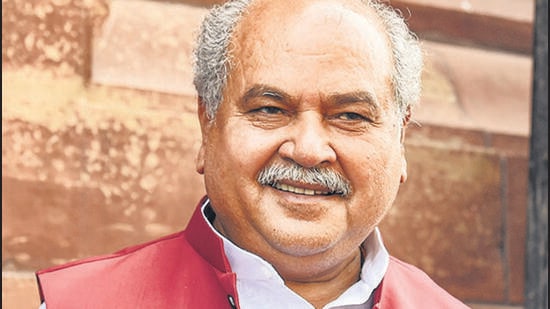
The wide-ranging research work, which lays down a midterm blueprint, signals the continued emphasis of policymakers on agricultural reforms, but advocates greater involvement of states in decision making.
The book, “Indian Agriculture towards 2030: Pathways for Enhancing Farmers’ Income, Nutritional Security and Sustainable Food and Farm System” calls for raising investments, especially in research. One study shows that every rupee invested in farm research yielded higher returns than other interventions.
The authors also warn that climate risks could pose serious challenges to the sector and impact the livelihoods of millions.
The government has rolled back the three farm laws, but some states have implemented some of aspects of the laws, such as contract farming and scrapping of restrictions under the agricultural produce marketing committees.
The book is a collaboration between Niti Aayog, the Union ministry of agriculture, and the Food and Agriculture Organisation (FAO), and has been published by the journal Springer.
“With the efforts of all the stakeholders, we will be able to handle the challenges identified and take Indian agriculture and the country to new heights,” Tomar said, releasing the book.
The book highlights specific challenges, such as growing food surpluses but poor nutritional outcomes in the country. “…India is home to the largest number of undernourished people in the world,” writes Ramesh Chand, who oversees farm policies at Niti Aayog.
It also points to large-scale environmental damage from farming: “Agriculture is both a victim of and contributor to climate change …”
Referring to poor prices of farm produce – which is at the heart of farmer angst -- it states that huge surpluses mean a fall in prices. Therefore, India must find export markets, the authors say.
On reforms, two of the authors, Seema Bathla and Siraj Hussain, write that states should be given more “flexibility”. They also say that a law for “interstate trade needs to be enacted by the Centre”, which was one of the three laws revoked in December 2021.
The book states the three farm laws repealed in December 2020 after a farmers’ uprising were a “breakthrough”.
The legislation sought to promote more private participation in farm trade by easing restrictions, allow traders to stock large quantities of produce for future sales and lay down a national policy on contract farming. Farmers opposed them because they feared exploitation by large corporations.
“There should be two future drivers: science and innovation and investment in research. We should have an agricultural policy for next 5-10 that is focused on exports,” said PK Joshi, one of the authors.
Farming still employs nearly half of all Indians, making it critical for livelihoods and rural incomes. Agriculture contributes nearly 18% of India’s gross domestic product, but a majority of agriculturists are small and marginal.
“I haven’t seen the book. But it seems to talk about the same things farmers are opposed to. These reforms will kill mandis (regulated markets) and expose farmers to exploitation,” said Gurnam Singh Charuni, a farm leader who opposed the farm laws.


