
 E-Paper



Pollution choke is on Delhi again
Agencies and governments expressly responsible for quelling the crisis have chosen to pass the blame to everyone but themselves

 Prefer HTon Google


Delhi’s pollution was firmly in the “severe” zone of the air quality index (AQI) for a second straight day on Thursday, as calm winds amplified the effects of local pollutants and stubble-fire smoke sheathed the Capital in a dome of filthy grey, hurling residents into an unmitigated public health disaster and underscoring the incompetence of agencies and officials who, once again, failed to fend off a nightmare that haunts the city every year.
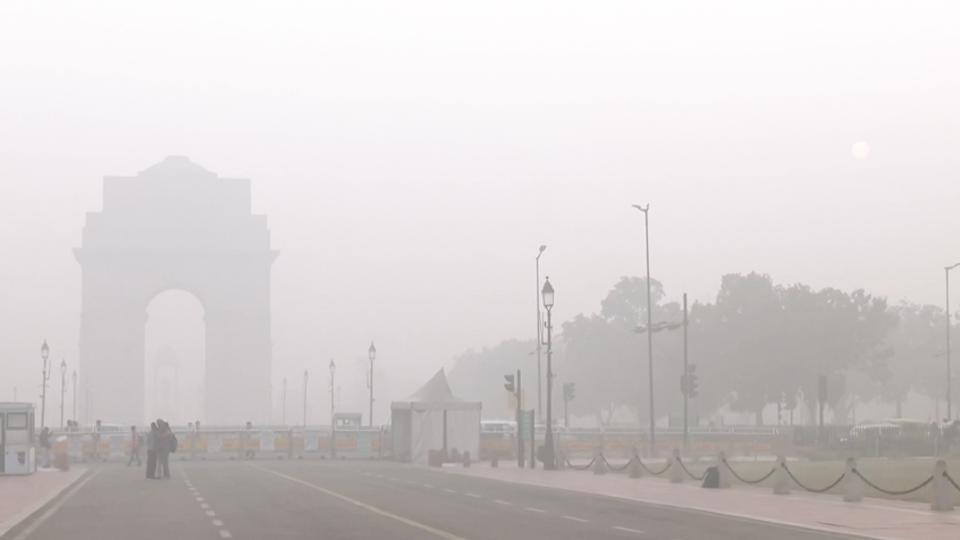
The Capital recorded a 24-hour AQI of 424 at 4pm, worse than the reading of 418 at the same time on Wednesday, showed data from the Central Pollution Control Board (CPCB).
Agencies and governments expressly responsible for quelling the crisis either shrugged their shoulders at the rapidly worsening crisis or chose to pass the blame to everyone but themselves.
“This is an air emergency. Like previous years, we seemed to have learned no lessons and people who suffer every year continue to suffer,” said Bhavreen Kandhari, an environmental activist part of the citizens’ group Warrior Moms.
The Commission for Air Quality Management (CAQM), the central agency whose sole task is to control pollution in the National Capital Region (NCR), belatedly imposed curbs under Stage 3 of its response plan on Thursday evening, a day after the air quality first hit “severe”.
The agency had met on Wednesday evening as the AQI surged into the upper margins of the “severe” category towards record levels, but, inexplicably, refrained from taking any control measures.
CAQM’s own charter says: “Actions under Stages 2, 3 and 4 of the GRAP (Graded Response Action Plan) shall be invoked in advance of the AQI reaching to the projected levels of that stage.” And yet, the body was again behind the curve on pollution control.
The 12-member panel took few preventive or mitigatory measures for months, even as the triggers and causes for the toxic smog that masks north India every winter are now well known : Vehicular emissions, local industries, construction, garbage burning, and above all, smoke from Punjab’s and Haryana’s burning paddy fields.
This, despite the Supreme Court pulling up the agency several times over the past two months alone, along with Delhi government agencies and the state government of Punjab and Haryana.
During a hearing in September, the top court pulled up CAQM for failing to act once again. “Calling meetings will not yield anything. Actions must follow,” it said.
Though agencies said inspection teams fanned out across farmlands in north India to snuff out stubble fires, it clearly hasn’t worked. Punjab has recorded 7,626 fires so far and Haryana 1,035.
Arvind Nautiyal, CAQM member secretary, told HT Wednesday’s deterioration was due to an episodic event, with forecasts by both IMD and IITM showing stronger winds were likely on Thursday. This led to them not invoking Grap, he said.
“The AQI was supposed to show a declining trend on Thursday and was likely to move back to the Very Poor category. Comprehensively reviewing this scenario, it was accordingly decided by the sub-committee to keep a close watch on the situation, before invoking these stringent and restrictive measures under Stage 3. This stage is to be imposed when the daily average AQI is expected or forecasted to be above the 400 mark for a sufficiently long duration, say three days,” he said.
Also in the dock was the Aam Aadmi Party (AAP), which runs the governments in Delhi and Punjab, home to the bulk of India’s winter farm fires. Instead of acting on pollution within the states it governs, it trained its guns on Uttar Pradesh and Haryana.
The party came to power in Punjab in 2022; before that, its leaders periodically blamed the agrarian state and its administration for the pollution crisis. But on Thursday, Delhi environment minister Gopal Rai shifted track.
Referring to a Centre for Science and Environment (CSE) of data from October 12 and November 3, he said a large chunk of pollution was coming from outside Delhi.
“It shows only around 30% is from sources within Delhi and the remaining 70% from outside. For this, we need cooperation from NCR governments too,” he said.
In winter, long-range transport winds blow from Punjab and Haryana towards Delhi and Uttar Pradesh, bringing dense, toxic plumes of smoke from scorching paddy fields to the National Capital Region (NCR). Last year, the contribution of farm fires to Delhi’s PM2.5 (an ultrafine pollutant) concentration peaked at 35.43% on November 3, when the AQI hit 450.
The worst may be yet to come this year.
Officials in Punjab on Thursday said half the area under paddy cultivation in the state was still to be harvested, implying that the number of farm fires will likely surge in the days to come as farmers scramble to clear their fields before the winter crop.
The administration has flailed in its attempts to snuff farm fires out. It has threatened farmers with a string of measures, including putting their name on “red lists” that would disallow them from availing loans.
None of these steps have worked.
“What we are seeing is that farmers that have more land and money are able to get machines and can even pay for bailors to lift residue. Smaller farmers are the ones burning their leftover residue and are the ones that are likely to suffer,” said Balkarn Brar, state president of the All India Kisan Sabha (AIKS) in Bathinda, Punjab.
And amid the cycles of blame game between agencies, residents were left to suffer helplessly , breathing in thick lungfuls of a toxic cocktail that slashed their life expectancies by several years.
Kunal Sharma (35), a resident of Subhash Nagar in west Delhi said the worsening AQI makes it almost impossible to ride a bike.
“My eyes and throat ate itching by the time I reach office in Gurugram. I know my exposure time pollution is high, but there is no option,” he said.
Doctors warned that such levels of pollution expose even healthy, young adults to serious respiratory and cardiac ailments, while seriously imperilling older people or those with chronic illnesses.
“We are noticing people complaining of throat and eyes problems, which prevail for days. An increasing number of patients aree coming with coughs and upper airway problems. These symptoms are prevalent even in healthy people. Meanwhile, people already with respiratory diseases are already suffering from aggravated symptoms,” said Dr Vikas Mittal, pulmonolgist and director at the Wellness Home Clinic and Sleep Centre in Paschim Vihar.


