
 E-Paper



Produce evidence or withdraw remarks: CEC to Rahul Gandhi on voter fraud claims
CEC Gyanesh Kumar termed Rahul Gandhi’s ‘vote chori’ allegations as a baseless charge that misleads the public and undermines faith in the Constitution.

 Prefer HTon Google


New Delhi: The Election Commission of India (ECI) on Sunday dismissed Congress leader Rahul Gandhi’s allegation of “vote chori”, terming it as a “baseless” charge that misleads the public and undermines faith in the Constitution.
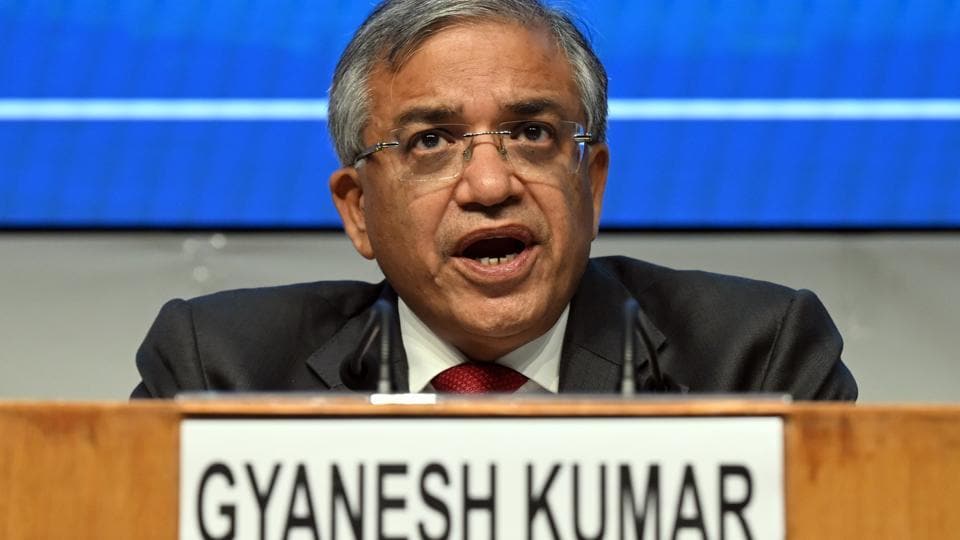
“Produce evidence of voter fraud or withdraw your remarks. There is no third option,” Chief Election Commissioner (CEC) Gyanesh Kumar said at a press conference in Delhi, giving Gandhi a one-week deadline and asserting that the poll body would not be cowed by political attacks
The press conference —first since the controversial Special Intensive Revision (SIR) of Bihar’s electoral rolls was ordered— was also attended by Election Commissioners Sukhbir Singh Sandhu and Vivek Joshi.
Also Read: 'Should be jailed...': TMC's Mahua Moitra slams CEC over '22 lakh dead voters' remark
“When politics is being done by targeting the voters of India by keeping a gun on the shoulder of the Election Commission, today the Election Commission wants to make it clear to everyone that the Election Commission fearlessly stood like a rock with all the voters of all sections and all religions, including the poor, rich, elderly, women, youth, without any discrimination. (It) is (still) standing and will continue to stand,” the CEC said.
The pushback came the same day Gandhi launched the Opposition’s Voter Adhikar Yatra in Bihar, escalating a political confrontation over the integrity of the rolls.
At the heart of the Commission’s defence was a categorical rejection of Gandhi’s central charge. “Preparation of electoral rolls and casting of votes are two different processes under two separate laws. When a voter goes to vote and presses the button, he can press it only once… vote theft cannot happen,” Kumar said.
He accused Gandhi of using misleading visuals to back his case. “If someone thinks that he can use a PPT presentation to falsify data and misinterpret facts, then that act is against both the law and Constitution,” Kumar said.
The SIR in Bihar—undertaken state-wide for the first time in two decades—has excluded nearly 65 lakh names from the draft roll published on August 1. Opposition leaders have flagged the removal of 22 lakh names as “deaths” in just six months.
Kumar said: “A Special Intensive Revision was last conducted 20 years ago. Since then, only summary revisions have taken place. The deaths were those unreported to the EC in the last 20 years, not in six months.”
On criticism of voters being listed under “house number 0,” Kumar insisted this was an inclusionary move. “There are people who stay under bridges, near lampposts, and in unauthorised colonies. The poll body tries to not leave out any voter and assigns them addresses. Nationality, proximity to the booth and age of 18 years were the criteria for inclusion, not a formal address.”
The CEC also addressed the politically sensitive issue of duplicate EPICs (Elector Photo Identity Cards). The EC had recently issued a notice to RJD leader Tejashwi Yadav for allegedly holding two voter IDs, prompting charges of bias. This came months after ECI declared that the voter database had been “cleaned” of dual EPIC ID issues back in May. Kumar sought to contextualise: “Duplicate EPICs can happen in two ways. One, that a person in West Bengal has one EPIC number and another person in Haryana has the same number. About three lakh such cases were found and corrected earlier this year. The second type comes when the same person’s name is in the voter list at more than one place with different EPICs. Before 2003, when deletions were not centrally tracked, many such names remained.”
But he conceded the risks of a hurried clean-up. “If this is done in a hurry, then any voter’s name can be deleted wrongly. Someone else’s name will be deleted in your place. We agree there is an issue but we will have to take time and caution to resolve this.”
Kumar accused Opposition parties of wilfully spreading doubt. “It is a matter of great concern that a few political parties have made allegations of vote chori despite their own booth-level agents having received and attested the corrected rolls in the first stage of SIR,” he said. “This means either local voices are not reaching national leaders, or there is a deliberate attempt to confuse voters.”
The CEC maintained that the Commission has received “28,370 complaints from ordinary voters, not political parties.” This contradicted RJD leader Tejashwi Yadav’s claim, made in a BBC interview, that booth-level agents had lodged hundreds of objections ignored by the EC.
Appealing directly to all 12 recognised parties in Bihar, Kumar set a hard deadline. “File objections by September 1. After that, no complaints will be entertained.”
On charges that the compressed timeline left little room for verification, Kumar cited precedent: “The last intensive revision in 2003 was completed in a month. Booth-level officers visit every household and compile fresh lists from scratch. This is aimed at maximum purity in rolls.”
The Commission also sought to showcase its speed in complying with last week’s Supreme Court directive. The Court had ordered the EC to publish searchable, district-wise deletion lists along with reasons and to accept Aadhaar as valid proof for reinstatement—reversing the Commission’s earlier position. “We created district-level portals within 56 hours,” Kumar said, adding that voters can now check deletion status online.
The press conference ranged beyond Bihar to touch on simmering disputes over privacy, citizenship and the Commission’s credibility. Kumar reiterated that the EC could not release machine-readable voter rolls, citing a 2019 Supreme Court ruling that such lists would compromise electors’ privacy. “You can search the voter list available on the EC website by entering the EPIC number and download it. That is searchable, not machine-readable.”
He warned Opposition leaders against exposing voters’ personal data. “They showed electors’ details in public. They are breaching their privacy. Should the Election Commission share CCTV videos of any voter, including their mothers, daughters-in-law, daughters?” he asked, in a swipe at Rahul Gandhi for releasing voter documents.
On the contentious question of whether the EC has the authority to verify voters’ citizenship, Kumar asserted: “Article 326 clearly says that only citizens have the right to vote, and thus the verification of citizenship is within EC’s domain of powers.” This marks a departure from the Supreme Court’s earlier observation that such verification lies with the Union home ministry.
Kumar closed with a forceful defence of the poll body’s neutrality: “We are not scared. I want to make it very clear today that the EC will conduct its duties with fearlessness and ensure that no one is discriminated against on the basis of class and faith. The EC stood with Indian voters like a rock, stands with them like a rock and will continue to be with them like a rock. When more than seven crore voters of Bihar are standing with the Election Commission, then neither can any question mark be raised on the credibility of the Commission nor on the credibility of the voters.”


