
 E-Paper



Punjab, Haryana square off again for control of ‘City Beautiful’
While Punjab wants Chandigarh to be ‘returned’ to it, Haryana, with its own share of historical grievances, feels it has the stronger claim on the Union territory.


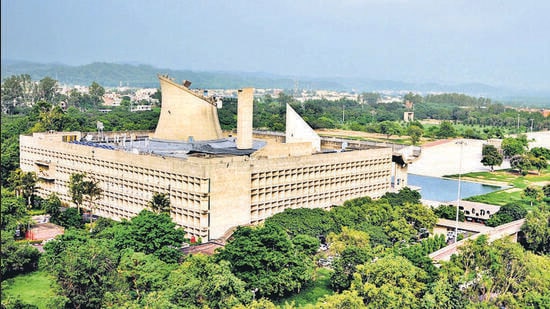
Chandigarh: To its admirers in Punjab and Haryana, Chandigarh is more than a Corbusierian masterpiece of architectural brutalism and machine-like functionality. The post-Independence city is a matter of honour and prestige, in a landscape that puts more than its fair share of stock in honour and prestige.
Not coincidentally, one of the politically charged rallying cries in the controversial song SYL by Sidhu Moosewala, released posthumously and subsequently taken down by YouTube over a government complaint, was that Chandigarh be “returned” to Punjab. Haryana, with its own share of historical grievances, feels it has the stronger claim on the Union territory.
The issue returned to the headlines when, on July 9, Haryana chief minister Manohar Lal Khattar raised the demand for a new building for the Haryana assembly at a meeting of the Northern Zonal Council, arguing that the one building which houses both the Haryana and Punjab assemblies since the bifurcation of the two states in 1966 was running short of space. The contention for support from Union home minister Amit Shah.
But, in Chandigarh, any such move isn’t about real estate. It has serious political ramifications, adding a new chapter of controversy to a city born out of Partition that became one of India’s first large-scale experiments in urban planning, and whose ownership has never been resolved satisfactorily with both Haryana and Punjab loath to giving up their claim on the jewel in their crowns.
The creation of Chandigarh
The months after Partition were a time for grief and mourning in Punjab. While there are several estimates for how many people lost their lives and homes, most accounts put the death toll upwards of 800,000, and the number of refugees upwards of 1.5 million. Among the losses that India had to recover from was the loss of Lahore, till then the capital of undivided Punjab, leaving the need for a new capital of Indian Punjab.
The official website of the Chandigarh administration says that, by March 1948, the government of Punjab, in consultation with the government of India approved the idea of Chandigarh, in the foothills of the Shivaliks, as the new capital. “The location of the city site was a part of the erstwhile Ambala district as per the 1892-93 gazetteer of district Ambala,” the website says.
Professor of history at Punjab University, Rajiv Lochan, says that during the discussions post-Partition, there were four other contenders — Ambala, Hisar, Ludhiana, and Jalandhar. “But Prime Minister Jawaharlal Nehru was differently minded. He was of the view that there should be a capital that was not weighed down by history.”
The government engaged Charles Edouard Jeanneret, a Swiss-French architect and urban planner, also known as Le Corbusier, to design the city. In the master plan Le Corbusier conceived, Chandigarh was analogous to the human body, with a clearly defined head (the capitol complex), heart (the city centre at Sector 17), lungs (innumerable open spaces and sector greens), intellect (the cultural and educational institutions), the circulatory system (the network of 7Vs, or seven roads ) and the viscera (the industrial area), the Chandigarh government website said. “The concept of the city is based on four major functions: living, working, care of the body and spirit and circulation.”
Partition redux
History, albeit with much less blood and gore was to repeat itself. With Indian states being redrawn on a linguistic basis, Punjab was divided again; into Punjab with its Punjabi-speaking population, and Haryana with its Hindi speaking population. The redrawn contours in 1966 gave Haryana 44,212 square kilometres, and Punjab 50,362 square kilometres. Five years later, in 1971, Himachal Pradesh was also carved out of Punjab.
But by this time, Chandigarh had grown into its role as a capital, and both Punjab and Haryana staked vociferous claims for it. “Since both the states claimed Chandigarh as its capital, the matter was settled by giving the city the status of Union territory. It was made the joint capital of both states. It was desired by the then Prime Minister Indira Gandhi that the matter be settled in about five years but events took such a turn that Chandigarh continues to be a Union Territory,” writes Aditya Prakash, an architect, in his book Chandigarh, The City Beautiful.
Clearly, for stakeholders in the region, Chandigarh being a Union territory was not a permanent solution, only a stopgap. In 1966, a Punjab boundary commission, headed by justice JC Shah, was asked to recommend boundaries for the Hindi and Punjabi speaking states to secure linguistic homogeneity. Two of the three members in the commission said that the tehsil of Kharar, which included the Chandigarh capital project, should be part of Haryana. One of the members, S Dutt, however, dissented and argued that Kharar, minus the Kalka police station, should be merged with Punjab.
Given the lack of consensus, and the threat of possible violence, the Chandigarh issue was put on the back burner and stayed there.
In 1982, the Akali Dal began protests seeking the implementation of the 1973 Anandpur Sahib resolution which contained a series of demands put forward by the party, including the handing over of Chandigarh, arguing that the city had always been intended as the capital of Punjab.
In July 1985, PM Rajiv Gandhi and Akali leader Sant Harchand Singh Longowal signed the Rajiv-Longowal agreement after months of protest in the wake of the anti-Sikh riots of 1984. The agreement held many promises, including setting up of an interstate water dispute tribunal and financial compensation to the kin of those killed in agitations. It also agreed that the Union government would give Chandigarh to Punjab, and in return, the Hindi speaking areas of Punjab would be handed over to Haryana.
The Centre appointed a commission headed by justice ES Venkataramiah in 1986 to identify such Hindi-speaking areas. Though the commission submitted a report in recommending the transfer of about 70,000 acres of Punjab’s territory to Haryana, the recommendation was never implemented (Punjab was unwilling to give up the land).
The fresh tussle
After Khattar sought land in Chandigarh to set up an additional state assembly building -- citing the lack of adequate seating in the existing assembly, and that this would likely get worse given the possibility of an increase in seats, from 90 to 126, after the proposed 2026 delimitation -- Punjab’s new CM, Bhagwant Mann of the Aam Aadmi Party, responded by seeking land in Chandigarh for a Punjab assembly on July 9.
His move, however, came in for criticism in Punjab for allegedly weakening the state’s claim on Chandigarh. Congress MLA and former Leader of Opposition Sukhpal Khaira said, “I am very disappointed that you are weakening our claim on Chandigarh by asking for land for a high court and a Vidhan Sabha in Chandigarh. Chandigarh is ours and you should vehemently oppose the grant of land to Haryana for a new Vidhan Sabha.”
Congress legislature party leader Partap Singh Bajwa was also critical of Mann for raising the issue of a separate high court for Punjab in “New Chandigarh”, a satellite town that falls in the contours of Punjab, instead of within the Union territory limits. Mann articulated this demand in an April 30 conference of chief ministers and chief justices of the high court. Bajwa said:“The high court complex built by Le Corbusier in Chandigarh should be given to the state of Punjab as Chandigarh was primarily built to be the capital of Punjab. Why should the HC of Punjab leave the city of Chandigarh?”
The new plans, and what is at stake?
Senior Haryana officials said while the state plans to build a new assembly on a 10-acre plot on the road leading to the IT park in Chandigarh, they do not intend to give up their claim on the unified Capitol building which currently houses the assembly of both states. “The state government will continue to have the existing Vidhan Sabha in the Capitol Complex. Some special sessions, the first session of the year which is addressed by the governor and the budget session can be held in the new assembly premises. The regular sessions can be held in the existing assembly building,’’ a senior Haryana official said, asking not to be named.
Political analyst Professor Ramji Lal said that the Haryana government’s move would likely weaken Punjab’s historical claim, and have deep ramifications. “It was always thought that Punjab would get Chandigarh and Haryana would be given money and some land from Punjab for a new capital. With home minister Shah seeming favourable to Haryana, it may weaken Punjab’s claim on Chandigarh and will create more friction between the two states. It is a controversy being created with an eye on next rounds of assembly and Parliament elections,” he said.
Former Rajya Sabha MP from Haryana, Tarlochan Singh said that the only lasting solution is for the future of Chandigarh to be decided once and for all. “If there is no possibility of Haryana and Punjab reuniting, how long can this linger? Nowhere in the country is there a dispute over state’s capital. What are we fighting for all the time? It is time this cold war between states that share a common language, customs and heritage ends.”
(With inputs from Chetan Chauhan)
 ABOUT THE AUTHORHitender Rao
Hitender Rao is Senior Associate Editor covering the state of Haryana. A journalist with over two decades of experience, he writes on politics, economy, migration and legal affairs with a focus on investigative journalism.Read More


