
 E-Paper



4-nation Quad gets cemented at Tokyo meet, sends stern message to China
The Quad has gained momentum as President Donald Trump pursues a more confrontational approach to China and India has come to distrust China.

 Prefer HTon Google


Hours before heading into the Quad security dialogue in Tokyo, US secretary of state Mike Pompeo on Tuesday backed formalising the informal grouping to build a “true security framework” that could counter the challenge posed by an aggressive China. Other countries, Pompeo told Nikkei Asia in an interview, could become part of this framework at “the appropriate time.”
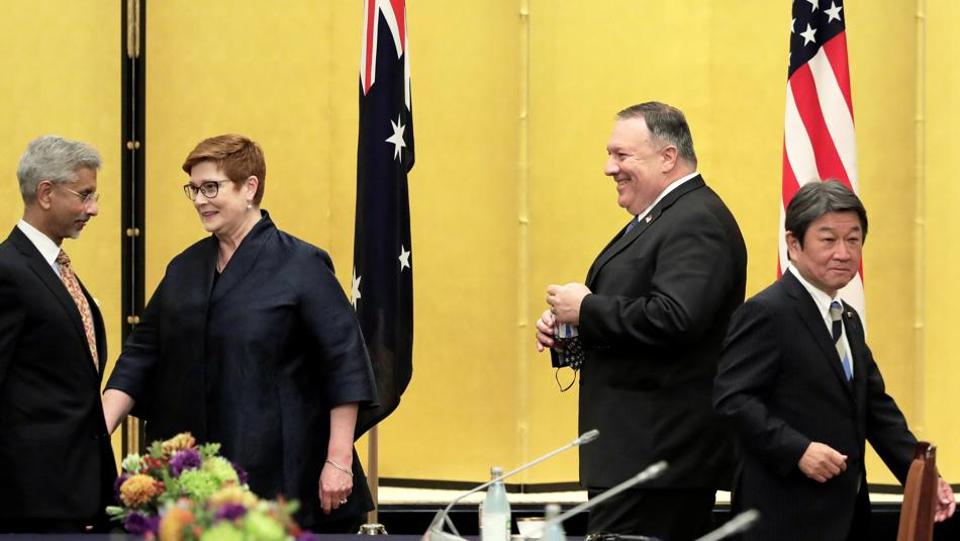
Tuesday’s meeting was the first face-to-face interaction between the foreign ministers of the four Indo-Pacific countries - the US, India, Japan and Australia - since the coronavirus pandemic broke out in China’s Wuhan in December last.
The foreign ministers had taken the first step to revive the security dialogue and upgrade it to a ministerial level in September last year when they met on the sidelines of the UN General Assembly. In his initial comments at the Quad meet, foreign minister S Jaishankar underlined that the world had “profoundly transformed” since then.
India, which had been preparing to host Chinese President Xi Jinping, has spent the last 150 days engaged in a bitter standoff with China’s People’s Liberation Army that has led to deaths on both sides.
Also Read: At Quad meet, Pompeo discusses China’s ‘malign activity’ with Australian counterpart
China’s relations with the three other Quad members have also nosedived over the last one year after Beijing, blamed for the spread of coronavirus disease that has infected 35 million and killed more than 1 million, adopted a hawkish approach elsewhere too.
“This is the Chinese using coercive power. This isn’t how great nations operate. So our mission is to reduce that,” Pompeo told Nikkei Asia.
Pompeo was particularly unsparing of China in his public comments ahead of the Quad meeting as well.
“As partners in this Quad, it is more critical now than ever that we collaborate to protect our people and partners from the CCP’s (Chinese communist party) exploitation, corruption and coercion,” Pompeo said.
“We see it in the South and East China Seas, the Mekong, the Himalayas, the Taiwan Strait.”
Stephen Biegun, the US deputy secretary of state, had hinted what a formalised Quad could look like last month when he noted at an online seminar that the Indo-Pacific region didn’t have “strong multilateral structures”.
“They don’t have anything of the fortitude of NATO, or the European Union… There is certainly an invitation there at some point to formalise a structure like this,” he said.
In a statement issued after Tuesday’s Quadrilateral Security Dialogue, a statement by the Indian external affairs ministry said the foreign ministers would hold the consultations “regularly”.
Also Read: Eye on China, Canada formulates new Indo-Pacific policy
“The Foreign Ministers exchanged views about regional issues of mutual interest, and issues related to connectivity; humanitarian assistance and disaster relief; maritime safety and security; health security, and counter terrorism. They reaffirmed their collective vision of maintaining a free, open and inclusive Indo-Pacific. They reiterated their firm support to ASEAN centrality and highlighted their readiness to work towards realizing a common vision for the Indo-Pacific. Appreciating the value of these consultations, they agreed to hold them regularly,” the statement said.


