
 E-Paper



Rahul Gandhi moves SC against conviction in defamation case
Congress leader Rahul Gandhi has approached the Supreme Court to challenge a Gujarat high court order that refused to suspend his conviction and two-year jail term in a criminal defamation case. Gandhi argues that the conviction violates his right to free speech and expression, and is detrimental to democratic institutions. He is seeking a stay on his conviction to regain his MP status and contest the next Lok Sabha elections. The BJP leader who filed the defamation case has filed a caveat to ensure that no orders are passed without hearing his side.


Congress leader Rahul Gandhi approached the Supreme Court on Saturday, challenging the Gujarat high court order that refused to put on hold his conviction and a two-year jail term in a criminal defamation case.
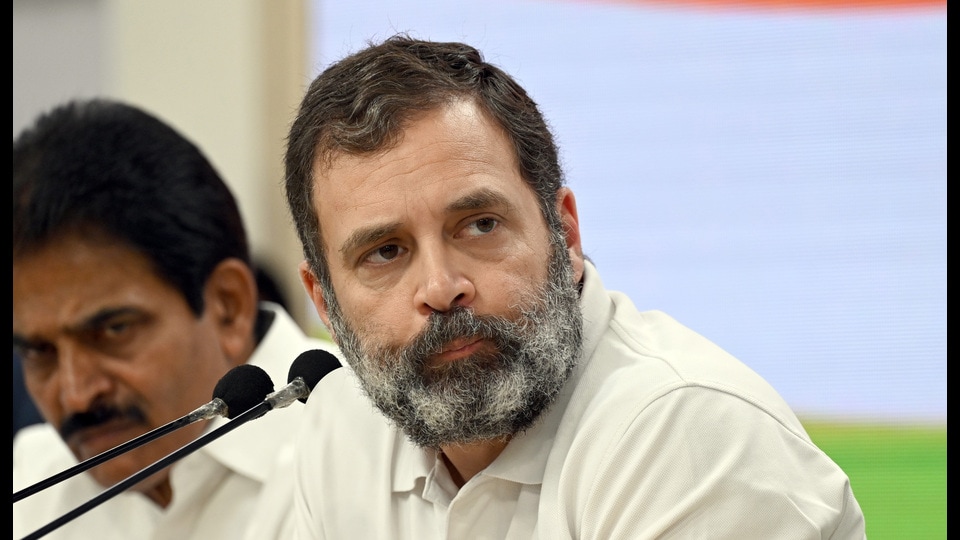
The appeal has been filed exactly a week after the high court dealt a blow to Gandhi’s endeavour to revive his Lok Sabha membership, ruling that the Congress leader “breached modesty” and that his offence involved “moral turpitude”. The appeal was filed on Saturday morning, and it is yet to be assigned a date of hearing. Gandhi’s lawyers are expected to mention the appeal for an early hearing next week.
Gandhi urged the top court to immediately stay his conviction to enable him to regain his MP status, arguing the conviction order would lead to throttling of free speech, free expression, free thought, and free statement.
“It would contribute to the systematic, repetitive emasculation of democratic institutions and the consequent strangulation of democracy which would be gravely detrimental to the political climate and future of India,” he said.
In his appeal, Gandhi complained that a political speech in the course of democratic political activity, critical of economic offenders, and also of Narendra Modi, has been held to be an act of moral turpitude inviting the harshest punishment.
“Such a finding is gravely detrimental to democratic free speech in the midst of a political campaign. It is respectfully submitted that the same will set a disastrous precedent wiping out any form of political dialogue or debate which is remotely critical in any manner,” it said.
The complainant in the case, BJP leader Purnesh Modi, has already filed his caveat in the top court to ensure no orders are passed in Gandhi’s appeal without hearing his side.
On March 23, a Gujarat magisterial court convicted Gandhi for his remarks on ‘Modi’ surname after Purnesh Modi filed a criminal complaint. The Congress leader was sentenced to two years’ imprisonment, which disqualified him as an MP under the Representation of People Act. Gandhi was declared disqualified as MP from Kerala’s Wayanad on March 24, following a notification of the Lok Sabha Secretariat.
Gandhi approached the sessions court, which rejected his plea for a stay on his conviction on April 20, compelling him to approach the high court. The April 20 order cited Gandhi’s stature as an MP and former chief of the country’s second-largest political party and said he should have been more careful in his comments.
On July 7, the high court affirmed this order, rejecting Gandhi’s criminal revision application seeking a stay on his conviction.
“The present conviction is a serious matter affecting a large segment of society and needs to be viewed by this court with the gravity and significance it commands... It is now the need of the hour to have purity in politics. Representatives of people should be men of clear antecedent,” said justice Hemant P Prachchhak.
The high court order meant that Gandhi’s disqualification from the Lok Sabha will continue. While Gandhi cannot be arrested since his jail term remains suspended for now. Only a stay on his conviction by the Supreme Court or a favourable judgment in his appeal by a sessions court can enable him to contest next year’s Lok Sabha elections.
Under the law, the conviction and two-year jail term renders Gandhi unfit to enter either House of Parliament for a period of eight years. But this can be reversed if he can get the conviction overturned or suspended by a higher court.
Gandhi’s legal team has to now get at least a stay on the conviction in the next 10 months to allow the former Congress chief to contest the 2024 Lok Sabha polls.
In his appeal to the top court, Gandhi has contended that the entire approach of the judgements by the high court and the courts below has been to mischaracterise his one-line statement as hugely serious.
“This has resulted in the inexorable exclusion of the petitioner from all political elective office for a long period of 8 years. That too in the world’s largest democracy where the Petitioner has been a former President of the oldest political movement in the country and is also continuously in the vanguard of opposition political activity,” the appeal added.
If political satire were to be held to be a base motive, Gandhi said, any political speech which is colourfully critical of the government, or any other political party or involves a turn of phrase in the course of a vigorous political speech, would become an act of moral turpitude. This would completely corrode the foundations of democracy.
“To equate a political speech criticising the government or a section of society, even if defamatory, to the aforesaid, sets a completely incongruous standard unknown to jurisprudence which deals with moral turpitude,” the plea said.
The July 7 verdict sparked a political row with the Congress saying it will appeal the decision in the Supreme Court and the Bharatiya Janata Party (BJP) saying Gandhi was a “habitual offender” in insulting people, pointing to his comments on the Modi surname before the 2019 general elections that prompted the criminal defamation case and eventually cost him his Lok Sabha seat.
The 125-page judgment of the high court on July 7 stressed on the fact that being a member of Parliament, Gandhi had a “bounden duty not to scandalise any person from the society” and that the trial court “has not committed any error of facts and law in passing the impugned order of conviction against the accused for the alleged offences”.
“Being a public personality, he is vested with the duty to exercise this vast power at his disposal with caution ensuring that dignity and reputation of a large number of persons or any identifiable class is not jeopardised due to his political activities or utterances... refusal to stay the conviction would not, in any way, result in injustice to the applicant,” held the high court.
The high court judgment further noted that there are 10 criminal cases pending against Gandhi, including the one filed by the grandson of VD Savarkar in a Pune court over the Congress leader’s controversial remarks on Savarkar at Cambridge University.
“In fact, the applicant is trying to seek stay of his conviction on absolutely non-existent grounds. It is a well-settled principle of law that stay of conviction is not a rule but an exception to be resorted to in rare cases,” added the high court, even as it requested the sessions court to decide Gandhi’s criminal appeal against the trial court’s March 23 conviction order “as expeditiously as possible”.
The high court noted that Modi surname holder and members of Modi community were certainly identifiable and well-defined classes, and thus, the seriousness of Gandhi’s offence was compounded by the fact that the defamation alleged was of a large identifiable class, and not just an individual.


