
 E-Paper



Rajapaksa, Hasina, Oli: Is there a puppeteer behind political upheaval in Indian sub-continent?
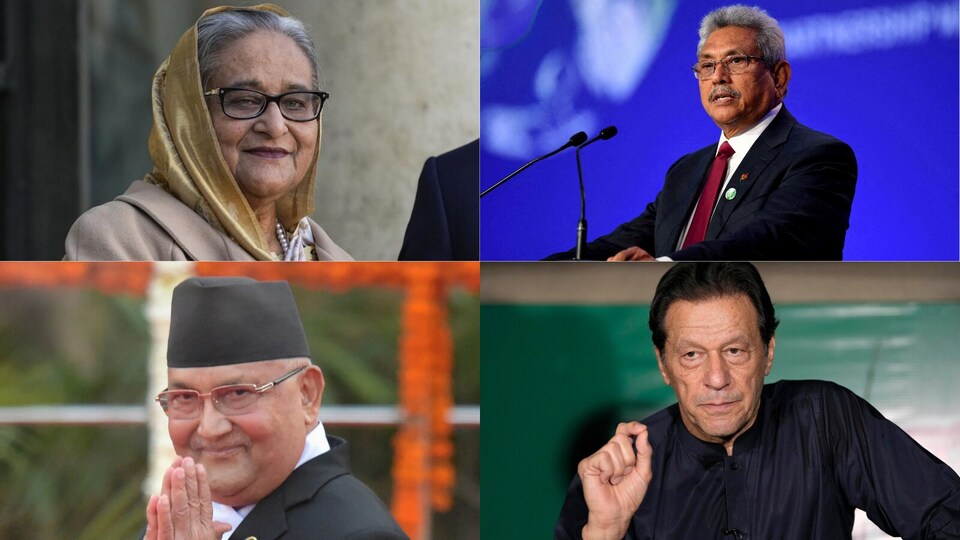
Rajapaksa, Hasina and Oli were not only seen as virtual despots in their own countries but also drew closer to China for political and strategic survival.

 Prefer HTon Google


Analysis of what is called the Gen Z uprising in Nepal reveals that it took three months for public to throw out then President Gotabaya Rajapaksa from Sri Lanka in July 2022, 15 days to throw out Sheikh Hasina from Bangladesh in August 2024 and mere two days to throw out K P Sharma Oli from Nepal on September 9, 2025.
Despite all three leaders being virtual despots, their intelligence agencies and political police could not pick up the uprising in the digital world before it translated on ground in mayhem and chaos with innocents being killed and maimed. The medium for uprising was digital applications like Chinese Tik Tok, American apps like Discord, Viber, Facebook etc. with orchestration done by the algorithm handling puppeteer or oligarch with bags of money, sitting in the west or east Europe or Russia or China or any part of the world.
Kathmandu mayor Balendra Shah was declared a leader by a western magazine in 2023, his rival Rabi Lamichanne has been playing the digital activism card and add to this political potpourri a host of west funded NGOs and the result is there to see in burning Kathmandu.
It is interesting that Rajapaksha, Sheikh Hasina and Oli were all anti-west and played in the hands of the Chinese for their own political survival. Rajapaksha gave Hambantota port to the Chinese, Sheikh Hasina was planning to give Chittagong and Mongla seaports to China and Oli got access to Chinese ports for his land-locked country. What is also significant is that mere six days ago before he was thrown out of power by mobs in Kathmandu, Oli attended the military parade in Beijing with neither he nor his Chinese handlers having any idea about the impending political hurricane. Fact is that even Indian agencies were also caught unawares to the political upheavals in the Indian sub-continent.
While in the age of algorithm, AI and deep fakes it is impossible to prevent instigation, radicalization and political polarization of the net obsessed youth, Arab Spring and rise of ISIS shows that chaos leads to more chaos and brutal violence with the old leadership getting politically massacred and the upcoming not having the bandwidth to rule or provide governance to a country. Institution can be destroyed in minutes but it takes ages to build one. Politics is all about compromises and not instant results as are expected by the youth.
However, the uprising in the Indian sub-continent is also a manifestation of poor governance in these countries with high levels of youth unemployment and OTT dramas reminding the youth of the utopia in the west. Fact is that it was rampant political corruption that did the leadership of these three countries. The same could have happened in Myanmar and Pakistan if the army generals had not shot down all the youth disturbance and threat to their regimes.
While intelligence agencies even with their best intentions and capability will not be able to pick up digital political sentiment, it is for the political leaders like Prime Minister Narendra Modi to keep on having a direct inter-face with the youth and public in order to understand which way is the wind blowing. This apart, it is for government in power to be more accountable to public with ease of doing business taken to the next level so that youth are self-employed and don’t look at the political leadership for jobs.
The bottom line is that perception is bigger than reality in the present day and age and it is for the government to move beyond tired and outdated babus for direct communication with the youth. Misinformation is the first step to regime change.


