
 E-Paper



Rapid expansion of gas-based economy a must to achieve self-reliance: PM Modi
While dedicating the 450-km Kochi-Mangaluru natural gas pipeline to the nation through a video conference on Tuesday, the PM said India wants to raise the share of natural gas in its energy mix from 6.2% to 15% by 2030


Prime Minister Narendra Modi said rapid expansion of gas-based economy is a must to become an ‘Atmanirbhar Bharat’ (Self-reliant India) and policy initiatives are being taken to push for ‘One Nation One Gas Grid’ to raise the share of natural gas in the country’s energy basket to 15% besides diversifying energy resources to meet future energy needs.
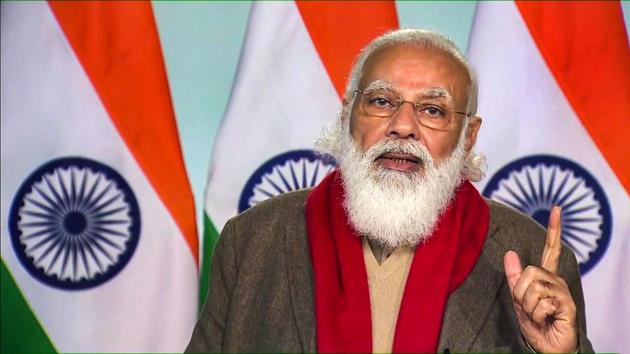
“Global experts say that in the 21st century, whichever country emphasises the most on connectivity and clean energy, would rapidly reach new heights,” he said, while dedicating the 450-km Kochi-Mangaluru natural gas pipeline to the nation through a video conference on Tuesday. India wants to raise the share of natural gas in India’s energy mix from the current level of 6.2% to 15% by 2030.
He said connectivity is the key to development. “Take any front – highway connectivity, railway connectivity, Metro connectivity, air connectivity, water connectivity, digital connectivity or gas connectivity – India has embarked upon these projects simultaneously that never happened earlier,” he said.
Also read | Centre may bring natural gas within the GST ambit
The Prime Minister said he does not want to find reasons why the country could not do these infrastructural developments at a rapid pace earlier. “It is, however, certain that today’s young India, the impatient India that wants to stand out in the world, cannot afford to progress at a slow pace. That is why, in the last few years, the country has increased the speed, and scale and simultaneously enhanced the scope [of these projects,” he said in Hindi.
The country could build only 15,000 kms natural gas pipeline in 27 years before 2014. The first inter-state pipeline was commissioned in 1987. Now, work is underway on more than 16,000 kms of new gas pipeline nationwide that will be complete in the next 5-6 years, he said.
Similarly, the first compressed natural gas (CNG) fuel stations was set up in India 1992. By 2014, there were not more than 900 CNG stations. In the past six years, about 1,500 new CNG stations have been operationalised. “Now the government is working to raise the number of CNG stations to 10,000. This pipeline, which is commissioned just now, will help to open 700 CNG stations in various cities of Kerala and Karnataka,” he said.
“There is another interesting data of PNG [piped natural gas] connections, which brings fuel to kitchens. Up to 2014, our country had only 25 lakh (2.5 million) PNG connections. Today, more than 72 lakh (7.2 million) households get cooking gas through pipelines. Kochi-Mangaluru pipeline will provide PNG facility to 21 lakh (2.1 million) more people,” he said. These increased connections have reduced usage of polluting kerosene and many states and Union Territories have declared themselves kerosene free, he added.
Prime Minister Modi said, “The need of the hour is to prepare the country for its future energy needs. That is why, one the one hand focus is on the natural gas, on the other hand, the country is diversifying its energy needs.” He gave example of the proposed world’s biggest hybrid -- wind and solar -- renewable energy plant in Gujarat and stressed on producing ethanol from rice and sugarcane. The goal of ethanol blending in petrol is raised 20% in the next 10 years, he said, adding that the government is committed to provide every citizen affordable, pollution-free fuel and electricity.
Kerala chief minister Pinarayi Vijayan hailed the completion of state-run GAIL India’s Kochi-Mangaluru pipeline and said that the project, one of the major poll promises of his government, was delayed due to various obstacles, according to a PTI report from Kochi.
“GAIL authorities also stood by us in making this project come to life. I am extremely happy that our combined efforts have borne fruit,” he said. Karnataka chief minister BS Yediyurappa said the pipeline would supply PNG to about 400,000 kitchens besides supplying fuel to several commercial establishments.
Experts said gas-based economy would not only help in reducing carbon emission but also lead to faster industrialisation. Besides, availability of gas it is also necessary to switch over to gas-based technologies in different sectors, said DK Srivastava, chief policy advisor at consultancy firm EY India.
“In the automobile sector, major changes would be required to switch over to cars that run on gas or on batteries. For power production, the proportion of gas-based electricity generation should overtake the conventional coal-based technologies,” he said.
According to Srivastava, there is a need to bring natural gas under uniform Goods and Services Tax (GST) regime to have a unified natural gas market in the country. At present, levies on natural gas vary from state to state, ranging as high as 24%, a major deterrent to making it a people’s fuel.
“Fiscal policies other than taxation may also be used to encourage switching over to production and consumption processes favouring the use of gas particularly by subsidising non-polluting technologies. On the supply side, both domestic production of gas and import of gas on favourable conditions require to be promoted. As gas supply increases, its related infrastructure covering storage and distribution would need to be expanded at an accelerated pace,” Srivastava said.


