
 E-Paper



Rivers remain in spate, reduction likely after record rain batters north India
Reduction in rain was likely for Delhi and neighbouring Haryana from Monday with the monsoon trough moving towards the Himalayan foothills

 Prefer HTon Google


The water flow in the Yamuna at Hathni Kund barrage in Haryana’s Yamunanagar rose to 3,09,526 cusecs between 3am to 4am on Monday, the highest this monsoon, as an interaction between a western disturbance and the monsoon trough led to heavy rainfall in the state and neighbouring Himachal Pradesh, Uttarakhand, Punjab, and Delhi.
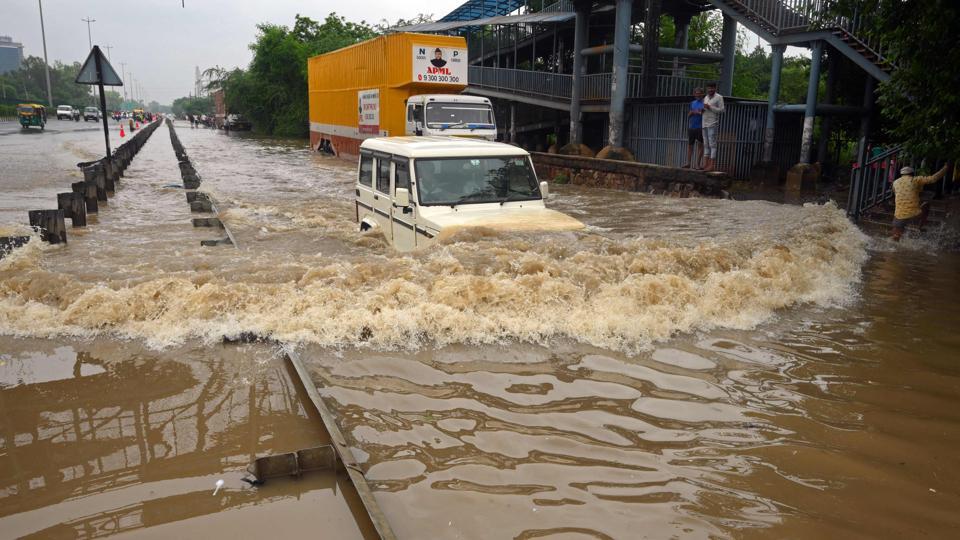
The flow earlier breached the danger mark of 70,000 cusecs at Hathini Kund at 12pm on Sunday, reaching 84,000 cusecs.
Officials said the flow from 70,000 cusecs to 1.5 lakh cusecs is considered “low flood”, from 1.5 lakh cusecs to 2.5 lakh “medium flood” and above 2.5 lakh cusecs “high flood”.
Flood alerts have been issued for low-lying areas in Haryana’s Karnal, Panipat, and Sonipat. A flood alert was issued for Delhi on Sunday as over 140,000 cusecs of water were released from the Hathni Kund barrage upstream on the Yamuna that was expected to lead to rising levels of the river in the Capital on Tuesday.
Water from overflowing Ghaggar entered the Sadhopur power feeder on Sunday night and prompted the authorities to shut the electricity supply until Monday evening in parts of Ambala.
Over 50 families were rescued through boats and taken to safer places in Ambala Cantt. Officials said the water levels reduced by about a foot overnight but increased as it started raining again on Monday morning.
The Ambala-Ludhiana section of National Highway-44 (Delhi-Amritsar) was among those that remained affected.
The Haridwar-Shri Ganganagar Intercity Express was halted at Barara due to a breach on a bridge on the Ambala-Saharanpur line near Dukheri. Over 300 passengers on board were taken to a nearby dharamshala and gurudwara for an overnight stay.
At least 10 people were killed as heavy rains lashed north India on Sunday. Rivers were in spate and incessant downpours caused widespread damage to property. A section of the National Highway-3 to Manali was submerged with the hill states of Himachal Pradesh, Uttarakhand, and Jammu and Kashmir suffering the worst damage.
Water logging was reported in the low-lying areas of Panipat, Kurukshetra, Karnal, Yamunanagar, Kaithal, and Ambala in Haryana.
Collapsing portions of buildings and uprooted trees left four people dead in Delhi on Sunday. The Capital recorded a little over 261mm of rain, or 125% of rainfall it receives on average over the entire month of July, between 8.30am on Saturday and 5.30pm on Sunday. It was one of the wettest spells the Capital has ever recorded.
A total of 153mm of precipitation was recorded at the Safdarjung station in the 24 hours until 8.30am on Sunday morning. It was the third-highest rainfall in the city’s history since records were kept.
The downpour left the city’s roads waterlogged. Many stretches were jammed as rain caused potholes. A sinkhole opened up at a crossing in Rohini. A yellow alert has been issued for the capital for Monday as light to moderate showers were expected.
The city received 296.8 mm of rainfall, or nearly 47% of the average during the June-September monsoon season, in the first nine days of July.
The rare interaction between monsoon winds blowing in from the south and moist winds from the west (western disturbance) created atmospheric troughs over the country’s northwest and brought very heavy to extremely heavy rainfall.
The rains forced the closure of schools on Monday in the National Capital Region.
Waterlogging complaints were received from 54 sites including key underpasses and tunnels in the Capital on Sunday. Key stretches such as the Minto Bridge and Pragati Maidan Tunnel were closed. Electricity supply was shut down in places such as North Avenue, Lodhi Estate, and Bharti Nagar to prevent the risk of electrocution due to flooding. Traffic was disrupted as trees were uprooted and branches fell at around 39 locations.
Two road cave-ins were reported at Rohini and Najafgarh while a house collapsed in near Moti Nagar. The Delhi fire services received 13 calls regarding damages or collapsing of houses on Sunday.
Reduction in rain was likely for Delhi and Haryana from Monday with the monsoon trough moving towards the Himalayan foothills.
The 153mm of rainfall recorded in 24 hours until 8.30am on Sunday was the highest since July 25, 1982 (169.9 mm) in the Capital. The highest-ever 24-hour rainfall in July was recorded on July 20, 1958 (266.2mm).For the first time since September 2021, Delhi recorded two consecutive days of over 100mm of rainfall.


