
 E-Paper



Tigers surge in MP as it counts more big cats outside reserves than in Karnataka
Madhya Pradesh was able to surge ahead of Karnataka in the race between the two states to be on top of the tiger numbers

 Prefer HTon Google


Madhya Pradesh was able to surge ahead of Karnataka in the race between the two states to be on top of the tiger numbers on the strength of the number of the big cats outside the reserves, according to data from the Tiger Estimation 2022 report released on Saturday, even as congestion inside tiger reserves in India is increasing, leading to more territorial deaths, forcing tigers to live in smaller spaces, and raising the prospect of human-animal conflict.
Madhya Pradesh and Karnataka, which together contribute 1,348 to India’s latest figure of 3,682 tigers, but interestingly, the former has seen a sharp rise in tiger numbers outside preserves, a fact that has prompted the latter to suggest that the tally be reviewed.
In 2022, of the 785 tigers in Madhya Pradesh, 346 were outside protected reserves compared to just 153 of the 563 tigers in Karnataka. Four years ago, Madhya Pradesh had just 203 of its 526 tigers outside reserves and Karnataka, 185 of its 524.
The difference in tigers outside reserves between the two states was just 18 in 2018, which increased to 195 in 2022, a significant reason for Madhya Pradesh surging ahead of Karnataka.
Karnataka forest minister Eshwar B has disputed the tiger estimation, saying such an increase in tiger population in Madhya Pradesh is baffling. “I will urge environment minister Bhupendra Yadav to review the numbers. Had the difference between Karnataka and MP been 40 to 50 tigers, it could have been convincing. But a difference of over 259 tigers between the first and second states in four years baffles me.”
The answer to this could lie in how the survey is conducted. The decision on installing camera traps is done by state forest departments in consultation with the Wildlife Institute of India, which analyses the data to arrive at an estimate. Placing more camera traps outside the reserves, especially in areas with a higher tiger presence, could result in higher estimation, a scientist who was part of the exercise said.
The data clearly showed that the number of tigers in Madhya Pradesh were rising in areas outside the reserves at a faster rate than inside, said Anish Andheria, chief executive officer of Wildlife Conservation Trust, a non-profit. “It is because of more area outside the reserves in MP was analysed during 2022 tiger estimation as compared to 2018. Also, MP was able to get more camera traps installed as compared to 2018,” he explained.
Compared to Madhya Pradesh, experts said, the scanning of buffer zones for estimation in Karnataka was lower and, therefore, the increase in tiger numbers outside the reserves there was just 34. “MP after losing its tiger state status to Karnataka in 2010 had really worked hard to regain the status. There was no such effort seen in Karnataka,” a government official said,asking not to be named.
Madhya Pradesh has a separate budget for animals outside protected areas and for cracking down on anti-poaching activities, according to J S Chauhan, former chief wildlife warden of the state. “We have an effective monitoring system for tigers outside the reserve,” he added, terming it as a major reason for the rise in tiger population in the state.
With India adding 515 tigers to its tally of 2,967 in 2018, taking the total to 3,682 in 2022, Rajesh Gopal, former member secretary of the National Tiger Conservation Force (NTCA) and Andheria agreed that several tiger reserves in the country have reacted saturation. Tiger habitats in India can hold a maximum of about 4,000 tigers, they said.
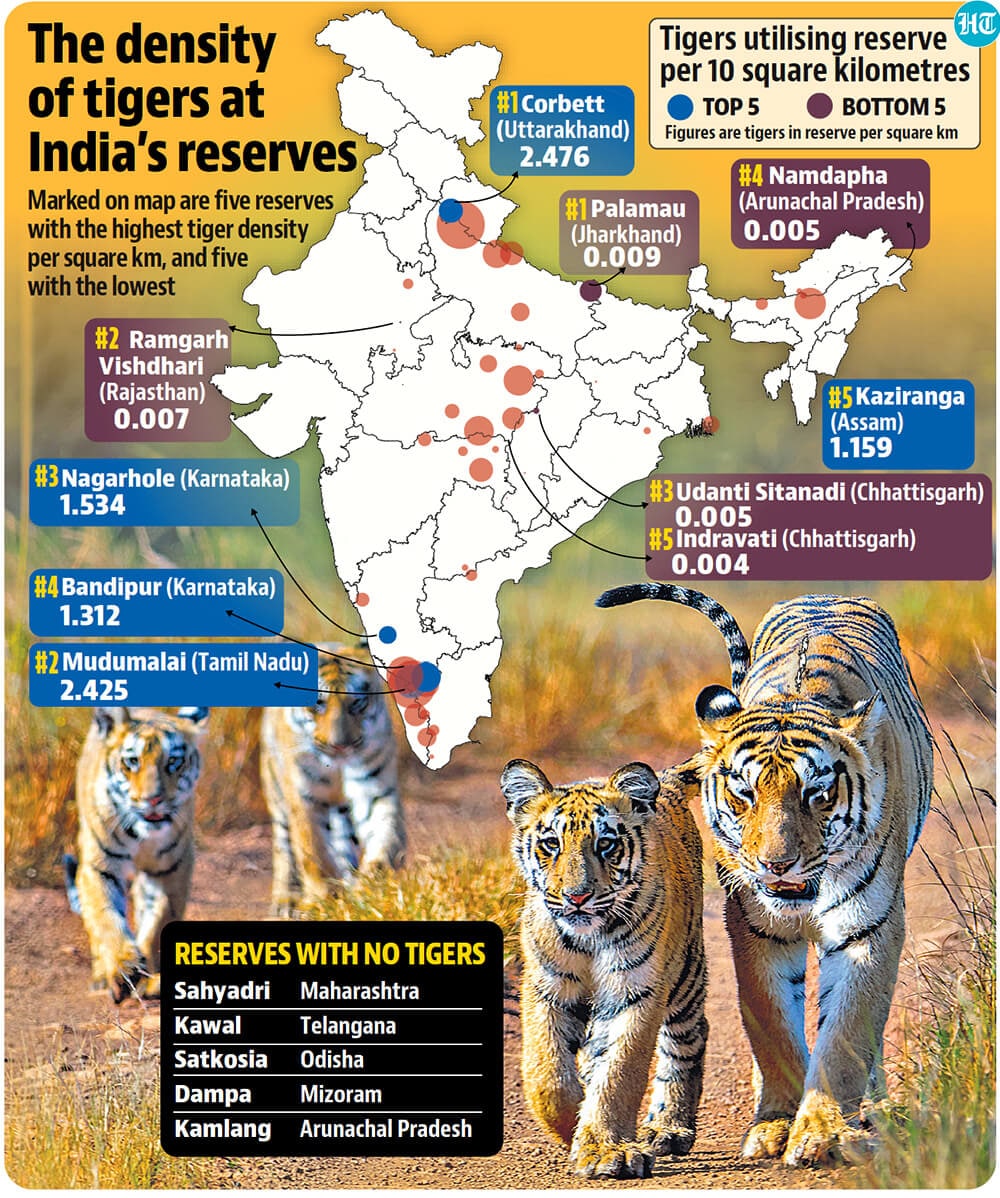
The 2022 tiger estimation showed that Corbett National Park in Uttarakhand, which has 260 tigers, Bandhavgarh in Madhya Pradesh with 135 tigers, Bandipur with 150 tigers and Nagarhole with 141 tigers, both in Karnataka, Madhumalai in Tamil Nadu with 114 tigers and Kaziranga in Assam with 104 tigers have reached their saturation points. These reserves have seen up to 15% annual increase in population and have around 40% of the population outside the reserves, which the Wildlife Institute scientists say is unprecedented.
Tigers in highly congested reserves such as Corbett and Nagarhole are living in smaller spaces compared to 2018, and their movement outside the reserve has also increased, experts said. “So much so, tigers from Corbett had reached up to Bijnore in Uttar Pradesh. We have seen tigers from Bandhavgarh reaching Pench and vice versa,” said a Wildlife Institute scientist, asking not to be named.
With the rise in congestion, deaths of tigers because of animal-human conflict is also high. According to data provided by Wildlife Protection Society of India, 125 tigers have died in first seven months of 2023, compared to 143 in 2022. Most of the tiger deaths have been reported from Madhya Pradesh,
Effective monitoring, good incentive-based schemes for voluntary relocation of communities outside forest areas and good prey base can reduce human-animal conflicts, Gopal said. “For example, Kahna has a prey density of 50 per sq km, which is not seen anywhere in the world. That is a reason that one sees very few cases of tiger conflict with people in Kanha,” he said.
Effective corridor management, as done between Kanha and Pench, can also reduce congestion without much conflict with humans, he added.


