
 E-Paper



RSS chief Mohan Bhagwat speaks of ‘common DNA’, gives definition of ‘Hindu Rashtra’
At RSS centenary event, Mohan Bhagwat says some “know but do not acknowledge themselves as Hindus” while some others do not know it

 Prefer HTon Google


RSS chief Mohan Bhagwat on Tuesday spoke about the Indian civilisation and the idea of a “Hindu Rashtra (nation)”, and referred to a “common DNA going back thousands of years", at an event to mark the centenary of the organisation in New Delhi.
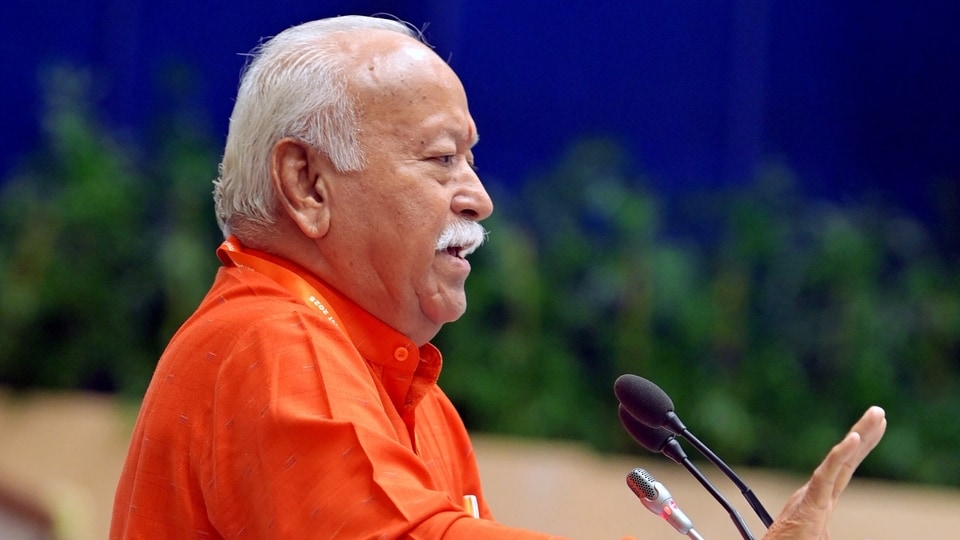
He defined “Hindu Rashtra (nation)” as a concept that has no link to "satta" (political power) and “does not mean excluding anyone”.
In his lecture at Vigyan Bhawan, Bhagwat also defined “Hindu” as an identity centred around geography and traditions. He said some people “know but do not acknowledge themselves as Hindus” while others “do not know it”, PTI reported.
This was not the first time that the Rashtriya Swayamsewak Sangh (RSS) — considered the ideological parent body of the ruling BJP — has sought to take the idea beyond religion to apparently make it less polarising. The occasion, however, was a big one this time — a lecture event titled ‘100 Years Journey of RSS: New Horizons’ that is part of mega celebrations.
Bhagwat said devotion to “Bharat Mata” and common traditions are the key factors for identity: “Our DNA is the same as well... Living in harmony is our culture.”
He added, "Justice is the same for everyone. ‘Hindu Rashtra’ does not mean excluding anyone. It does not mean opposing anyone… Diversity does not cause disunity. That unity comes from uniformity is not the case. Unity is also in diversity."
Since ancient times, he stressed, Indians considered everyone and the world to be bound together by the same divinity. The term ‘Hindu’, he said, was used by outsiders for people living in region was “akhand Bharat” or undivided India, or the South Asian subcontinent.
India could not reach its desired status in the 75 years after independence from the British, he said, adding that it was the objective of the RSS to make it "vishwaguru" (a guide for the world). The time for that has come, he further said.
The term “vishwaguru” is among keywords used by PM Narendra Modi and his government to stress India's place in the world.
In pressing the point that the RSS "believes we don't need to have uniformity to be united", Bhagwat appeared yet again to address and allay allegations of divisiveness and anti-minority bias leveled on the organisation.
He further spoke about the need for a transformation for India's rise. "It will not happen by leaving the job to someone. Everybody will have a role to play," he said, listing politicians, parties and governments as those who can assist the process. But the main factor in such a rise, he said, would be the gradual transformation of society itself.
Among the attendees were yoga guru Ramdev, JDU leader KC Tyagi, Bollywood actor and BJP MP Kangana Ranaut, and union ministers Jyotiraditya Scindia and Anupriya Patel.
As part of the centenary outreach, the RSS will also hold more than 1 lakh 'Hindu Sammelan' events across the country. That will begin with Bhagwat's address at the RSS headquarters in Nagpur on Vijaya Dashami, which falls on October 2 this year.
At the event on Tuesday, representatives from as many as 25 embassies including China, Denmark, USA, Russia and Israel were present.
RSS office-bearers such as Arun Kumar and Krishna Gopal were there too, as were representatives from think tanks such as ORF, Thinkers USA and Infinity Foundation.


