
 E-Paper



SC forms panel to address protesting farmers’ issues
The Supreme Court forms a committee led by ex-judge Nawab Singh to address farmers' demands, urging depoliticization and minimizing public inconvenience.


New Delhi The Supreme Court on Monday constituted a high-powered committee, headed by a former Punjab & Haryana high court judge, to address various demands of farmers who have been protesting since February, including a legal guarantee of minimum support price (MSP) for crops, even as it warned the farmers against politicising the issue and asked them to minimise public inconvenience caused by their continued blockades of highways.
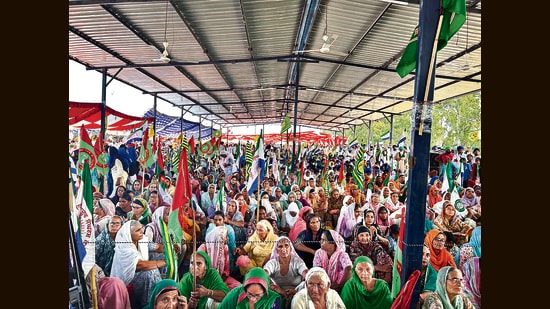
A bench of justices Surya Kant and Ujjal Bhuyan highlighted that while farmers have legitimate grievances, these must be addressed without turning the protests into a political tool, thereby ensuring that the larger public, especially those relying on essential services, are not unduly affected.
The court order outlined the composition of the committee, which will be chaired by justice Nawab Singh, a former judge of the Punjab & Haryana high court. The committee also includes BS Sandhu, former director general of Police, Haryana; Devinder Sharma, known for his expertise in agricultural issues; Prof Ranjit Singh Ghumman, professor of eminence at Guru Nanak Dev University, Amritsar; and Dr Sukhpal Singh, agricultural economist from Punjab Agricultural University, Ludhiana. Prof Baldev Raj Kamboj, vice-chancellor of CCS Haryana Agricultural University, Hisar, has to be consulted as a special invitee by the committee.
Asking the committee to hold its first meeting within a week, the bench left it to the panel to formulate and address the issues raised by the protesting farmers, with a focus on understanding the ground realities and the hardships faced by rural and marginalised communities in Punjab and Haryana that may not be directly involved in agriculture.
The states of Punjab and Haryana have been allowed to suggest issues for the committee’s consideration, which is expected to place on record these proposed issues before the court by October 14 for further deliberation.
The Supreme Court order also called for immediate action to alleviate the hardships caused by the blockade at the Shambhu border near Ambala, where farmers have been camping since February 13 with border sealed. The court directed the committee to reach out to the protesting farmers and persuade them to remove their tractors, trolleys and other blockades from the national highway.
“We hope and trust that the one of the major demands of the agitating farmers regarding constitution of a neutral high-powered committee having been accepted with the consent of both the states, they will immediately respond to the request of the committee and will vacate the Shambhu border or the other roads connecting the two states without any delay,” it said.
The court emphasised the need for this gesture, stating that it would “facilitate the high-powered committee and both the states to consider the farmers’ genuine and just demands in a dispassionate and objective manner.”
In February, the Haryana government set up barricades on the Ambala-New Delhi national highway in response to a march announced by the Samyukta Kisan Morcha (Non-Political) and the Kisan Mazdoor Morcha. The march aimed to push various demands, including a legal guarantee of MSP for crops. The barricades were a preventive measure, anticipating the large-scale movement of farmers towards the national capital.
Furthermore, the court cautioned the farmers to remain independent of political parties and to avoid raising demands that are not feasible for immediate acceptance. “We caution the agitating farmers to keep themselves at a safe distance from the political parties, political issues, and not to insist on such demands which are not feasible to be accepted outrightly,” said the bench, making it clear that while all issues would be considered, this would be done in a phased manner based on the recommendations of the committee.
The order also noted that both Punjab and Haryana have identified alternative sites where the farmers can continue their peaceful protests, ensuring that public inconvenience is minimised.
The court directed the chief secretaries and director generals of police of both Punjab and Haryana to provide all necessary logistical support to the committee, enabling it to fulfil its mandate effectively.
The Supreme Court’s decision to form a panel marks a crucial intervention in the ongoing conflict between the government and protesting farmers. By creating a neutral and expert-led platform for negotiation, the court aims to resolve the farmers’ grievances while minimising public inconvenience. Its emphasis on depoliticising the protests and focussing on feasible solutions underscores the court’s intent to find a balanced resolution that respects both the rights of the farmers and the broader public interest.
The Supreme Court was hearing a plea by the Haryana government challenging a March 7 Punjab and Haryana high court decision of setting up a committee headed by a former high court judge to probe the death of farmer Shubhkaran Singh during a clash between protesting farmers and Haryana security personnel in February. Singh, 21, a native of Bathinda, was killed and several police personnel were injured in clashes at Khanauri on the Punjab-Haryana border on February 21. The incident occurred when some protesting farmers tried to move towards barricades at the border and were stopped by security personnel from marching to Delhi. A subsequent plea by the Haryana government challenged the high court’s July 10 order directing the opening of the highway within seven days.
Hearing the matter on July 24, the bench underscored the “deep trust deficit” between the central government, states and farmers, as it proposed the establishment of an independent committee to address the farmers’ demands. On the day, it directed the Centre and the states of Haryana and Punjab to suggest names for the committee while ordering a status quo for a week on protests at the Shambhu border.
On August 12, the court asked the states of Haryana and Punjab to partially reopen the Shambhu border, ensuring passage for ambulances, senior citizens, women, students and other essential services. It also turned down the Haryana government’s plea to halt the judicial inquiry into Singh’s death, stating that the inquiry could strengthen the police by ensuring transparency and accountability.


