
 E-Paper



SC questions Centre on ex-gratia payouts
Can’t there be any uniform standards for compensation? Otherwise, there will be heartburn that somebody has got, and somebody has not, the Supreme Court said.


The Supreme Court on Monday lamented the absence of uniform guidelines on payment of ex-gratia to the families of those who have died of Covid-19, and questioned the Union government whether there was a conscious decision taken by the Prime Minister-headed National Disaster Management Authority (NDMA) against framing of the compensation scheme.
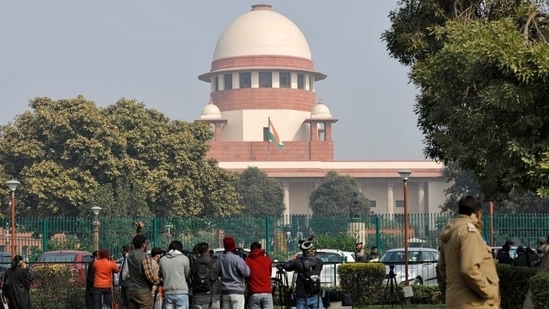
The bench of justices Ashok Bhushan and MR Shah observed that the ad-hoc ex-gratia payments being made by the state governments were a cause of “heartburn” among the citizens since different states paid different amounts.
“Where is the decision against payment of ex-gratia? Was it a conscious decision or was it not considered at all during the first and second wave of the pandemic? We cannot see any document regarding the fact that the national authority, under the honorable Prime Minister, had considered this and then a decision was taken,” the bench asked solicitor general Tushar Mehta, who appeared for the Centre.
Also read | Over 8 million shots on Day 1 of new drive
The question came in the wake of the Union government’s affidavit stating that the ex-gratia amount of ₹4 lakh (ex-gratia is mandated under the disaster management law) cannot be paid to the families of those who have died of Covid-19 as it is beyond fiscal affordability, and the finances of central and state governments are under severe strain. The Centre maintained such payouts may have the “unfortunate consequences” of affecting the pandemic response because the central and state governments were already under severe financial burden due to reduction in tax revenues and increase in health expenses on account of the pandemic.
As the bench set out to examine the affidavit on Monday, it failed to find any document in support of the Centre’s stand on not having framed a scheme for ex-gratia payments under NDMA.
Senior advocate SB Upadhyay and advocate Gaurav Kumar Bansal, appearing for the two public interest litigations (PILs), complained that financial constraint could never be a ground to shy away from constitutional and legal obligations that the Union government has under NDMA.
Mehta, on his part, tried to draw a distinction between Covid-19 and any other disaster such as floods and earthquakes. While it is mandatory under Section 12 of NDMA to frame guidelines prescribing ex-gratia as part of ‘Minimum Standards of Relief’, the S-G submitted to the court that “the peculiar and unprecedented situation” created by Covid-19 would require a situational interpretation. He said that the law will have to be interpreted like such a scheme on ex-gratia was only recommendatory and not mandatory.
“Ex-gratia may not be insisted upon when the government was spending huge amounts on securing food security, hospital infrastructure, medical equipment, vaccine coverage, which equally are means for mitigating or preventing the pandemic...It is not the case of the government that we do not have money. But our focus is on managing the disaster through a multipronged approach,” said Mehta.
He also read from the report of the Finance Commission for 2021-26, which allocated funds under Disaster Risk Management, to make the point that ex-gratia of ₹4 lakh for every person who loses life due to Covid-19 will alone mop up the entire allocations under state disaster relief funds.
But the court told the S-G that a decision on ex-gratia under Section 12 was nonetheless essential. “The recommendations by Finance Commission cannot override statutory requirement under NDMA,” it remarked.
Meanwhile, the petitioners contended that the scheme framed under Section 12 by the Union home ministry (MHA) in its letter of March 14, 2020, consciously dropped ₹4 lakh ex-gratia from the list of relief. This letter was issued at a time when the first wave of the pandemic was yet to set in.
The court failed to find any document issued after March 2020 where ex-gratia payments to Covid-19 deceased was considered. Even the April 2015 MHA letter announcing the ₹4 lakh ex-gratia payout was meant to operate till 2020. The affidavit did not mention if this period was extended.
The bench reserved orders on the petitions while giving the Centre three days to file written submissions on the questions raised, including whether a pan-India uniform compensation scheme for Covid-19 deaths could be fixed.
Also read | Study: Delta variant more transmissible than others
“Can’t there be any uniform standards for compensation? Otherwise, there will be heartburn that somebody has got, and somebody has not. If a migrant worker goes and dies elsewhere, he may be at a loss,” it told Mehta.
The bench was responding to an application filed by the families of Covid-19 deceased who complained that Bihar was offering ₹4 lakh compensation from CM Relief Fund while Delhi announced ₹50,000 for Covid-19 deaths.
The Centre also gave details of the ₹50-lakh insurance cover provided to nearly 2.21 million health care providers under the Pradhan Mantri Garib Kalyan Package (PMGKP). The court asked Centre to indicate if the same covered Class IV employees and crematorium workers, equally at risk for providing Covid-19 services.
Referring to the government’s compulsion on registering Covid-19 deaths, the bench told Mehta that the procedure was complicated and needed to be simplified so that any person admitted with Covid-positive report was declared as a Covid-19 death.
The bench said that hardships of common man must be borne by policymakers as harsh reality exists on ground. “In this country you see when morality and humanity is gone and black marketeering is happening, our priority has to be the poor, common man,” the bench said.
Calling the government’s submission on financial constraints “an afterthought”, senior Congress leader Abhishek Singhvi said, “It shows that the court is rightly asking the question: did the govt at all apply its mind to the payment of ex-gratia. Absence of even consideration of the issue is a glaring omission fully reviewable by the court. The Centre’s submission on lack of money appears to be an afterthought if mind was not applied to the issue at all. The amount needed for this would be paltry compared to the huge collection under PM-Care or several cess or taxes that have been imposed by the government.”
There was no response from the government on the matter.


