
 E-Paper



SC seeks Chidambaram evidence, order on Sep 5
Chidambaram’s legal team had strongly objected to the submission of documents in a sealed cover at the stage of pre-arrest bail and said the former minister had never been confronted with the papers despite being interrogated thrice.

 Prefer HTon Google


The Supreme Court on Thursday reserved its order on former finance minister P Chidambaram’s pre-arrest bail petition in the INX Media money-laundering case until September 5, when it will deliver its verdict, extending the Congress leader’s interim protection from arrest by the Enforcement Directorate (ED) until then.
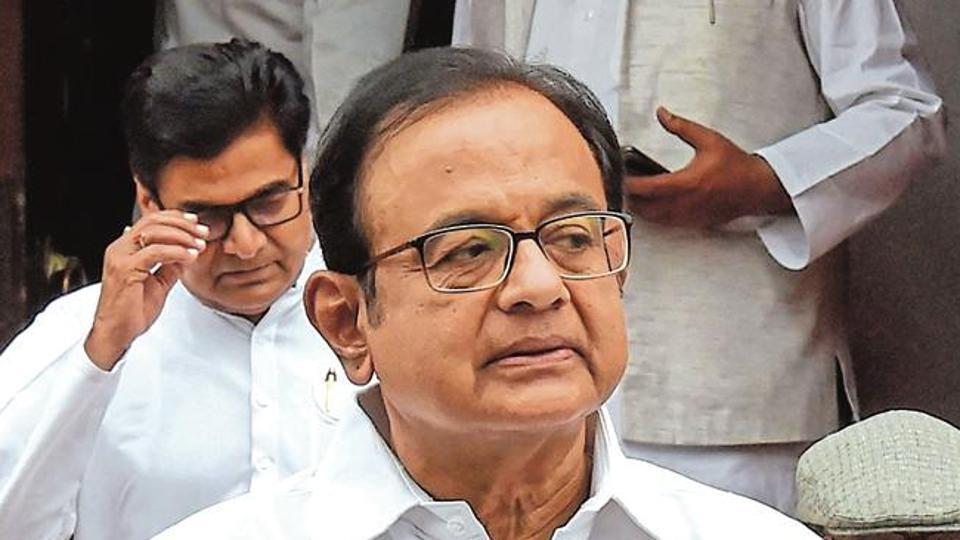
A bench of justices R Banumathi and AS Bopanna asked the ED to submit within three days the documentary evidence it has relied upon in opposing Chidambaram’s plea in an envelope with an authenticated seal. It clarified that the court would look at the documents only if concludes that it can do so under the law.
Chidambaram’s legal team had strongly objected to the submission of documents in a sealed cover at the stage of pre-arrest bail and said the former minister had never been confronted with the papers despite being interrogated thrice. They asked the judges to refrain from considering the papers which, according to the lawyers, are not in the form of a paginated case diary.
“Without prejudice to both parties, the ED should produce the documents in a sealed cover with an authenticated seal. Whether to look into the documents is a decision that would be taken after the order is passed,” the bench said.
Solicitor general Tushar Mehta, who on Thursday continued his arguments against providing protective cover against arrest to Chidambaram, countered the reasoning extended by the former minister’s lawyers, senior advocates Kapil Sibal and Abhishek Singhvi, that the agency should have shown him the papers before handing them over to the court in a sealed cover.
The submission by Chidambaram’s team, Mehta told the top court, was “absurd and devastating results would follow if this submission is to be accepted”.
“It is preposterous. If the court accepts this, then this proposition will have ramifications… It will lead to exposing evidence and witnesses in similar cases at an investigating stage,” Mehta submitted before the court.
Mehta continued: “If the Supreme Court accepts Chidambaram’s plea, then it is bound to adversely affect other cases including those of Vijay Mallya, Mehul Choksi, Nirav Modi, Chhagan Bhujbal, Deepak Talwar, Zakir Naik, Hafiz Saeed… and others.”
Confronting an accused with evidence when he is still a free man “is an open invitation to tamper [with] the evidence”.
Chidambaram, who he referred to as an individual with resources and knowledge, would be able to erase the details of the money trail if he gets to know the nature of the evidence with the investigators. If an accused is confronted with evidence at a pre-anticipatory bail stage, then this would destroy the case, Mehta said, underscoring that it was best to confront the accused with evidence when he is in custody.
ED had wanted the judges to peruse the documents on the first day of the hearing on the petition, which is an appeal against the Delhi high court’s August 20 order denying Chidambaram anticipatory bail. HC had refused relief to him in cases registered both by the ED and the Central Bureau of Investigation (CBI), which secured the former minister’s custody to interrogate him.
The CBI is probing corruption allegations related to the INX Media case. ED is investigating the money laundering angle.
The government’s second senior-most law officer also rebutted the argument presented by Singhvi and Sibal that the high court judge had incorrectly described the charges against Chidambaram as grave.
The Centre has also countered Chidambaram’s claim that the agencies did not ask the pertinent questions when they had summoned him for questioning.
“Investigation is a science, not a question-answer session. If we have 10 things, we may divulge only three. This is the art of investigation,” he said.
Sibal and Singhvi rebutted Mehta’s charges and arguments. Sibal said a sealed cover report cannot be allowed to seal the fate of a person. Sibal clarified that he never questioned ED’s powers to arrest Chidambaram.
“My argument is he called me [Chidambaram] but he did not put the documents to me and the [HC] judge says that because I was evasive and did not cooperate, I can be arrested,” the senior counsel added. He dared the ED to provide details of even one benami property.
The CBI arrested Chidambaram on August 22, hours after he failed to secure an urgent Supreme Court hearing of his two appeals – one in the CBI case and the other in the ED case. His appeal in the CBI case was later declared infructuous because of his arrest by the agency and the subsequent custodial remand granted by a special CBI court. Chidambaram’s custody in the CBI case ends on Friday.
The former minister has also challenged his custodial interrogation in the CBI case in a separate appeal. On the request of Sibal, the bench fixed Monday, September 2, to hear the appeal and asked the CBI to file its response.
After the court set a date, both Sibal and Singhvi requested the bench to extend Chidambaram’s CBI remand till Monday with Sibal suggesting Chidambaram was cooperating with the CBI was even willing to stay put in the agency’s custody till Monday.


