
 E-Paper



SC slams CAQM on stubble burning: ‘You’re not enforcing your own orders’
Delhi and its surroundings are engulfed in an annual specter of air pollution that envelops the NCR around Diwali every year, extending well into the winter.


The Supreme Court on Thursday said that the criminal prosecution of farmers and public servants is key to stop stubble-burning, pulling up the Commission for Air Quality Management (CAQM) for not making efforts to implement its own orders.
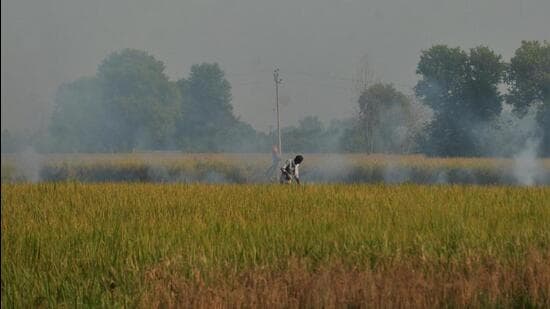
The bench headed by justice Abhay S Oka said that though the CAQM Act provides drastic penalties for violation of its orders, ranging from the closure of polluting units to imprisonment up to five years for violators, not a single case was registered.
Calling for action-taken reports against stubble-burning from Punjab and Haryana within one week, the bench, also comprising justices Ahsanuddin Amanullah and Augustine George Masih said, “Nothing will happen unless you start criminal prosecution. For different reasons they (Punjab and Haryana) don’t want to prosecute anybody. Unless people know that there will be prosecution, farm fires will not stop and they will not even use the machinery to remove stubble.”
Delhi and its surrounding regions are engulfed in an annual spectre of air pollution that engulfs the National Capital Region around Diwali every year, which extends well into the winter. Experts blame a toxic cocktail of smoke from paddy fields in Punjab and Haryana, along with local pollutants such as vehicular emissions, localised dust, as well as geographical and climatic factors such as the glacially slow surface-level winds during the winter along with the dipping temperatures for the air emergency. The pollution mess across the region, however, has been exacerbated by administrative inaction, particularly by the governments of Haryana and Punjab which have been unable to curb the perennial menace of stubble-burning.
Posting the matter for October 16, the bench told CAQM to disclose if it had two experts on air pollution in its panel, and why two NGOs as independent experts were kept vacant. “If we find the two experts on air pollution are not in the commission, we will exercise our powers under Article 142 of the Constitution,” the bench said, asking both the Centre and CAQM to file responses within a week.
Article 142 is a unique power available to the Supreme Court under the Constitution which allows it to pass any order to do “complete justice” in any cause or matter before it. Such an order passed will be applicable throughout the country.
The court noted that CAQM was doing very little to enforce its own June 2021 order, followed by another order passed in April this year, to curb the menace of farm fires. CAQM, represented by additional solicitor-general (ASG) Aishwarya Bhati, said that pollution in Delhi can be attributed to 10 sources, with stubble-burning being one of them. She claimed that, through a multipronged strategy, farm fires have reduced over the years and the collection of stubble from farmers for other uses has shown a marked increase.
The CAQM report said that three subcommittees under the commission dealing with monitoring and identification of pollution sources, safeguarding and enforcement of its directions, and research and development, met 11 times in the past nine months.
But the bench was not satisfied. “You must show an implementation of your order in letter and spirit. Holding of meetings will not yield anything; action must follow,” it responded. The bench noted that stubble-burning cases were still being reported from Punjab and Haryana.
“There are repeated incidents of stubble-burning and not a single prosecution under the Act, even as per your 2021 order. Why have you not acted against these persons who did this? Why has no action been taken against officials who allowed this to happen? Is there any ban on you to prosecute them under Section 14? If farmers cannot be prosecuted, at least the official should be punished,” it said.
Section 14 of the Act says that any non-compliance or contravention of any provisions, rules or any order or direction issued by the commission, “shall be an offence punishable with imprisonment for a term which may extend up to five years or with fine which may extend up to one crore rupees or with both”.
The ASG told the court that 1,099 closure orders have been issued against polluting units and FIRs have been registered under Section 223 of Bharatiya Nyaya Sanhita (BNS), which deals with disobedience of orders passed by officials.
But the bench said: “You have found out the softest provision to penalise persons when you have drastic provisions under the CAQM Act. One gets an impression that you have fixed some targets but your own machinery is not working to implement your orders.”
During the hearing, Punjab informed the court that penal action should follow only after alternate incentives are provided to farmers in form of machines to remove stubble. State advocate general Gurminder Singh said that though more than 140,000 machines are available in state, small farmers with less than 10-acre farms want drivers and fuel to run them, and the state had written to the Centre for financial help to facilitate this.
Senior advocate Gopal Sankaranarayanan, however, said that the Punjab’s argument was baseless as the stubble-removing machines do not need a driver because they can be attached to tractors. He further said that the state may later argue that they even need tractors. The bench told Punjab’s law officer: “Keep aside your political compulsions. You are bound by the statutory commission and the Act.”


