E-Paper



Supreme Court spares Pocso convict to aid victim, now wife
The Supreme Court said this case was not, and should be a precedent. "This case is an illustration of the complete failure of our society and our legal system”


The Supreme Court on Friday chose not to jail a man convicted of rape under the Protection of Children from Sexual Offences (Pocso) Act, ruling that the victim — now married to him with a child — had suffered more from the legal proceedings than from the original offence.
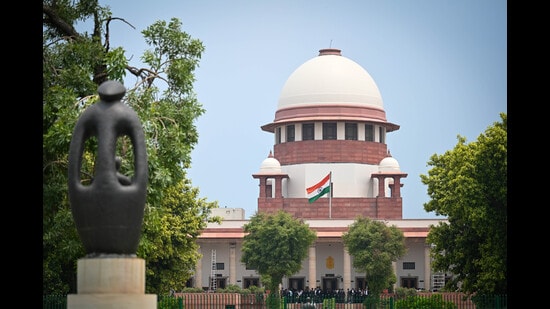
A bench of justices Abhay S Oka and Ujjal Bhuyan made the rare move to invoke Article 142 of the Constitution, which empowers the apex court to do “complete justice” by taking any decision in order to suspend the sentence while upholding the conviction. The ruling was one of 11 involving justice Oka, who retired on Friday.
“In the context of this situation, sadly, true justice lies in not sentencing the accused to undergo imprisonment,” the court said, emphasising that the case would not serve as precedent. “This case is not going to be a precedent and should not be a precedent. This case is an illustration of the complete failure of our society and our legal system.”
The ruling emerged from a suo motu case initiated in December 2023, following controversial observations by the Calcutta High Court. The high court had acquitted the 25-year-old man but made unnecessary remarks about adolescent sexuality, advising female adolescents to control their sexual urges.
The Supreme Court had previously termed these observations “unwarranted and erroneous” while restoring the man’s conviction. However, it constituted a committee of experts, social workers and psychiatrists to assess the case’s unique circumstances. An amicus curiae was also appointed to assist the court.
The committee and amicus curiae findings revealed that while the man’s actions constituted a legal offence, the victim did not perceive it as such. The case stemmed from a consensual relationship but constituted statutory rape since minors are not deemed to be of the age where they can give informed consent.
The victim had been more traumatised by the legal proceedings following her husband’s 2021 arrest and the two years he spent in custody thereafter than by the original incident, the committee found.
“She is now emotionally committed to the accused and has become very possessive of her small family,” the court observed. “Sending the accused to jail would make her the worst sufferer.”
The court noted that the victim had spent years fighting a legal battle defending her husband after being failed by society, the legal system and her own family. “The society judged her, the legal system failed her, and her own family abandoned her. Now, she is at a stage where she is desperate to save her husband,” it said.
The West Bengal government informed the court of its decision to provide financial support to the victim and child, including funding her education. The Supreme Court directed the state to act as “true guardian”, providing better housing and covering educational costs through graduation, plus the daughter’s schooling and nutritional needs.
The court issued broader directives for all states and Union Territories to review implementation of Pocso and Juvenile Justice Acts, reporting to the Union Ministry of Women and Child Development. It also endorsed recommendations for establishing adolescent wellbeing systems, sex education programmes and improved data collection.
“The facts of this case are an eye-opener. It highlights the lacuna in our legal system,” the court concluded, emphasising the need for victims to make “informed decisions” - something this victim had been unable to do.