E-Paper



Experts urge Yadav, MPs not to table forest bill in House session
They have sought more time to submit objections to the joint committee of Parliament studying the draft legislation

 Prefer HTon Google


Around 400 ecologists, scientists and naturalists have written to environment minister Bhupender Yadav and members of Parliament on Tuesday, urging them not to table the Forest Conservation Amendment Bill, 2023, during the monsoon session that begins on July 20.
They have sought more time to submit objections to the joint committee of Parliament studying the draft legislation. Public feedback on the proposed legislation ended on May 18.
“As the devastating impacts of climate change and environmental degradation become clearer, highlighted in the recent floods across north India, this is the time for the government to reaffirm its commitment to protecting the country’s immense biodiversity,” said the letter. “This amendment will only seek to hasten the decline of India’s natural forests. For these reasons, and those described above, we urge that this Amendment Bill not be tabled in Parliament without additional consultations with domain experts.” HT has seen a copy of the letter.
The letter by ecologists follows several such petitions by retired civil servants, experts on forest rights, opposition MPs, people and groups from the northeast, legal and policy experts, among others. The parliamentary panel approved and adopted its report on the bill, HT reported on July 13. Objections and suggestions, including notes of dissent submitted by opposition lawmakers, have been taken on record and are likely to be annexed with the panel’s report. The parliamentary panel is expected to submit its report during the monsoon session starting July 20.
The bill, which proposes to modify the Forest (Conservation) Act, 1980, has a number of controversial clauses, which have been opposed by several environmental and legal experts and also by members of Parliament from opposition parties. Four opposition MPs have submitted notes of dissent. Certain provisions of the bill could jeopardise vast tracts of ecologically important forests and leave out several so-called unclassed forests that cover around 15% of India’s total forest cover, a report by a high-level working group constituted by Vidhi Centre for Legal Policy on the bill said in May.
Unclassed forests are recorded as forests but not included in the reserved or protected forests category. The ownership of such forests varies from state to state, according to the Forest Survey of India
The letter signed by ecologists from the Ashoka Trust for Research in Ecology and Environment, Nature Conservation Foundation, Habitats Trust, Wildlife Institute of India and several independent ecologists and those who have retired from important scientific institutions has raised concerns on four aspects of the proposed modifications.
Some of the ecologists who signed the letter include Farai Divan Patel from The Habitats Trust, Dr R Ganesan from Ashoka Trust for Research in Ecology and the Environment, Dr Aparajita Datta from Nature Conservation Foundation, Dr Ghazala Shahabuddin, Senior Adjunct Fellow, Ashoka Trust for Research in Ecology and Environment and associate professor Dr Vinod Saranathan from Krea University among others.
The bill proposes to cover only lands that have been declared or notified as a forest under the Indian Forest Act, 1927, or under any other law. It seeks to recognise only forest lands that were recorded as forests as on or after October 25, 1980. This has raised legitimate fears that the amendment will invalidate the Supreme Court’s 1996 judgment in TN Godavarman vs Union of India in which the court interpreted the meaning of forest as its dictionary definition, expanding the purview of the forest conservation law.
If these areas are declassified, it will mean that thousands of square kilometers of forests will lose protection overnight, the letter said. While 516,630 sq. km of the forests are within recorded forest areas, 197,159 sq. km of forests lie outside, according to the India State of Forest Report 2021.
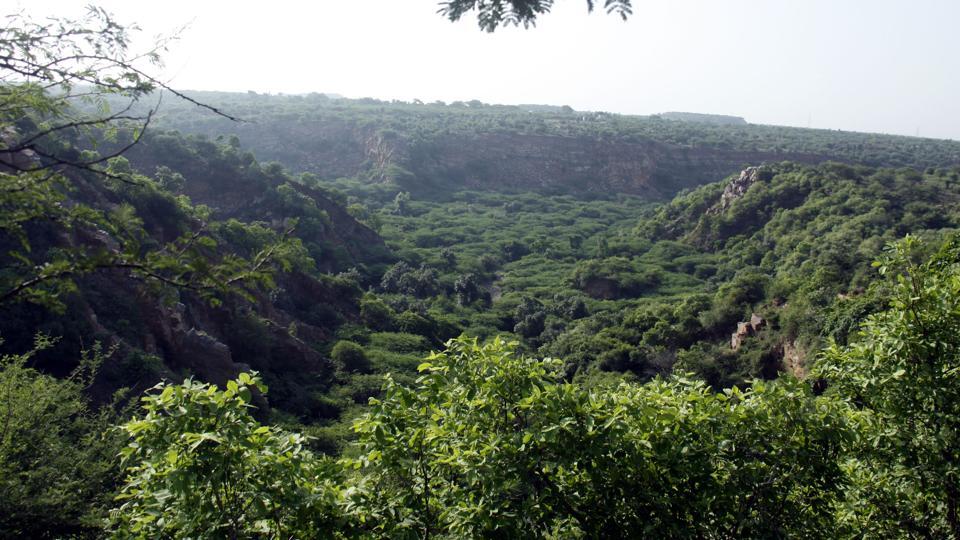
“Areas such as the Aravalli forests, which will lose protection, are a vital green lung for northern India and provide refuge to hundreds of species of birds, reptiles, mammals and amphibians, apart from serving critical hydrological and climatic modulation for the entire Delhi NCR,” the letter said. “Innumerable examples can be given of the ecological necessity of maintaining 33% of India’s land area under forests, as enshrined in the Directive Principles of State Policy.”
Another proposed clause exempts prior forest clearance for strategic developmental projects of national importance on forest land located within 100km along international borders. Ecologists have highlighted that these areas are home to the most ecologically important ecosystems, including the forests of northeast India, the high-altitude deserts of Ladakh and Spiti, the alpine forests of Uttarakhand and Himachal Pradesh, and the open scrub and desert ecosystems of West India.
“Other security-related infrastructure in different parts of the country is also exempted from forest clearances, which means that every part of the country could be impacted by military infrastructure,” the letter said. “However, the need for fast-tracking should not imply the complete elimination of the need for appraisal.”
Another clause of the draft legislation has a list of activities permitted on forest lands, which include zoos, safaris, eco-tourism facilities and silviculture. “As should be obvious, a zoo or safari park and a forest cannot be equated. One is a thriving ecosystem, interconnected in thousands of ways, many of which we are still only learning about. The other, a zoo, can be a place for ex-situ conservation or education but can never be a replacement for the former,” the letter said.
The proposed law also sidelines the rights of forest dwelling communities, the letter said. Exempting such a large number of projects from the clearance process will mean that forest dwelling people will no longer be consulted, it said.
“This is an extremely important way that forest dwelling people are given a voice. The Scheduled Tribes And Other Traditional Forest Dwellers (Recognition Of Forest Rights) Act, 2006, has made it mandatory to get free, prior and informed consent of local communities through their gram sabhas (village councils), a right that they have won over years of struggle,” it added.