
 E-Paper



Seas turning into data oceans, warns Navy chief on rising cyber threats
The Admiral was speaking at a seminar, ‘Impact of Cyber-attacks in maritime sector and its effects on national security and international relations’, which saw participation from the cybersecurity experts, academicians, Cert-In officials and navy officers


The seas themselves are becoming data oceans, navy chief Admiral Dinesh K Tripathi said on Thursday, highlighting how India’s maritime domain is rapidly transforming through digital technologies, and with it, facing growing cyber vulnerabilities. For India, with 12 major ports, more than 200 non-major ports, over 11,000 km of coastline, and expanding blue economy projects, the implications of a cyber disruption could be enormous.
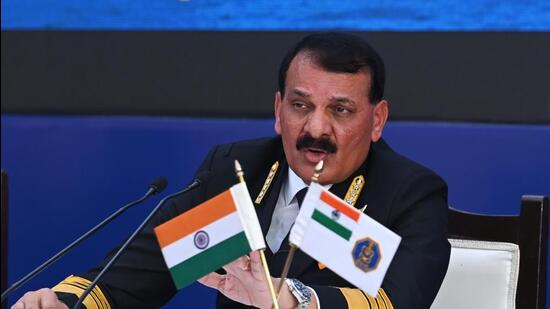
“The seas are our global commons. A cyber disruption at sea, or in any major port, therefore, does not remain confined to one nation’s boundaries. Its impact can ripple across supply chains, distort global markets, and even unsettle diplomatic equations,” said the Admiral.
The Admiral was speaking at a seminar, ‘Impact of Cyber-attacks in maritime sector and its effects on national security and international relations’, organised by the ministry of defence and ministry of ports, shipping and waterways, which saw participation from the cybersecurity experts, academicians, Cert-In officials and navy officers.
The chief guest at the seminar was Minister of State for Electronics and Information Technology Jitin Prasada, who said that India was faced with millions of cyberattacks during Operation Sindoor and that the four-day military standoff between India and Pakistan tested India’s resolve and capability.
“The synergy between our defence forces was flawless, and we neutralised threats with precision, protecting our interests with unwavering resolve. But what many did not see and don’t know still is the silent and parallel battle that was fought and won on the side,” said Prasada, referring to cyberwarfare against disinformation, misinformation, phishing, and other forms during Operation Sindoor.
This comes at a time when the National Stock Exchange revealed that it recorded its highest ever cyberattacks in a day during Operation Sindoor. According to PTI, NSE faced 40 crore attacks in a day, when on an average it faces about 17 crore attacks.
Discussions throughout the day focused on who holds responsibility for the maritime sector’s cyber preparedness, given that oversight remains fragmented across multiple ministries and agencies. Participants pointed to persistent gaps in basic cyber hygiene and awareness, with people still using weak passwords and underestimating the human element in security.
The sector’s rapid digitalisation through smart ports, automation, and AI is expanding its vulnerability surface, even as its economic weight, contributing nearly 27% of India’s GDP and handling 95% of the country’s trade, makes cyber resilience critical, noted Vice Admiral Tarun Sobti. Most importantly, the seminar underlined the absence of a centralised framework or nodal agency to set cyber standards and coordinate across the maritime, naval, and offshore domains, recommending tighter inter-agency coordination or even a dedicated maritime cyber vertical.
CERT-In Director General Dr Sanjay Bahl said that work has been underway for nearly four to five years to establish a dedicated Maritime CERT (Computer Emergency Response Team), a specialised agency to handle cyber incidents, coordinate responses, and set security standards for India’s maritime sector. He noted that while the framework for this sector-specific CERT has already been developed, it has been awaiting finalisation and adoption by the maritime sector.
“I encourage that the Maritime CERT should be set up so that action can be taken immediately whenever there is an incident, and these incidents are only going to increase, as more and more automation starts happening,” said Dr Bahl. The administrative control of Maritime CERT will be with the sector, while the technical control will be with Cert-In.
Citing global incidents, Admiral Tripathi recalled the six-day Suez Canal blockage in 2021 that froze nearly $10 billion in trade every day, warning that “a similar disruption caused by a line of malicious code” could paralyse trade routes. He also referred to the 2023 cyberattack on DP World Australia, which halted nearly 40% of the country’s container trade, and the targeting of Iran’s shipping network by the Lab Dookhtegan group earlier this year.
The 2024 Maritime Cybersecurity Report, he noted, recorded over 50 billion firewall events globally, 1,800 vessels targeted, and 178 ransomware incidents, each costing over half a million dollars on average. “In cyber terms, these are not merely attacks on systems. They are strikes on the very arteries of the global economy,” he said.


