
 E-Paper



Shortage of safety equipment crippling states’ Covid-19 containment efforts
Admitting the shortage, UP health secretary, Amit Mohan Prasad said 31 units in the state had started manufacturing kits and that the government had also placed orders with other companies.

 Prefer HTon Google


In India’s two biggest states -- Uttar Pradesh and Maharashtra that have nearly a thousand cases between them -- health officials admitted to a shortage of PPE, saying that private companies had expressed their inability to provide the kits early because of an increase in demand. This is because of a sudden increase in cases, the officials, who spoke on condition of anonymity, said.
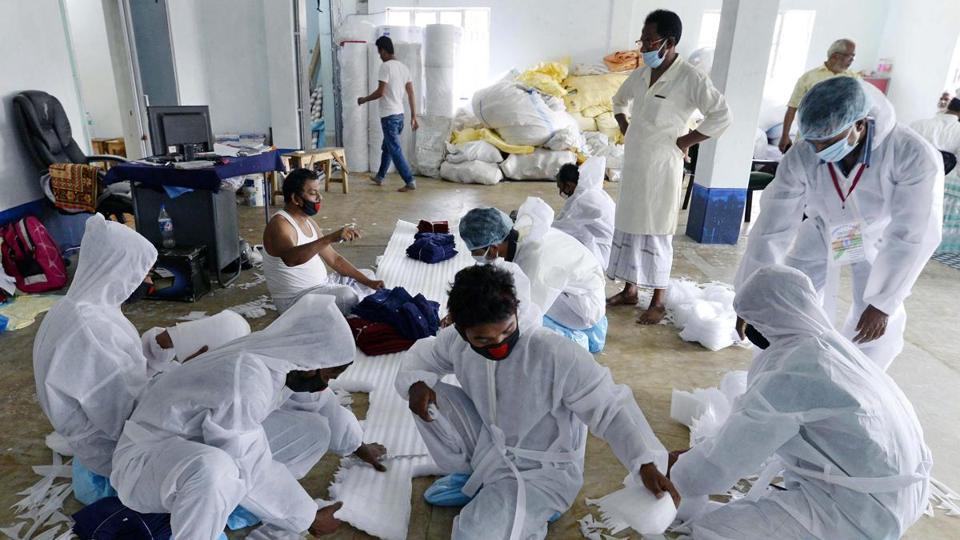
Admitting the shortage, UP health secretary, Amit Mohan Prasad said 31 units in the state had started manufacturing kits and that the government had also placed orders with other companies. He did not provide any break-up of the kits needed and procured by the government. A doctor in King George’s Medical University in Lucknow, the largest hospital in the city, has been infected.
Click here for the complete coverage of the Covid-19 pandemic
In other states such as Bihar, a large number of health workers have been provided with only masks, gloves and sanitisers -- and not coveralls. “To tide over the shortage of PPE kits, we have requested our doctors to utilise the kits rationally,” said Sanjay Kumar, Bihar’s principal secretary, health.
The situation is no different in Madhya Pradesh’s biggest Covid-19 hot spot Indore, where only half of the health workers have been provided with proper kits.
“Only 20 to 30% of around 55,000 to 60,000 health workers have been provided with proper kits in the state,” said MP’s health department employees’ association leader Laxminarayan Sharma. In the state, eight more health workers and staff tested positive on Sunday. All these officers used to meet one another in meetings held in the state secretariat and the health directorate and monitor implementation of the measures undertaken by the government across the state. At least 50 other officers, including head of the health department, are in self quarantine.
State Commissioner of health services, Faiz Ahmad Kidwai, said, “We are providing PPE kits to health workers as per guidelines of government of India. Currently we are getting supplies from certain companies including some companies based at Indore. We are trying to get about 1.5 lakh kits in the coming days.”
The northern states of Punjab, Haryana and Uttarakhand and the Union Territories of Jammu and Kashmir and Chandigarh have placed orders with private companies for the kits but haven’t received them yet. A health worker each in Chandigarh and J&K and two in Haryana have tested positive for Covid-19.
Also Read: How Delhi answered PM Modi’s call to fight ‘coronavirus darkness’
In Punjab’s Patiala and Amritsar districts, nurses protested outside hospitals, alleging a shortage of kits even though the official spokesperson for Covid-19, Rajesh Bhaskar, denied the charge. The Punjab cabinet has authorised additional chief secretary Vinni Mahajan to buy kits and masks for medical staff from manufacturers in the state and elsewhere. Haryana minister Anil Vij said tenders had been floated to get the kits.
The eastern states of Bihar, Jharkhand and West Bengal have also reported a shortage of kits even though local manufacturing has started. Bihar has been supplied 16,700 PPE kits against its demand for 960,000 kits. Another 21,000 PPE kits are in transit. Jharkhand has 13,000 kits as against the demand of 21,000.
Kumar said they were tapping all possible sources to get the kits. Jharkhand’s health minister, Banna Gupta, said the state government had placed orders with various companies. “We have also requested the central government to ensure supply of the kits but they are not listening to us,” Gupta said.
West Bengal chief minister Mamata Banerjee has also blamed the Centre although governor, Jagdeep Dhankhar, had claimed that there were enough kits with the state. Doctors in several hospitals in the state have protested and refused to report for work citing inadequate safety equipment.


