
 E-Paper



'Sirf hungama khada karna maqsad nahi': Team Operation Sindoor's big message to Pakistan
Operation Sindoor was launched on May 7, 2025, in response to the April 22 Pahalgam terror attack that killed 26 people.

 Prefer HTon Google


As Operation Sindoor marks one year on Thursday, May 7, the defence forces team which led the military strike against terrorism in Pakistan and Pakistan-occupied Kashmir (PoK) said that the operation was not an end, but "just the beginning". The then-director general of military operations, Lt Gen Rajiv Ghai, said that the "hungama" (chaos) was not the intention, but bringing a "change" was.
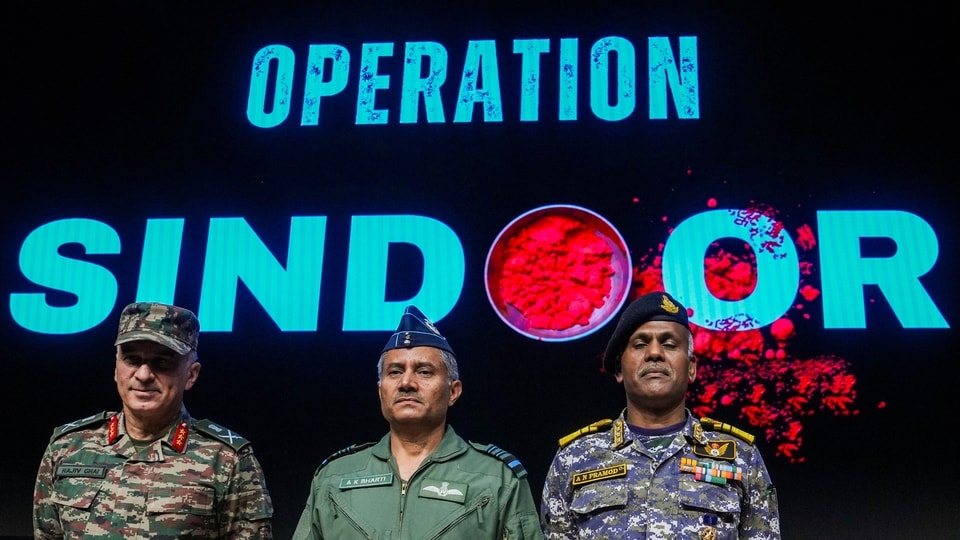
Operation Sindoor was launched on May 7, 2025, by the Indian armed forces in response to the April 22 terror attack that killed 26 people in Jammu and Kashmir's Pahalgam.
The Indian forces targeted terror infrastructure, belonging to outfits like Lashkar-e-Taiba and Jaish-e-Mohammad, in Pakistan and PoK.
‘Hungama karna maqsad nahi’
Lt Gen Rajiv Ghai, the then-DGMO, said during a press conference in Rajasthan on Thursday that India's fight against terrorism will continue.
"Sirf hungama khada karna mera maqsad nahi. Meri koshish hai ki yeh soorat badalni chahiye. Operation Sindoor was not an end. It was just the beginning. India's fight against terror will go on," Ghai added.
He further said a year on since the offensive, India remembers not just Operation Sindoor, but also the principle behind it.
ALSO READ | One year of Operation Sindoor: How India crippled terror to avenge Pahalgam killings
"India will defend its sovereignty, its security, and its people decisively, professionally and with the utmost responsibility," the former DGMO added.
Lt General Rajiv Ghai, Air Marshal AK Bharti and Vice Admiral AN Pramod led Operation Sindoor from the forefront, being the chiefs of the Indian armed defences.
Op Sindoor a ‘statement of resolve’
Ghai said that the military operation was possibly a defining moment in India's strategic journey. "Operation Sindoor saw India very consciously and coherently go beyond its erstwhile approaches and methods and target terror across the Line of Control and our international boundary with Pakistan," he added.
He defined the operation as a "statement of resolve, responsibility and strategic restraint by a nation."
Ghai reaffirmed that the Centre gave the armed forces two clear directives -- defined political-military objectives and flexibility to take operational decisions.
Firm direction at the top, and professional autonomy and flexibility at the operational level were key to the Indian armed forces' success, the former DGMO said.
ALSO READ | One year of Operation Sindoor: Every time India countered Pak's claims, Trump's ceasefire ‘role’
"Operation Sindoor underscored India's evolving whole of government approach, which played out in a clockwork fashion on the battlefield," Ghai added.
The Lt Gen further detailed that of the nine standoff precision strikes carried out by the tri-services, seven were executed by the Indian army and two by the Indian air force. He said the strikes were "timed to perfection, achieved total surprise and inflicted maximum damage in each established hub deep" in PoK and heartland Pakistan, "signalling that no sanctuary is safe."
'Every arm of state carried responsibility'
The former DGMO further stated that Operation Sindoor is proof that Atmanirbhar is not just a slogan, "it is indeed a force multiplier".
In a seeming reference to the conflicts in the Middle East and between Russia and Ukraine, Lt Gen Rajiv Ghai said, "In an era of prolonged conflicts around the world, we struck hard, achieved clearly defined objectives and then decided to cease hostilities when the Pakistanis were compelled to negotiate and requested us to stop."
He said that not just the Indian armed forces, but every arm of the state carried a responsibility during Operation Sindoor.
ALSO READ | 'Just took 88 hours': Army shares video revisiting Operation Sindoor as it completes one year
"Intelligence agencies provided the accurate information that is so critical to precision targeting. Cyber and electronic warfare units maintained information dominance. The government managed the international environment as also the internal security and public reassurance. The armed forces executed the kinetic phase with discipline, precision and minimal collateral impact. This multi-agency, multi-domain coordination will remain the template for future operations," Ghai detailed.
The three chiefs 'met almost every day'
Air Marshal Awadhesh Kumar Bharti said that though we cannot bring back those who lost their lives on April 22, 2025, India can certainly ensure that such incidents are not repeated.
Operation Sindoor is an effort towards that very resolve, said AK Bharti. He also noted that, since time immemorial, India has lived with a simple philosophy of live and let live.
"But when our desire for peace is mistaken for weakness, and our silence is taken as absence, there is no choice but to act. And when we act, there are no half measures. It is decisive, it is lethal, and it translates into Operations Sindoor," he added.
He said that when the first hit on the early morning of May 7, 2025, the decisive flash was the strength and the resolve of the people of India being projected into the enemy heartland.
ALSO READ | Operation Sindoor was India’s first stand-off weapon war
AK Bharti recalled that he, the then-DGMO and Vice Admiral AN Pramod, met every day, and on more than one occasion, "our aim was not just to hit".
"It had to be lethal. It had to be precise, avoiding collateral. Hence, selection of targets, timing, weapons to be used, everything needed to be carefully considered," he added.
India called Pak's nuclear bluff
Vice Admiral AN Pramod said that the Indian Navy forced the Pakistani naval and air units to enter a defensive posture largely confined to harbours or operating close to their coastline.
Pramod further stated that by striking terror hubs in the heart of Pakistan with long-range precision weapons, "India effectively called the bluff on Pakistan's nuclear blackmail."
Justifying Indian Navy's investment in indigenous capability, Pramod said, "The performance of indigenous ships such as the aircraft carrier Vikrant, Kolkata and Visakhapnam class destroyers validated the Indian Navy's investment in indigenous capability, blue water readiness and integrated war fighting, thus reaffirming Atmanirbharta as a critical enabler for operational success."
He said that if Operation Sindoor was a proof of calibrated resolve, India's next response "will be about sustained overmatch."
"If challenged again, we will not merely respond, we'll shape the battle space from the outset," he added.


