
 E-Paper



Solar project near Gir sanctuary put on hold: Officials
The decision followed concerns raised by environmentalists and wildlife advocates about its impact on the Asiatic lion’s last natural habitat, a senior state government official said

 Prefer HTon Google


Ahmedabad: The Gujarat government decided in the first week of January to put on hold a 25 MW solar power project proposed by the National Thermal Power Corporation (NTPC) group near the Gir National Park and Wildlife Sanctuary. The decision followed concerns raised by environmentalists and wildlife advocates about its impact on the Asiatic lion’s last natural habitat, a senior state government official said.
“After carefully evaluating the project’s advantages and disadvantages at the highest levels of government, we have decided to withhold clearance and put the project on hold for now,” the official added, requesting anonymity.
A senior forest department official noted that while large-scale solar installations are typically not allowed in eco-sensitive zones, this project was initially considered as an exception. However, the project developers are now exploring alternative locations, he added.
“NTPC recently proposed a total of 200 MW of solar projects to the Gujarat government. Of this, a 25 MW project was planned for Ghodasan village, part of the Asiatic lion corridor connecting Gir to Girnar, which is included in the draft eco-sensitive zone notification. The remaining 175 MW was planned for Surendranagar and Dahod districts, outside the lion habitat,” another forest department official said.
The forest department’s approval has been delayed for about two months, prompting NTPC to consider relocating the 25 MW project to other sites, he added.
The PSU had initially proposed a 60 MW project in the eco-sensitive zone around Gir, seeking 125 hectares of land. However, opposition from wildlife experts and environmentalists led to the project’s reduction to 25 MW, occupying around 40 hectares.
An NTPC official declined to comment on the matter when contacted.
The government has recently issued draft eco-sensitive zone guidelines near the lion sanctuary to enhance habitat protection. However, critics argue the state is also pushing for large-scale commercial projects in the same areas.
Some political leaders have accused the government of selectively applying environmental rules—strictly enforcing them against locals while relaxing them for corporate benefits.
Aam Aadmi Party (AAP) leader Pravin Ram recently criticised the government during a rally near Junagadh for allowing the solar project in the lion corridor despite a 2011 notification prohibiting commercial activities in the area. He questioned the government’s priorities, stating, “When farmers protest about eco-zone threats to their livelihoods, the government talks of environmental protection and lion conservation. But when vast tracts of land are allocated for solar projects, doesn’t it harm the lions and conservation efforts?”
Bhushan Pandya, a former member of the state wildlife board and veteran wildlife photographer, recently wrote to the Gujarat chief minister emphasising the importance of preserving wildlife corridors, including villages and farmlands, as vital habitats. He said that the forest department has previously submitted negative reports on this project twice.
Rajya Sabha lawmaker Parimal Nathwani, a lion enthusiast, voiced concerns on social media, stating that the solar project would hinder the movement of Asiatic lions and urged both the state and central governments to stop the project.
Mulu Bera, Gujarat’s minister for forests and environment, could not be reached for comment.
Environmentalists and wildlife conservationists argue that such projects could disrupt wildlife corridors essential for the movement and survival of Asiatic lions, which are already under pressure from habitat loss. The Asiatic lion population has grown from 523 in 2015 to 674 in 2020, according to the last census. However, only about 300–325 lions reside within the 1,412 sq km Gir sanctuary, with the remaining population relying on surrounding corridors.
Jalpan Rupapara and Purvesh Kacha, medical practitioners and wildlife experts with over two decades of experience in lion conservation, highlighted the risks of large-scale solar projects in critical areas of Gir. They noted that such projects require clearing vegetation, adversely affecting herbivores and their predators. They also cited past instances where solar projects led to increased human-wildlife conflict.
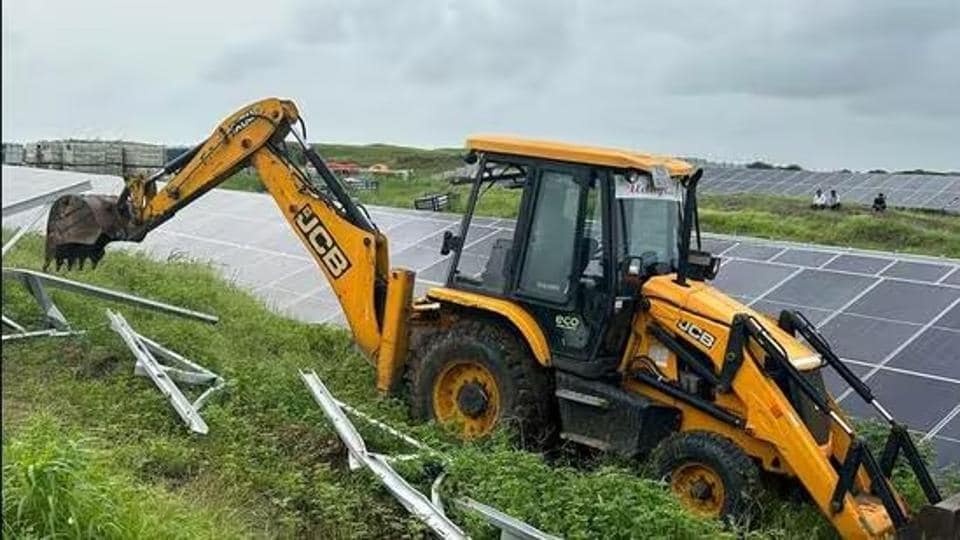
In August, the Amreli collectorate office demolished illegally installed solar panels by Dhari Solar Park Pvt Ltd in the eco-sensitive zone near Gir Sanctuary. The company had set up the panels without requisite permissions, occupying over 4,19,028 square metres of land.
Also Read: Solar panels razed in eco-sensitive zone near Gir lion sanctuary
According to the Ministry of Environment, Forest and Climate Change’s guidelines, small-scale renewable energy projects are permitted in eco-sensitive zones for local communities and eco-friendly tourism. However, large-scale projects with potential ecological impact must be regulated.
In the past six months, at least three large-scale solar project proposals in the region have been put on hold, officials confirmed.


