E-Paper



A not-so-sweet surprise: How India went from a year of possible sugar glut to shortage & high prices ahead of festivals
At the beginning of this sugar season, the government and the industry prepared for a surplus

 Prefer HTon Google


Buying a packet of sugar in any of the major metros today will set you back by roughly 40% more than a fortnight ago. The reason: A severe supply crunch. This has prompted the government to fortify sugar stores at the onset of the festive season which traditionally begins with Onam and Rakshabandhan in August.
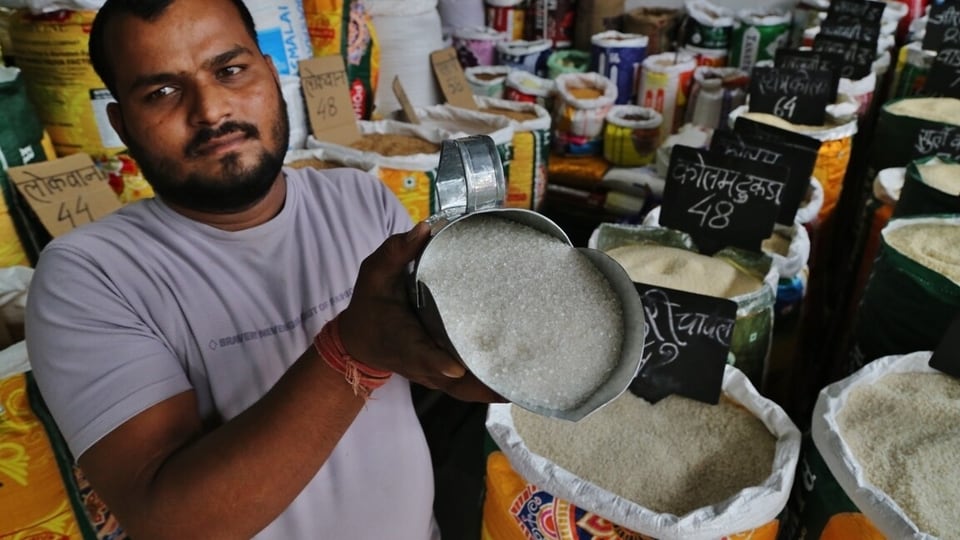
India went from a possible glut, to a serious dearth of sugar in a year.
At the beginning of this sugar season (October 1, 2025; it ends on September 30, 2026), the government and the industry prepared for a surplus. Sugar production was expected to rise sharply, diversion to produce ethanol was expected to be lower, and mills were pressing for permission to export more sugar to prevent stocks and dues to cane farmers from piling up.
Industry body Indian Sugar and Bio-energy Manufacturers Association (ISMA), expected sugar output at 34.90 million tonnes (MT) in its first preliminary estimate released in July 2025 for the 2025-26 season. This represented a 18.3% year-on-year increase from 29.6 MT the year before. This was reiterated at its annual conference in September.
Based on the estimate, the government allowed the industry to export sugar earlier in the season. This was starkly different from the year before. In the 2024-25 season, the government had allowed 1 million tonnes of exports only in January 2025, whereas for the current season it approved an initial 1.5 million tonnes in November 2025, soon after the season began . It allowed export of another 500,000 tonnes in February.
But by May, projections changed and the policy took a U-turn.
The government in May banned sugar exports until September 30, citing the need to preserve domestic supplies. By July, it was tightening controls on mills and dealers, and in August it kept the monthly sales quota at 2.25 million tonnes — unchanged from a year earlier — even though the market expected 2.30-2.40 MT because the festival season was approaching.
Sugar prices responded sharply.
Ex-mill prices in Maharashtra and Uttar Pradesh which had been rising since late June, touched ₹4,880-4,980 per 100kg in the first week of August. Prices then touched a record ₹5,350 per 100kg, August 18. A day later, ex-mill prices of sugar in Uttar Pradesh were ₹5,850 , up from ₹4,830 per 100kg a week ago.
Reacting to the sudden, steep rise, the government, late on August 19 further tightened sugar stockholding limits, restricting large industrial buyers from holding more than 15 days of their requirement from September. It then went on to open imports of sugar for the first time in nearly a decade, scrapping the 100% import tariff, and allowing 1 MT of sugar imports on August 20. That day, prices shot up to as high as ₹7,100 per 100kg in mills in Karnataka.
What happened? “How is it that a market that was expected to have enough sugar to permit exports and divert for ethanol, moved so quickly towards a situation where the government is even worried about releasing a higher quota?,” a trader with an international commodities firm asked, requesting anonymity.
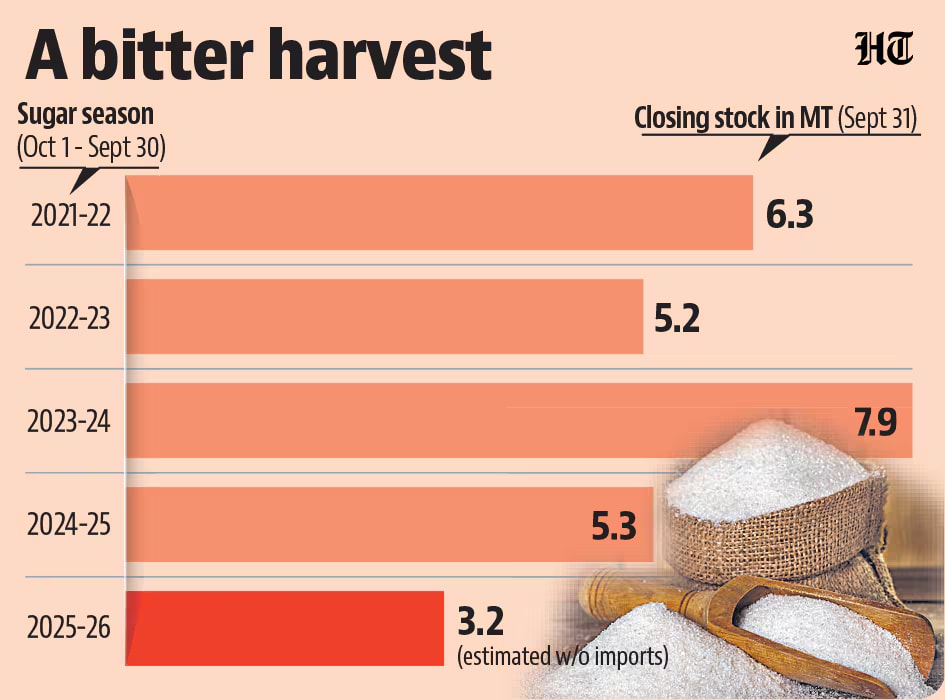
How surplus turned to deficit
The sugar year’s timeline tells the story.
ISMA cut its gross sugar production estimate slightly in November, to 34.35 MT.
Of this, about 3.4 MT was expected to be diverted for ethanol production, leaving net sugar production of 31 MT for food use. With opening stocks of about 5 MT, total sugar availability was projected at nearly 36 MT, against domestic consumption of about 28.5 MT, leaving a comfortable surplus that ISMA said could support exports of at least 2 MT.
However, production estimates kept weakening.
In February, ISMA cut its gross production estimate to 32.4 MT. This reduction is equivalent to a month of the country’s total sugar consumption. The industry body also reduced its estimate of net sugar production (the gross less the diversion) to 29.3MT and expected about 3.1MT of sugar equivalent to be diverted towards ethanol.
In April, the gross production estimate was cut again to 32MT.
The government now projects output for the ongoing season at 30.6MT. With 2.9MT diverted for ethanol and 800,000 tonnes exported, the leftover balance for the country stands at 26.9 MT, below the consumption estimate of 28.5 MT. However, buffer stocks from last year will boost availability till end of season.
Much before ISMA’s April estimates, another sugar body, the All India Sugar Trade Association (AISTA) , in the first week of March, sharply reduced its net sugar production forecast for the 2025–26 season to 28.3 MT (excluding sugar for diversion). It said lower yields in Maharashtra and Karnataka, two of India’s largest producing states, were responsible for the downgrade.
“The government has understandably relied on industry bodies such as ISMA for production assessments, given their close visibility of the sector. However, their repeated revisions in sugar and cane estimates over recent years suggest both official and industry forecasting systems need to be more robust. Inaccurate assessments have influenced major policy decisions with consequences for consumers, domestic trade and India’s credibility in global markets,” said Deepak Pareek, founder HnyB, an agri advisory.
In a press conference on Monday, ISMA defended its estimates stating that the first estimates are only preliminary and are revised as the season progresses. “These revisions are made basis yields, recovery etc,” Director General Deepak Ballani said.
ISMA’s production estimates have repeatedly proved too optimistic. In each of the past four sugar seasons, its first estimate was significantly higher than the eventual output. That history matters because the government’s decision to allow exports was based on projections of comfortable availability that changed substantially as the seasons progressed.
To be sure, the government has denied that it goes by industry estimates. The department of food and public distribution said: “Sugar production estimates used by the government are based on inputs received from the Cane Commissioners/Sugar Commissioners/Sugar Directorate of the sugarcane-producing States. Industry estimates are not the basis of the Government’s production forecast or policy decisions.”
“The lower-than-initially-estimated production in the current season is due to crop and weather-related factors, including Red Rot and Top Borer disease and waterlogging caused by excess rainfall in Maharashtra. Despite the lower production, adequate sugar stocks are available to meet domestic requirements until the commencement of the new crushing season in October,” it added.
Also read: Not ethanol, but low output, festive demand behind sugar price hike: Centre
Ethanol paradox
Ethanol policy is an important part of this story as it determines how much of the sugarcane crop actually goes to sugar.
At the beginning of the 2025-26 sugar season, the ethanol programme was expected to absorb considerably more sugar than it ultimately did. Industry expected 4.5-5MT of sugar equivalent to be diverted to ethanol. But oil marketing companies allocated only 2.9 billion litres of ethanol from sugar-based feedstocks for the 2025-26 ethanol supply year.
ISMA had earlier estimated that around 3.2-3.4MT of sugar would be diverted to ethanol production. The actual diversion in 2025-26 is now estimated at around 3MT, meaning less sugar was taken out of the food market for ethanol than initially expected.
This matters because less sugar going into ethanol should mean more sugar being available for the domestic market. However, as production numbers changed, even the lower amount felt more than what should have been allowed.
To be sure, India began blending ethanol in petrol to reduce its fuel import bills. With sugar prices at record highs, the blending from sugarcane is likely to stop for the remainder of this year as well as for the next year, owing to supply worries that spill onto the latter.
The government has maintained that ethanol did not lead to this price spike. In a statement released on August 21, it said the recent surge in sugar prices cannot be attributed to the diversion of sugar for ethanol, pointing instead to lower-than-expected domestic production, higher festive-season demand, and weather-related crop damage.
“The recent increase in sugar prices is attributable to a combination of factors, including lower-than-expected production, increased festive demand, weather-related crop damage, global supply conditions and market behaviour. It cannot be attributed to ethanol diversion. The share of sugar diverted for ethanol has, in fact, declined from around 12% in 2022-23 to around 9% in 2025-26, while nearly three-fourths of ethanol production now comes from grains, particularly maize.”
When were sugar prices last this high?
Sugar prices have never reached the highs witnessed this year. In this century, only two major episodes of tight domestic sugar supplies were seen-- first in 2009-10 and then in 2016-17.
In February 2017, wholesale sugar prices in key markets reached ₹4,080-4,180 per 100 kg. Market participants at the time cited tight stocks, strong bulk demand, speculative buying and lower production estimates.
In a similar situation, ex-mill prices in 2009 touched ₹4,400 per 100 kg in key markets owing to a fall in acreage after bumper crop in 2007-08 disillusioned farmers and the monsoon failed in 2009.
Closing stocks plunged to a critical low of 3.22MT. India was forced to import over 4MT of raw sugar, driving global prices to 30-year highs.
Also read: Maharashtra teams to verify sugar stocks at mills, traders amid suspected hoarding
Outlook for the next season
Closing stocks are the quantity of sugar left unsold and available at the end of a sugar season, after accounting for production, imports, domestic consumption, exports and other uses such as ethanol diversion.
That closing stock then becomes the opening stock for the following season. So if India ends a season with unusually low stocks, it starts the next season with a smaller buffer against a poor crop or unexpectedly strong demand.
Industry estimates suggest India’s carry-over stocks could fall to around 3.2 million tonnes, the lowest level in nearly two decades. At the same time, the sugarcane crop that will determine next year’s production-- sown in the ongoing kharif (monsoon crop) season-- is already facing productivity concerns in crucial states of the country as a strengthening El Nino is increasing the risk of hotter and drier conditions. Sugarcane needs intermittent rains to have a healthy yield.
“Maharashtra and Karnataka account for almost 50% of the variability in national sugar production. Fluctuating rainfall and significant deficits in some parts of Maharashtra, very low reservoir levels in Karnataka and rainfall deficiency in eastern Uttar Pradesh and Bihar are all concerns. With (weather forecaster) Skymet also forecasting a rainfall deficit in September, we could see about 2 million tonnes less sucrose production in 2026-27 than this season,” said GK Sood, chairman of KN Agri Resources Ltd.
Sood said such an outcome would leave production at barely enough to meet annual consumption of around 29 million tonnes. “If output matches this year’s 31 million tonnes, it would be prudent to build additional stocks, because the current stock-to-use ratio of about 11% is already uncomfortable and less than the 14% seen during 2008-09 when stocks fell that low,” he said. With opening stocks low, India imported as much as 5 MT of sugar in 2009-10, according to a Reuters report. Stock-to-use ration refers to how much sugar is left in stock relative to annual domestic consumption.
According to preliminary industry estimates, sugar output for the next year 2026-27 may be even lower, at 29 million tonnes.
In a response to HT’s queries, the department of food and public distribution in a statement said, “The government will continue to closely monitor sugar availability, prices and market practices and take further measures, as necessary, to protect consumers while safeguarding the interests of sugarcane farmers,” the statement added.