E-Paper



Same-sex couples may be given ‘certain rights’
The solicitor general (SG) has submitted that the government is “positive” about making efforts to address some of the “human concerns” of same-sex couples.

 Prefer HTon Google


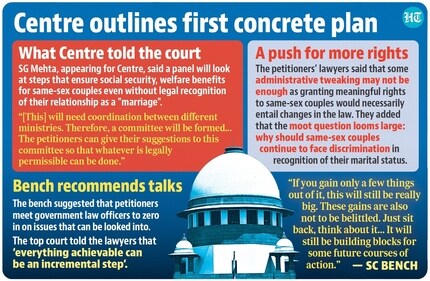
Nudged by the Supreme Court, the Union government on Wednesday agreed to set up an interministerial committee, headed by the cabinet secretary, to examine the “administrative steps” that the Centre can consider for ensuring social security and other welfare benefits for same-sex couples even in absence of a legal recognition of marriage.
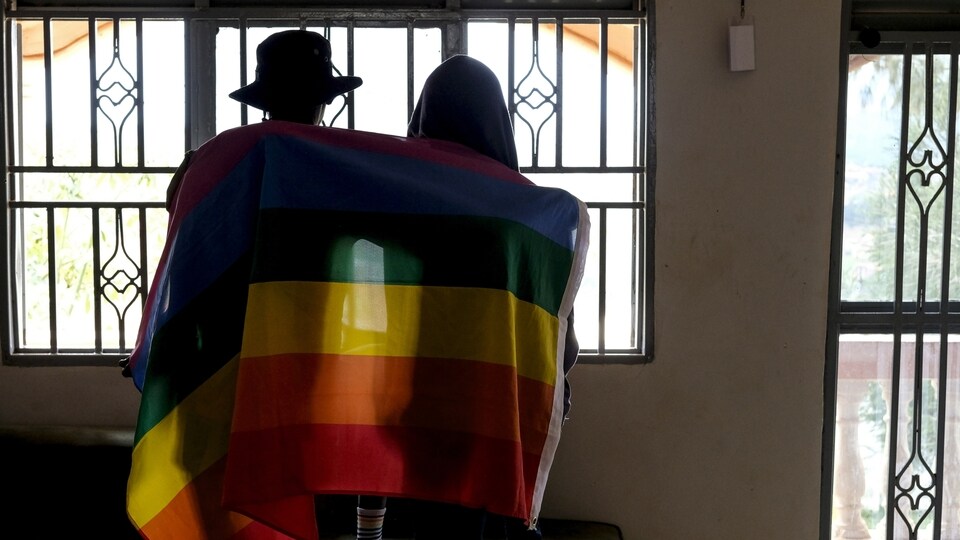
The Constitution bench, on its part, appreciated the government’s offer calling it a “big step”, and added that it does not want to leave same-sex couples “with nothing in their hands” if the top court eventually decides against their petitions for the legal recognition of such unions under the Special Marriage Act (SMA). It also advised the petitioners against an “all-or-nothing” approach.
While there is no certainty of how things will go, Wednesday’s developments perhaps indicate the steps the government is willing to take to address the issues raised by same-sex couples – without legally recognising their union – as well as the direction of the court’s thinking. In April, the five-judge bench hearing the case said it will not be touching upon the aspects of personal laws, adding that an “incremental approach” to the process of judicial determination in the case will reflect “sage wisdom”.
Last week, the court implored the Centre to mull over certain benefits and rights that same-sex couples could be granted in view of government’s statement that they have a fundamental right to cohabit and celebrate their unions.
Read here: VHP to hold nationwide protests against same-sex marriage plea
Appearing on Wednesday before a Constitution bench led by Chief Justice of India (CJI) Dhananjaya Y Chandrachud, solicitor general (SG) Tushar Mehta submitted that the government is “positive” about making efforts to address some of the “human concerns” of same-sex couples, wherever “legally permissible”.
“What we have decided is that it will need coordination between different ministries. Therefore, a committee will be formed and this will be headed by nobody less than the cabinet secretary. The petitioners can give their suggestions to this committee so that whatever is legally permissible can be done,” the SG told the bench, which also comprised justices Sanjay Kishan Kaul, S Ravindra Bhat, Hima Kohli and PS Narasimha.
Acknowledging the “first step” taken by the government, the bench suggested that the petitioners should have a meeting with the SG and some other law officers from the government to zero in on issues that can be looked into by the proposed committee even as the hearing on the legal issues that the petitions have raised could go on in the court.
At this point, senior advocates Abhishek Manu Singhvi, Menaka Guruswamy and Saurabh Kirpal raised red flags. The lawyers pointed out that some administrative tweaking in a few circulars may not be enough since granting meaningful rights to same-sex couples would necessarily entail changes in the law. They added that in spite of the government’s offer, the moot question looms large why same-sex couples should continue facing discrimination in recognition of their marital status and why they should settle for anything else.
The bench, however, responded by elucidating the court’s limitations in making legislative changes and added that the petitioners should not stress on “all or nothing” since even the smallest changes today can be the building blocks of greater movements in future.
“He (Mehta) may say administrative changes, but they can bring about many substantial changes. Sometimes, the beginnings are small but they can prove to be very substantial in various aspects. As the SG argued on the last day, the government accepts that same-sex couples have a right to cohabit, and it has been accepted as a social reality. Based on that, there may be some incidents like the right to reside, bank account, insurance etc. From your perspective, this can be very important. This can’t be all-or-nothing,” it told the lawyers.
The court clarified that it is ready to go into the legal issues relating to the community’s right to marry but it may not be prudent on the petitioners’ part to undermine or reject the government’s offer.
Singhvi, on his part, pressed that the real meaning of marriage is a juristic question that only this court can decide.
The court replied: “The conceptual domain requires legislative changes and it is completely beyond our domain. So, we have to see how we frame the conceptual doctrine... We are saying that we will decide this issue as a concept but the government taking the first step forward will be to recognise the cohabitation of same-sex couples and that’s a big step.”
Kirpal and Guruswamy, however, emphasised that a vast majority of same-sex couples want to get married and that they do not want to keep being treated as “second-class citizens”.
To this, the bench replied that the Supreme Court cannot be guided by popular or segmental morality but it is only the constitutional morality that can guide its decisions. “There is a constitutional problem with the argument on what young people feel because then we will have to also go by what other people feel. This is why the salutary safeguard that we have is what the Constitution guides,” it added.
The bench told the lawyers that everything achievable can be an incremental step. “This is a social institution which is evolving and the court, as a facilitator, can ensure that there is some development. If we don’t recognise same-sex marriage, we do not want you to be with nothing in your hand,” it observed.
The court added: “If you gain only a few things out of it, this will still be really big. These gains are also not to be belittled. Just sit back and think about it... To the extent to which the government takes the first step, it will be substantial advancement in the status of cohabitational relationships. If this results in gains that may not be as substantial as you may want, it will still be building blocks for some future courses of action. If there is some quietus to it, this is not the end.”
The lawyers then submitted that they will hand over the draft of the changes desired by the petitioners to SG Mehta.
After Mehta concluded his submissions on the seventh day of the hearing, attorney general R Venkataramani argued for a brief time. The AG argued that the court should not fundamentally alter the basic text of the statute (Hindu Marriage Act), adding that it was never intended for non-heterosexual couples.
Senior advocate Rakesh Dwivedi, appearing for the Madhya Pradesh government, submitted that preparedness of society is very important for bringing such changes, suggesting the court must not rush into anything.
“There is nobody stopping them from forming associations or getting married. But there is no fundamental right to seek legal recognition. The regulations that we have come to protect women and children. If a change in those regulations has to come, social evolutions involving elected representatives can do it. A cultural revolution brought by courts cannot do it. Parliament understands the pulse of society and they will know what to do, when to do and how to do it. These are not matters to go with speed. Slowness is the way forward,” contended Dwivedi.
Read here: Tripura VHP writes to Chief Justice of India against same-sex marriage pleas
He added that heterosexual couples do not depend on any law for validation of their marriage since there is acceptance of society and thus, even a striking down of SMA will not affect their status.
The court will resume hearing the case next week.