E-Paper



Article 370: Constitution doesn’t restrict Prez from reorganising a state, says SC
On August 28, 2019, the Supreme Court issued notices on the pleas despite resistance from the central government, which argued that Article 370 had international and cross-border implications

 Prefer HTon Google


The Constitution does not restrict the President from reorganising a state, the Supreme Court observed on Wednesday, responding to an argument to the effect, while hearing the matter of the abrogation of Article 370 and the restructuring of Jammu & Kashmir into two Union territories.
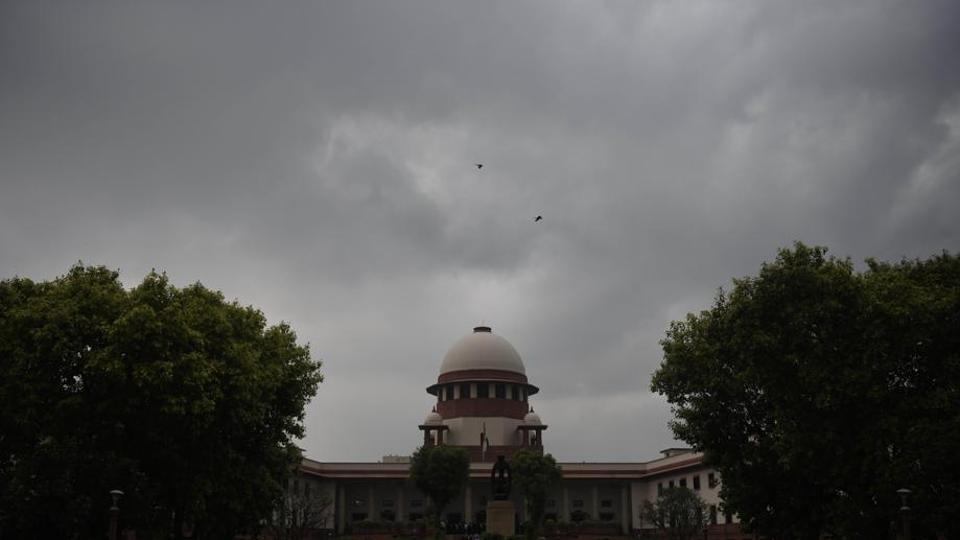
It may not be accepted as a proposition of law that the boundaries of a state cannot be reorganised during President’s rule, a Constitution bench of the Supreme Court observed on Wednesday, adding that the Constitution authorises the President to put on hold any constitutional provision relating to any authority in the state.
Responding to an argument that Jammu and Kashmir could not have been reduced to two Union territories during the President’s rule nor could Article 370 be abrogated since such a power was available only with the J&K legislative assembly, the Constitution bench responded that the contention was too broad and wide to gain acceptance.
“Such a broad proposition with regard to articles 3 and 4 may not be correct in terms of the language used in Article 356(1)(c)...Suppose there are disputes between two states which are impossible to resolve and then the Centre steps in with regard to boundaries or something...So, if you are making a broad proposition like that, it is very difficult to accept,” said the bench, led by Chief Justice of India Dhananjaya Y Chandrachud.
The bench, which included justices Sanjay Kishan Kaul, Sanjiv Khanna, BR Gavai and Surya Kant, added that there are myriad situations which cannot be defined and therefore, circumscribing the powers of the President with respect to altering the boundaries of a state may not be an acceptable argument in law.
Article 356 envisages issuance of a presidential proclamation in case of failure of constitutional machinery in a state while Article 356(1)(c) provides that the President can make such incidental and consequential provisions, necessary or desirable for giving effect to the objects of the proclamation, including provisions for suspending in whole or in part the operation of any provisions of the Constitution relating to any body or authority in the state.
Representing Jammu and Kashmir People’s Conference in a batch of petitions that have challenged the August 2019 nullification of Article 370 and division of J&K into two UTs, senior counsel Rajeev Dhavan argued that it was beyond the power of the President to suspend the requirement of obtaining the views of a state before ratifying the reorgnisation of the erstwhile state. Article 3 requires the President to refer a reorgnisation bill to the state legislature for conveying its views. Article 4 holds that no law framed under Article 3 shall be deemed to be an amendment of the Constitution.
According to Dhavan, the President cannot assume the “non law-making powers, such as providing views or consent” and that powers to effectuate permanent changes in the character of a state cannot be transferred during a proclamation under Article 356 which, by its very nature, is temporary and emergent.
“The object of Article 356 is to maintain the form of the Constitution and protect the constitutional machinery in the state. Under the garb of protecting the constitutional machinery in the state. Parliament cannot eliminate the state itself and derogate a federal unit,” he said.
But the bench asked Dhavan if such a restriction could be located within the Constitution which, it said, in fact authorises the President to declare that the powers of the legislature of the state shall be exercisable by Parliament, besides suspending any provision of the Constitution to effectuate the proclamation.
It pointed out that Article 356 further lays down that the President shall not assume the powers of a high court whereas there are no other restrictions enumerated under the Constitution on the exercise of her powers.
“The proviso seems to indicate that if the constitution wanted to exclude a power from the authority to suspend a provision of the constitution, that has been specifically defined. So, where it wanted to restraint, it did so. How do we now say that there will be other restraints on his power?” it asked Dhavan.
Dhavan concluded his submissions on the sixth day of the arguments in the matter, urging the bench to restore the statehood of J&K and order a fresh assembly election.
On behalf of another petitioner, senior advocate Dushyant Dave opened his arguments, contending that the only way open for the Centre to remove Article 370 was to amend the Constitution which would be a long-drawn process requiring two-third majority in both houses of Parliament and concurrence of state legislatures. The arguments will continue on Thursday.
A raft of petitions, filed by parliamentarians from the National Conference party, Kashmiri citizens, former bureaucrats and various organisations laid the challenge to the abrogation of Article 370 soon after the presidential order in August 2019.
While some petitioners brought up the requirement of consent from the Constituent Assembly for the abrogation of Article 370, others questioned the validity of the President’s Rule that was in effect when the abrogation was made. A few of these pleas went back to the Instrument of Accession, while some highlighted the Supreme Court’s ruling of 2018 that observed that Article 370 had gained a status of permanence. Many of these pleas also challenged the Jammu & Kashmir State Reorganisation Act, by which the state was bifurcated into two Union territories with effect from October 30, 2019.
On August 28, 2019, the Supreme Court issued notices on the pleas despite resistance from the central government, which argued that Article 370 had international and cross-border implications.
On July 3, the Supreme Court notified the setting up of a new Constitution bench, comprising its first five judges. A week later, the new bench directed that day-to-day hearing in the case would begin from August 2.