E-Paper



Number theory: A SWOT analysis of the Congress in Karnataka
Can Congress capture power in Karnataka? Congress has the biggest support base in the state, but its seat share to vote share ratio is the lowest among parties.
Updated on: Jun 11, 2023, 21:34:54 IST


Share via


Copy link

Can the Congress capture power in the Karnataka elections scheduled for May 10? Here are three charts that try to answer this question in a strength-weakness-opportunity-threat (SWOT) framework.
The charts that matter
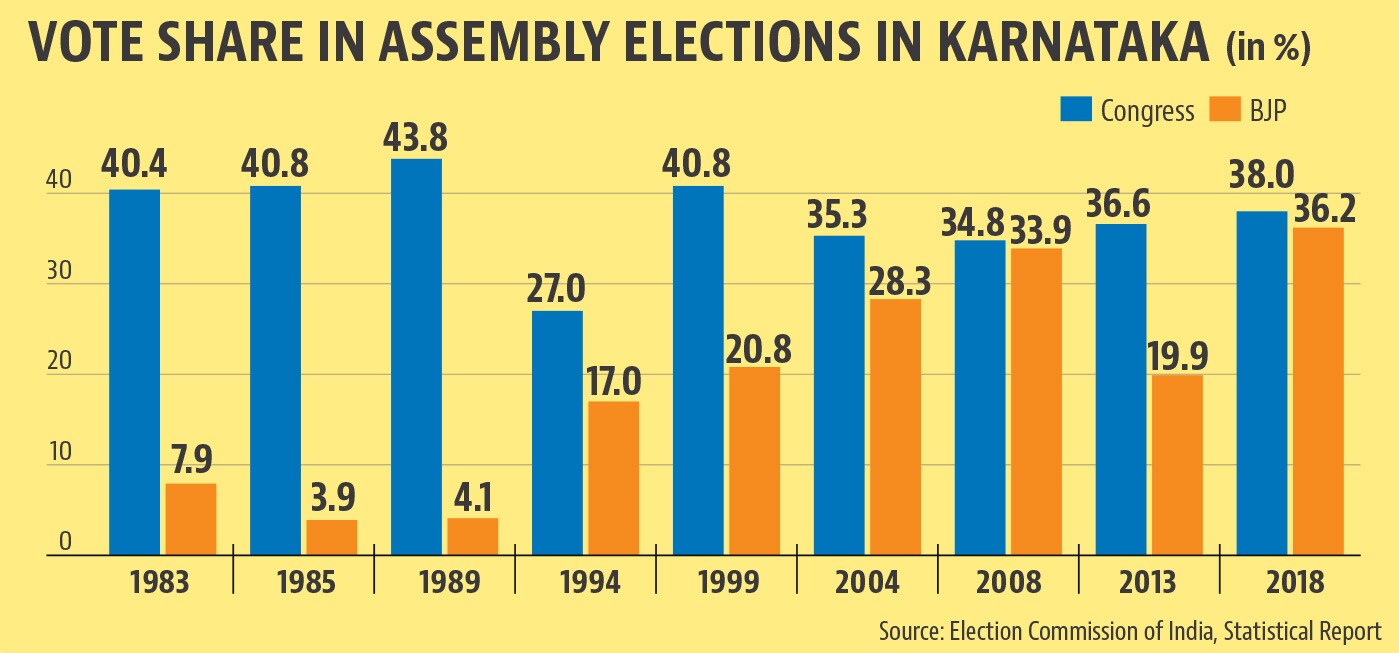
 Strength: Congress has the biggest support base in the stateAt a time when the Congress is facing a shrinking footprint across the country, it can take some solace from the fact that its support base – measured in terms of vote share – has almost always been higher than its competitors in Karnataka. An HT analysis of the past results shows that Congress has had the highest vote share in all assembly elections held in Karnataka except in 1985 and 1994. It is important to note that this includes the 2004, 2008, and 2018 elections when the Congress did not end up as the single largest party in the state. A comparison with the ruling Bhartiya Janata Party (BJP)’s vote share in assembly elections shows that the latter has never had a higher vote share than the Congress in the state.
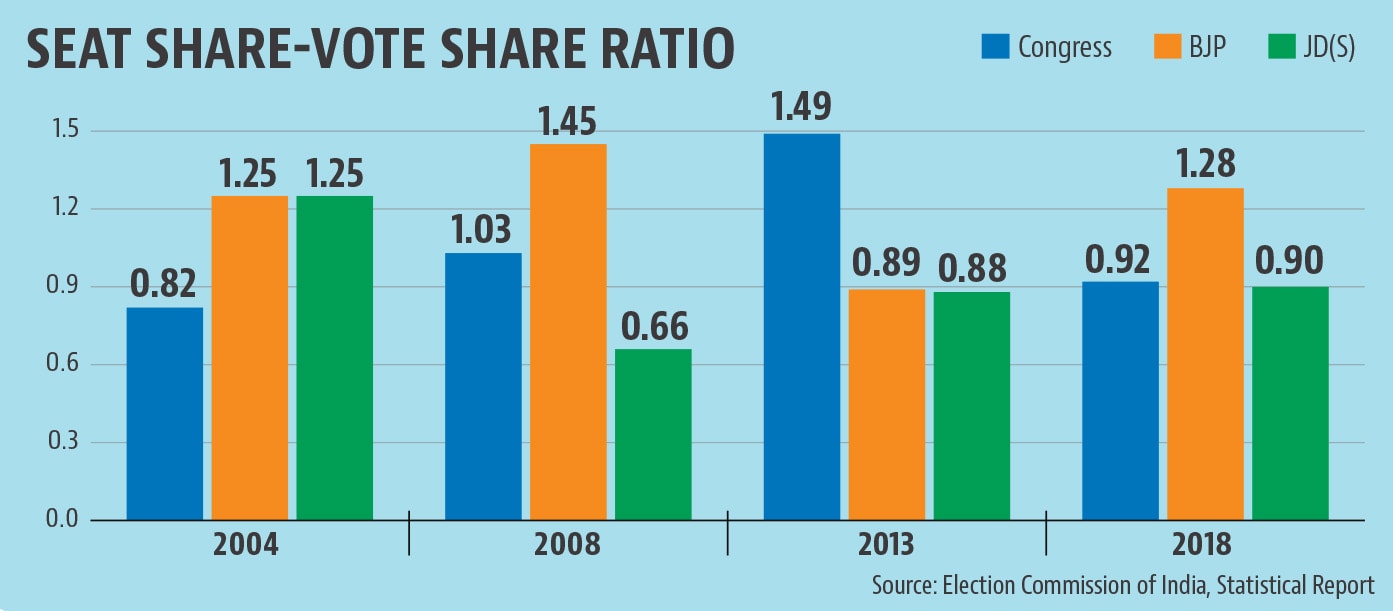
- Weakness: Congress’s seat share to vote share ratio is the lowest among the three major parties in KarnatakaWhile a higher vote share is enough to guarantee power in a proportional voting system, things are different in a first-past-the-post (FPTP) system, where a party’s ability to win elections is contingent on converting its vote share into seat share at the constituency level. Theoretically speaking, it is possible for a party to have a much smaller vote share and end up with a higher seat share if its support base is concentrated in a selected region. A useful metric to measure the ability of the party to convert popular support into seats is the seat share to vote share ratio. A comparison of this number for the past four elections in Karnataka shows that Congress has not fared well on this front except in 2013. This is the biggest weakness of the Congress in the forthcoming elections. The BJP has the highest seat share-vote share ratio during the last four assembly elections, with 2013 as an exception when its seat-vote share ratio was drastically reduced.
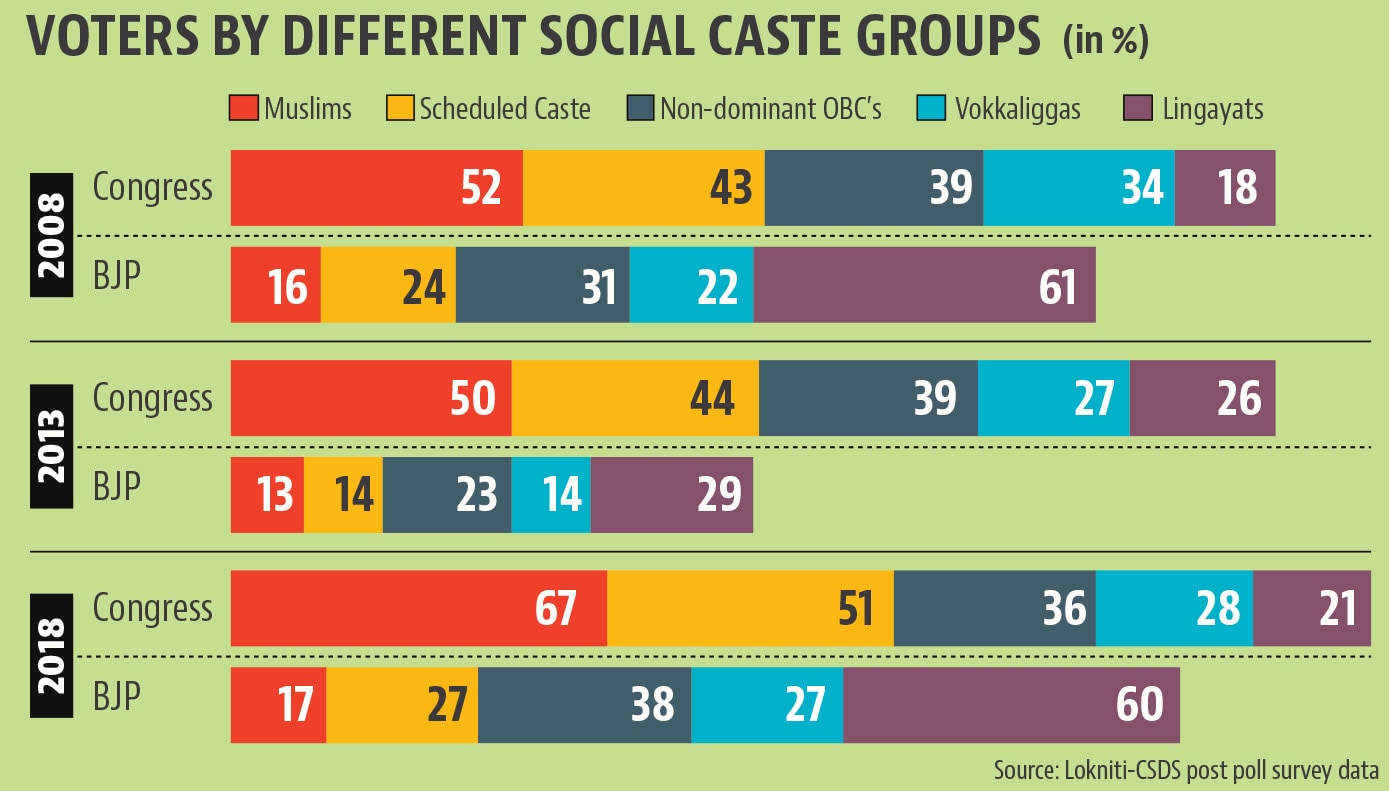
- Opportunity: Will 75% reservation promise expand the traditional vote bank of the Congress?The Congress’s best performance in Karnataka was achieved on the basis of a social coalition called AHINDA under the leadership of Devraj Urs. AHINDA is a Kannada acronym for Alpasankhyataru or minorities, Hindulidavaru or backward classes, and Dalitaru or Dalits. This alliance was also aimed at othering the two dominant castes in Karnataka’s politics, namely Lingayats and Vokkaligas. While the social groups broadly defined as AHINDA are still the biggest support base of the Congress in the state, its primary opponent, the BJP, has closed the gap as far as non-minority constituents of AHINDA are concerned. With the BJP trying to increase its advantage among the state’s two most important social groups by announcing additional reservations for Lingayats and Vokkaligas at the cost of reservations for Muslims – the decision has been stayed for now – the Congress has tried to counter this by announcing proportionate reservations going up to 75% in the state. If the promise gains political momentum, Congress stands to gain the support of additional social groups without compromising its traditional support base.
- Threat: Will a post-poll discord undo Congress’s gainsThe Congress has managed to form governments in Punjab, Rajasthan, Madhya Pradesh, Chhattisgarh and Karnataka in the post-2014 period. But in almost every state, its organisation has been mired in factional fights between state-level leaders. While tensions have not led to the fall of government so far in Rajasthan (Ashok Gehlot versus Sachin Pilot) and Chhattisgarh (Bhupesh Baghel versus TS Singhdeo), the party has lost a government between elections in Madhya Pradesh after Jyotiraditya Scindia walked out of the Congress in 2020, and elections after it replaced chief minister Captain Amarinder Singh with Charanjit Singh Channi before the 2022 Punjab polls. Even in Karnataka, the party has seen competitive factionalism between former chief minister K Siddaramaiah and its state president DK Shivakumar. Given the fact that the Congress has already seen a major defection of 13 MLAs in 2019, which led to a fall of the Congress and Janata Dal (Secular) alliance government, the possibility of discord within the Congress ranks even if the party were to win a majority cannot be ruled out.