
 E-Paper



Take remedial steps on oil spill in Tamil Nadu, pollution body tells CPCL
The Tamil Nadu Pollution Control Board, which is investigating the source of the oil spill, on Tuesday concluded that its source was from the premises of the Chennai Petroleum Corporation Limited (CPCL) in the city’s industrial area in the northern region, Manali

 Prefer HTon Google


The oil spill in Chennai during cyclone Michaung is said to have spread into an area of 20 sq km entering homes and reaching the sea, four times of the initial estimate submitted by the state to the National Green Tribunal (NGT), according to locals and experts.
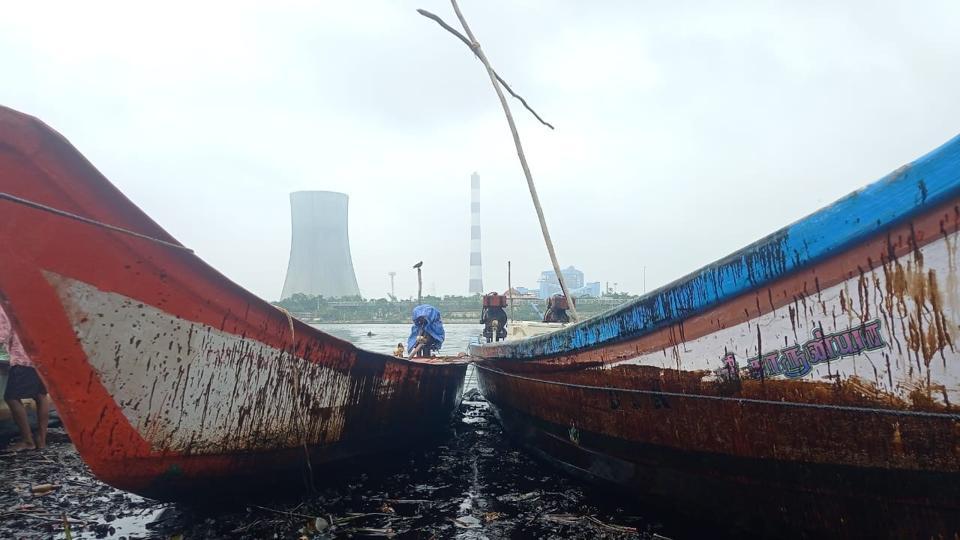
The Tamil Nadu Pollution Control Board, which is investigating the source of the oil spill, on Tuesday concluded that its source was from the premises of the Chennai Petroleum Corporation Limited (CPCL) in the city’s industrial area in the northern region, Manali.
“The team has also noted inadequate storm water management issues in CPCL premises,” the pollution board said in its report, directing CPCL to take remedial measures on “war footing”.
The spread of the oil spill has affected hundreds of families, their livelihood which is dependent on the coastal habitat, biodiversity and aquatic life. The NGT which took up the case suo moto in its hearing on December 12 directed the state to compensate for the loss of livelihood.
Local fishermen first noticed oil coming out of the premises the day the cyclone struck on December 4 bringing torrential rains that submerged the city. The CPCL denied leakage in their premises. It still remains unclear how the oil mixed with flood water and came out of the premises. The pollution control board which was tasked to ascertain the cause has only reported that the oil spillage happened from CPCL and spread into the Buckingham Canal (running through the north and south of Chennai) reaching the Ennore Creek, according to report released by the department.
After conducting a recce on December 9 and 10, the Indian Coast Guard found that the oil spill had extended at sea from the mouth of the Kosasthalaiyar river up to the fishing harbour Kasimedu, which is a rocky beach. “...the spilt oil continued its way, engulfed the city drains, Ennore creeks and entire coastal sea area through Kosasthalaiyar river mouth,” the Coast Guard said in a statement.
While the Coast Guard’s ships and helicopter said that they undertook extensive response operations on December 10 and “averted a major damage to the delicate coastal ecosystem”, the state is using its manpower and machinery to remove the trapped and floating oil from the canal, creek and land.The state has roped in agencies who manage oil spills and deployed three gully sucker machines and oil controlling booms in the Ennore Creek area which will absorb the floating oil. Specialised oil cleaning agencies have been mobilised to remove oil debris from affected areas. “A coordination centre has been set up by the Environment and Climate Change and Forest Department at Nattukuppam village to coordinate mitigation activities,” a statement from the department said. The department has also done a rapid assessment of biodiversity loss in the region. “The oil will be disposed of at a licensed unit for storing hazardous waste,” a government official said.
Environmental activists said the response system has been too slow. “Immediate steps have not been taken in such a big disaster. The cleaning process started today,” said Prabhakaran Veeraarasu, environment engineer of NGO, Poovulagin Nanbargal. “First, they should have shifted the affected people to another locality. They have been exposed for seven days to a hazardous substance. But we still do not know if it is unprocessed crude oil, spent fuel, if some other chemical has mixed with the oil and what its harmful effects can be.”
Affected people in the locality such as in Nattukuppam of low-income families said that they have respiratory issues, fever, skin allergies for which the Greater Chennai Corporation has organised medical camps.
S Murugan, a 6-feet tall driver, says that the flood water inside his home was above his height. He moved with his family to a government relief shelter and when he came back home two days after the cyclone to retrieve some essentials, he found that there was oil mixed with flood water. Families living 1,500 homes in this locality face the same hazard.
“All my belongings, vehicles, documents are destroyed by the oil,” says Murugan. But more dearly for him the oil has destroyed son’s class 10 school books. The government has given them rice, water to drink and bathe. “The government has started cleaning our houses today. The stench of the oil mixed with bleaching powder is nauseating,” he said.
Officials belonging to the pollution control board, departments of health, environment, animal husbandry, dairying, fisheries, disaster management are at the sites to monitor the mitigation works. Tamil Nadu’s Oil Spill Crisis Management Group which was constituted earlier in May held a meeting on Monday night and are currently assessing the biodiversity loss and impact of the oil spill. Chief secretary Shiv Das Meena reviewed areas of the oil spill following which a technical committee was formed on December 11 including members of the state, experts from Anna University, National Environmental Engineering Research Institute (NEERI), Central Pollution Control Board (CPCB)and the Coast Guard, a statement from the government said. Chennai collector and the corporation are enumerating the affected families and fishermen. “Senior officials are undertaking immediate mitigation measures and providing relief to affected families including fishermen. A team of doctors including dermatologists are providing treatment,” a government official said. The pollution control board has given seven instructions to CPCL which includes mapping the oil spread with the help of a technical institution and submit an action plan immediately and a warning that if CPCL is found to discharge oil containing water or polluted water against the norms under the Water (Prevention and Control of Pollution) Act, 1974, their operations are liable to be suspended.
President of the Kattukuppam Fishermen Cooperative, R L Srinivasan filed a petition in the NGT armed with photos of dead fish and animals. “It’s a big loss,” Srinivasan said. He claimed that the CPCL deliberately let out waste oil while pumping out excessive storm water from their premises. “Because it’s not the first time that oil has leaked from their premises. We have conducted several protests about this problem over the years,” says Srinivasan.
A CPCL official who did not wish to be named maintained that they have found no leakages in their pipelines and refinery. Due to unprecedented flooding, they suspect that reverse flow of storm water may have led to slippage of oil traces into Buckingham Canal.
“We are clearing the spillage at the earliest now as ordered by the state and the NGT,” the official said. “That’s our focus now.”
The current disaster is worse than the oil spill which occurred in Ennore in 2017 when two ships collided at sea, said Prabhakaran. “Marine life was affected in 2017 but this time it has also entered people’s homes,” he said, adding that dense oil is still present along the Kosasthalaiyar river and Ennore creek.
Naturalist Yuvan Aves said that despite Ennore being a highly abused landscape with 37 industries including the CPCL, there is fertility and richness here with migratory birds and near threatened species. “An oil spill is a lingering problem. The impact of any pollutant that is hydrophobic takes years and years to go away,” says Yuvan.
There are at least 50-species of birds including migratory and near-threatened such as Spot-billed Pelican, Whiskered Tern, Painted Stork in large numbers here. “You find the white bellied sea eagle nesting here for years,” says Yuvan. The oil spill is particularly lethal for birds who were affected in huge numbers even in 2017. “A bird dipped in oil is finished,” says Yuvan. “Bird feathers have a cuticle layer on them which makes them waterproof. That cuticle layer is soluble in hydrophobic substances like oil. So when a cormorant (medium to large birds) gets in contact with this, it cannot go into water again. They will drench and drown. An impact assessment on biodiversity and the local communities must be done.”
The most important hydrological system and a large flood draining system in Chennai is the Ennore-Pulicat wetlands spanning 8000 acres, he adds. The coastal economy is largely driven by prawns, he says adding that the confluence of habitats here have the richest oyster reefs, and algal beds which are important for the reproduction of prawns- which have a split life cycle at sea and in coastal wetland.


