
 E-Paper



Talks with China to continue for resolving border issues: Rajnath Singh
Military commanders of both countries concluded the 21st round of talks on February 19, during which they agreed to continue the military dialogue.

 Prefer HTon Google


Defence minister Rajnath Singh on Tuesday said that the ongoing negotiations with China will continue for a peaceful resolution on outstanding issues along the Line of Actual Control (LAC) in eastern Ladakh, even as Indian troops stand firm along the country’s northern borders.
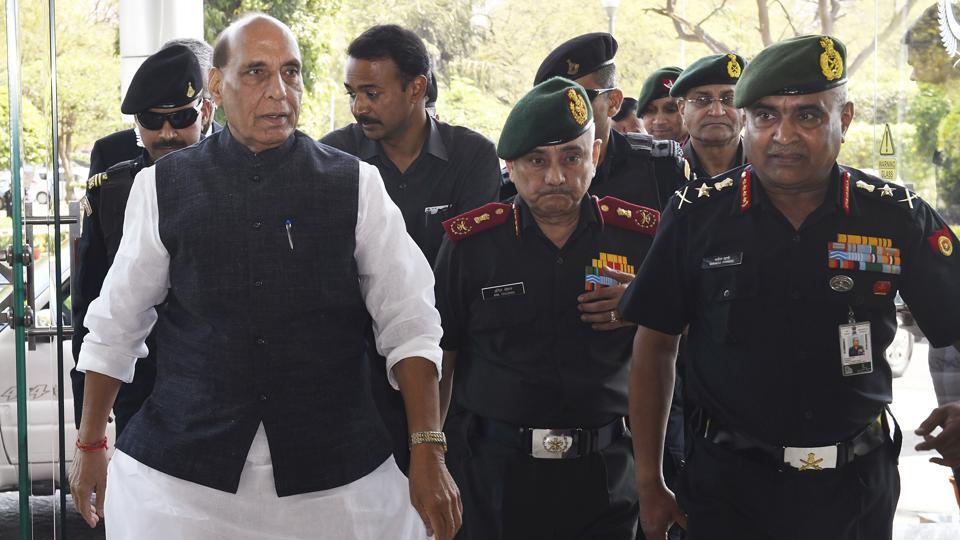
“Disengagement and de-escalation are the way forward,” he said while addressing the country’s top generals at the bi-annual Army Commanders’ Conference.
Singh recently celebrated Holi with soldiers deployed in Leh and called Ladakh the country’s “capital of valour and bravery”, his description of the Union Territory drawing attention to the Indian Army’s role in guarding India’s farthest frontiers. Militaries of India and China have been locked in a dragging standoff for almost four years in the region.
Read: India, China hold another round of diplomatic talks on border standoff
Military commanders of both countries concluded the 21st round of talks on February 19, 2024, during which they agreed to continue the military dialogue and maintain peace along LAC; there was no immediate breakthrough.
Despite four rounds of disengagement from Galwan Valley, Pangong Tso, Gogra (PP-17A) and Hot Springs (PP-15), Indian and Chinese armies still have tens of thousands of troops each, and advanced weaponry, deployed in the Ladakh theatre. Problems at Depsang and Demchok are still on the negotiating table.
Singh also complimented the Border Roads Organisation (BRO) for “quantum improvement of road communication” in the country’s forward areas.
Read: Rajnath Singh to head BJP manifesto committee
In March, Prime Minister Narendra Modi dedicated to the nation the Sela tunnel (built by BRO) in Arunachal Pradesh, the infrastructure upgrade putting in the fast lane military mobility and logistics support for forces deployed in the strategic Tawang sector, where Indian soldiers hold posts close to the contested border with China.
BRO has completed 330 infrastructure projects at a cost of ₹8,737 crore in the last three years, and significantly improved the strategic mobility of the Indian armed forces along the border with China, as previously reported by HT.
Referring to the situation along the western borders with Pakistan, Singh complimented the Indian Army’s response to cross-border terrorism, while stressing that proxy war by India’s adversary continues.
“I compliment the excellent synergy between the CAPF/police forces and the army in tackling the menace of terrorism in Jammu and Kashmir. The synergised operations in the Union Territory of Jammu and Kashmir are contributing to increased stability in the region and the same should continue.”
Read: It will be Rajnath vs Ravidas in Lucknow going to polls on May 20
During the conference on Tuesday, the army top brass deliberated upon all aspects of the existing security scenario, situation along the borders and in the hinterland, and challenges for the present security apparatus, the army said in a statement.
“In addition, the conference also focused on issues pertaining to organisational restructuring, logistics, administration, human resource management, modernisation through indigenisation, induction of niche technologies and assessment of impact of the various existing global situations,” it said.
In his address, Singh also touched upon the complex global situation that affected everyone.
“Unconventional and asymmetric warfare, including hybrid war, will be part of future conventional wars. Cyber, information, communication, trade and finance have all become an inseparable part of future conflicts. The armed forces will have to keep all these facets in consideration while planning and formulating strategies,” he added.


