
 E-Paper



Telangana police, now under Cong, says Vemula ‘not a Dalit’
The family said that it will meet CM Reddy over the weekend, & seek an appointment with Rahul Gandhi, who has repeatedly expressed his solidarity with Vemulas.

 Prefer HTon Google


University of Hyderabad doctoral student Rohith Vemula, whose suicide in 2016 sparked a nationwide movement on caste discrimination, was not Dalit and died because he was “feeling frustrated” and over constant fears that his real caste identity would be discovered, the Telangana Police told the high court on Friday, declaring its investigation closed.
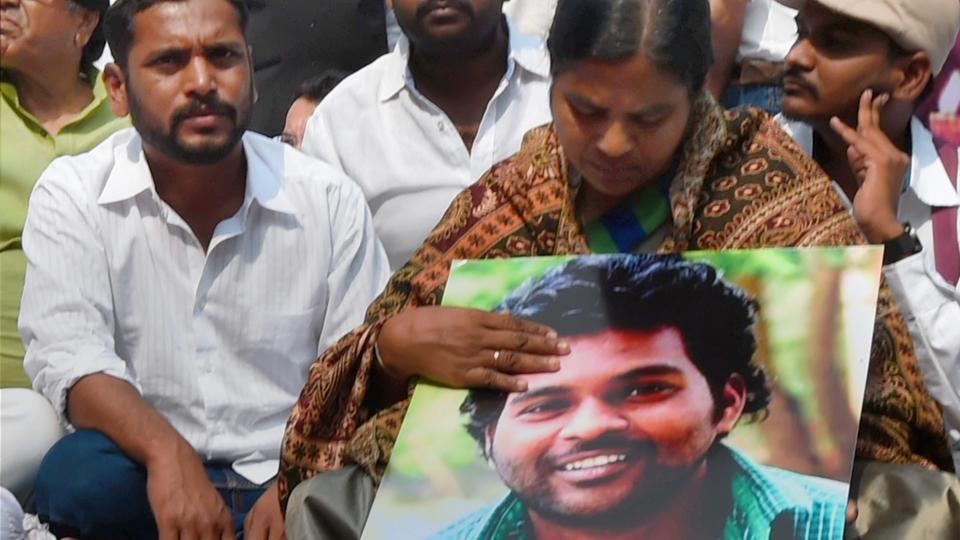
The 60-page closure report sparked a controversy, prompting the state police to announce late in the night that it would seek the court’s permission for further investigation in the case.
The report, signed by assistant commissioner of police CH Sreekanth, also cleared a host of accused – ranging from then vice-chancellor Appa Rao Podile, then Secunderabad MP Bandaru Dattatreya, university administration and leaders from the Bharatiya Janata Party and Akhil Bharatiya Vidyarthi Parishad – of all charges, citing lack of evidence.
The Telangana government is now run by the Congress, which publicly stood by the Vemula family as protests raged in 2016 with senior leader Rahul Gandhi even walking with Vemula’s mother Radhika during his Bharat Jodo Yatra in 2022.
ALSO READ | Hyderabad university students burn Roopanwal Commission report on Rohith Vemula
“The deceased himself is aware that he does not belong to scheduled caste and his mother got him SC certificate. This could be one of the constant fears as the exposure [of] the same would put him to loss of his academic degrees that he earned over the years and be compelled to face prosecution,” said the report, which HT has seen.
“Despite best efforts, no evidence could be found to establish that the actions of the accused have driven the deceased to commit suicide,” the report added.
The police closed the case registered under section 306 (abetment of suicide) and various sections of the Scheduled Caste and Scheduled Tribe (Prevention of Atrocities) Act, because it said Vemula was not Dalit.
Late in the evening, the state director general of police issued a statement, saying that the final report in the case was prepared in 2018 and filed in the jurisdictional court on March 21.
“As some doubts have been expressed by the mother and others of the deceased Rohith Vemula on the investigation conducted, it has been decided to conduct further investigation into the case. A petition will be filed in the court concerned requesting the hon’ble magistrate to permit further investigation into the case,” the statement added.
PhD student Vemula’s suicide in January 2016 at the University of Hyderbad campus sparked a nationwide movement on caste discrimination in educational institutions, especially after his fellow students alleged that he battled months of caste bias by university administration. His last letter, which spoke of the “accident” of his birth and his dreams, helped kindle a pan-Indian conversation against pernicious casteism and the ecosystem that incubates discrimination.
ALSO READ | Rohith Vemula not a Dalit, says collector; Andhra govt to cancel SC certificate
“We are disappointed but won’t give up. The police is focussed more on our caste than on finding out what was behind the death of my brother. This is a nexus and we shall fight this in court. We’ll file a petition soon,” said Raja Vemula, Vemula’s brother.
He also dismissed the police allegation that they had fraudulently obtained SC certificates.
The family said that it will meet chief minister Revanth Reddy over the weekend, and seek an appointment with Rahul Gandhi, who has repeatedly expressed his solidarity with the Vemulas and blamed the Bharatiya Janata Party for the death. “They say Rohit Vemula committed suicide. I call it murder. He was murdered by the indignities he suffered. He was killed because he was a Dalit,” Gandhi tweeted in 2017.
The Congress appeared to be caught in a bind. Telangana Congress vice-president G Niranjan said there was no change in the party’s stance. “Our party will stand by the family and whatever best it can do to secure justice to them, it will do. The party is also committed to bring the necessary legislation, as promised, to prevent atrocities on Dalits and other weaker sections in the educational institutions,” Niranjan said.
CH Sreekanth refused to elaborate on the reasons behind the closure report. “The unit officers have investigated the case. I cannot speak more because of the election code,” he said.
Senior BJP leader and ex-state legislative council member N Ramchander Rao, who was named as one of the accused in the case, said the police had closed the case after thorough investigation and finding that there was no merit in the allegations.
“Right from the beginning, I have been telling that I have absolutely no connection whatsoever with the suicide of Rohit Vemula. The Congress party, the ultra-leftists and so-called social activists made a hue and cry only to politicise it,” Rao said.
The police report attempted to establish in detail that the Vemula family was not Dalit, alleging that the district-level scrutiny committee in Andhra Pradesh’s Guntur district, where the Vemula family hails from, had found that the SC certificates of Rohith Vemula, his mother Radhika Vemula and his other siblings were found to have been fraudulently obtained.
“This report conclusively decided the caste of the deceased Vemula Rohith Chakravarthy and his family members as Vaddera falling under BC (backward class)-A category and it was found that they had obtained SC caste certificates fraudulently,” the report said.
This is in line with the initial line of inquiry of the police in 2016 and 2017. But Raja Vemula said that the police had not considered a number of witness statements submitted by the family to the district collector, who is the final adjudicator of caste certification. “How can the district committee give a final decision when the proceedings before the collector are pending? It seems part of a nexus to deny caste discrimination,” he said.
The police also cited a previous government commission report to say that the punishment given by the university authorities to the Dalit students could not have been a reason behind the suicide as this had been challenged it in court.
“The suicide did not relate to any activities of the university administration or the above political leaders including vice-chancellor professor Appa Rao Podile. It was wholly a decision of his own…he was feeling frustrated for reasons best known to him,” said the report.
The police said had Vemula been angry with the university, he would have mentioned it in his final letter, but did not do so, indicating that the circumstances in the campus were not responsible for his death.
The police admitted that he wrote a letter in December 2015 to the university authorities against his own expulsion and that of fellow students – in that document, he asked the vice-chancellor to give Dalit students poison since there was pervasive discrimination against them – but concluded that the suicide came a month later, and that his anger didn’t continue till then.
“There is no evidence of any fact or circumstance available on record which dragged him to commit suicide and no one is responsible for his death,” the police concluded.
Student organisations condemned the report and said the police had resorted to falsehoods to twist Vemula’s caste identity. “We do not want any favour to be done, rather we only appeal for a fair and unbiased investigation…We shall fight until justice is achieved,” said the Ambedkar Students Association, of which Vemula was a prominent member.


