
 E-Paper



Terms Of Trade: World’s caught in a Catch-22 situation between Trump and US
Trump’s Iran war decision exposes a collapsing world order as US power, global stability and the Strait of Hormuz face mounting economic, geopolitical risks

 Prefer HTon Google


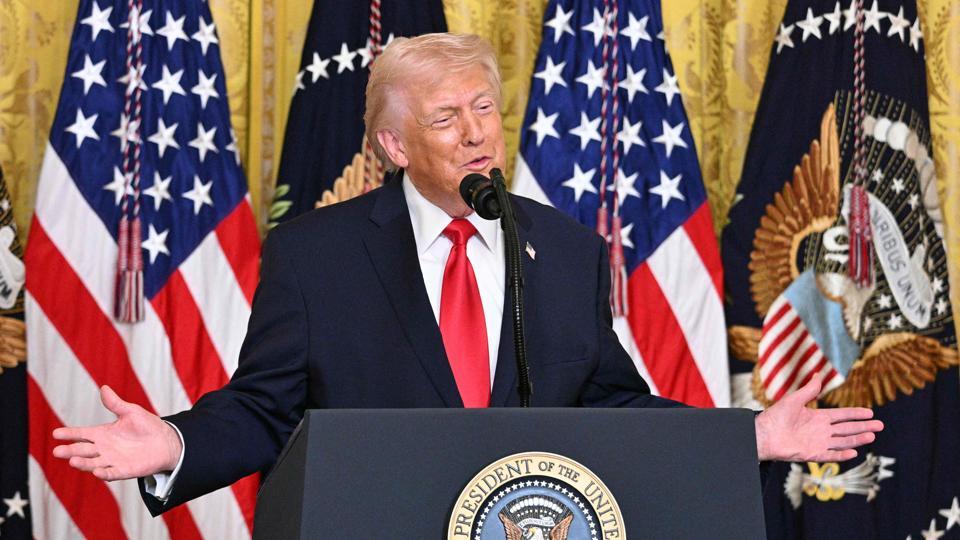
The world, before February 28—when the US and Israel decided to attack Iran and inflicted the biggest ever oil shock in the history of capitalism—was obsessed with AI model hallucinations. In the two weeks following that, debate increasingly centres on whether our near-term future depends on the hallucinations of one person who has brought the world to its current predicament: US President Donald Trump. His statements on the origins and future direction of the ongoing conflict have swung so wildly—sometimes simultaneously—that someone on X (formerly Twitter) joked that the new left leaning mayor of New York might have taught dialectics to Trump. The joke would be funny if the economic and human costs of the war were not so high, especially the former for countries and people uninvolved in starting the current conflict.
Where does this leave the rest of the world and what some starry-eyed folks still like to call the world order? Let us begin with the most obvious answer.
There is no world order right now. Trump not only completely bypassed existing international and even U.S. rules to launch the war, but he also, most likely, ignored U.S. intelligence regarding not just Iran but also U.S. capabilities, such as munition inventories before entering the conflict. Trump’s latest admission suggests his son-in-law’s input mattered most in his decision to launch the war. The only country which can perhaps claim to have violated more international laws than Trump has recently is Israel in the aftermath of the unequivocally barbaric attacks by Hamas on innocent Israeli citizens. There is a growing consensus among foreign policy observers that US’s policy today is the proverbial dog which is being wagged by its Israeli tail.
To be sure, Trump is not the only US president who has bypassed international rules to launch a war. But he might very well be the first to drag it in a war where the US is, in a way, doing exactly what the last GOP president before Trump, George W Bush Junior warned against. “I’m not going to fire a $2 million missile at a $10 empty tent and hit a camel in the butt”, Bush had said after he attacked Afghanistan to avenge the 9/11 attacks on the US. Trump today is firing missiles worth billions of dollars to intercept Iranian drones worth a few thousand dollars. It is no wonder the latter keep coming and the US is increasingly running out of the former and even having to redeploy them from other important geopolitical theatres, as was described in detail in this Bloomberg story.
Some would say that Trump should never even have engaged with such a decision in the first place. He was, after all, the darling of the MAGA coalition, which has been vocally against any outside military intervention by the US. Well, it turns out, this narrative might have just been a narrative rather than reality. The Economist published a survey of 14,000 Republican voters in August 2025 which should have disabused us about MAGA being an effective impediment to military misadventures by Trump. Only 10% of the Republican voters were “isolationists” when it came to foreign policy. They were in fact the smallest coherent group among the top five which also included, in descending order of importance, (very rich) culture warriors (30%), economic populists (26%), neocons (20%) and moderates (14%).
To be sure, there is good reason to believe that Trump would not commit to a US engagement in terms of deploying American military in Iran unlike his predecessors in Iraq and Afghanistan to avoid a political backlash. This might be good news for American soldiers and their families but it is definitely bad news for the world as Iran, the adjoining region, and the critical chokepoint of Strait of Hormuz, could descend into even more chaos than it is in right now.
Why is Trump doing what he is doing? Evidence suggests the economic costs of war are generating widespread anxiety among his allies vis-à-vis prospects in the forthcoming mid-term polls in the US scheduled for later this year. The story was not very different when he imposed tariffs too. Most people saw them feeding into inflation.
By now, it is clear that Trump’s policies do not have any larger or consistent objectives and he is essentially a man with a reverse Midas touch destroying things he comes across. What really explains this attitude from a politician who has shown remarkable political capabilities and resilience in the last ten years?
This question is best answered in a political economy treatise by Karl Marx published in 1852 which explained the coup d’état of 1851 in France where the then president (and nephew of Napoleon Bonaparte) Louis-Napoléon Bonaparte dissolved the national assembly and re-established monarchy in France. “The class struggle in France created circumstances and relationships that made it possible for a grotesque mediocrity to play a hero’s part”, Marx writes in his preface to the second edition of The Eighteenth Brumaire of Louis Bonaparte. “Driven by the contradictory demands of his situation, and being at the same time, like a juggler, under the necessity of keeping the public gaze on himself, as Napoleon’s successor, by springing constant surprises – that is to say, under the necessity of arranging a coup d’état in miniature every day – Bonaparte throws the whole bourgeois economy into confusion, violates everything that seemed inviolable to the Revolution of 1848, makes some tolerant of revolution and makes others lust for it, and produces anarchy in the name of order, while at the same time stripping the entire state machinery of its halo, profaning it and making it at once loathsome and ridiculous”, Marx writes about the conduct of Louis-Napoléon Bonaparte. The similarity to Trump and what he doing is as striking as it gets.
It is no wonder that Trump’s political ascent in the US comes at a time when the country is more polarised than ever and Trump’s support base is an extremely diverse in class terms. The point being, the root of Trump’s political irrationality is not to be found inside his mind but in the political milieu in which he has taken over. The US is a declining power, deeply polarized and also under growing (crippling according to some) debt. An overwhelming majority of the mainstream leadership tried to bury the contradictions under the carpet of politics.
Where does this leave the rest of the world? Capitalism in its present form has created a condition where an overwhelming majority is struggling to make their ends meet while a small privileged minority continues to amass fortunes at an unprecedented level. Democracies, from the US to Europe and to some extent, also in India, are struggling to maintain peace through acts of fiscal jugglery which is increasingly becoming more difficult. While there is an occasional outburst of restoring order by “middle-powers” etc. nobody in the world is willing to decouple from the US led economic order yet. Any such readjustment will not happen without significant disruption to the world as we know it, especially for comparable powers to the US such as China which is still heavily invested in exporting to the US.
Until a new contender emerges to reshape the world, it’ll continue to be in a catch-22 situation where Trump will keep destabilising it while it looks forward to the US for stability.
(Roshan Kishore, HT’s Data and Political Economy Editor, writes a weekly column on the state of the country’s economy and its political fall out, and vice-versa)


