
 E-Paper



T’gana: Panel cites low payment for ‘poor’ mid-day meal
Following a series of food poisoning incidents in various government schools in the state, the Telangana education commission headed by retired IAS officer Akunuri Murali made an extensive study of the conditions prevailing in the schools in the implementation of the mid-day meals scheme.


Hyderabad The Telangana government, which has substantially enhanced the mess charges being paid to students of residential schools and welfare hostels by 40% since November 1 resulting in improved diet for them, has started taking measures to improve the quality of food being provided to students under the mid-day meal scheme in the state-run schools across the state, officials familiar with the matter said.
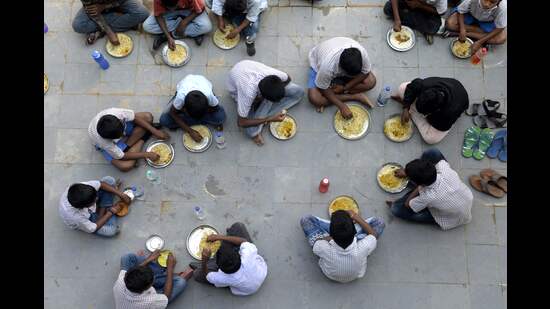
Following a series of food poisoning incidents in various government schools in the state, the Telangana education commission headed by retired IAS officer Akunuri Murali made an extensive study of the conditions prevailing in the schools in the implementation of the mid-day meals scheme.
The commission, comprising senior academics, toured all the districts and inspected government schools, Kasurba Gandhi Balika Vidyalayas and residential schools and completed its study on December 8. They interacted with students and identified problems in the implementation of the mid-day meals scheme, which covers 2,036,000 students across 26,519 government schools in the state.
“The committee is expected to submit a report to the government this week along with its recommendations,” an official in the school education department, who preferred anonymity, said.
The commission has apparently observed that one of the main reasons for poor quality of food being provided to students under mid-day meal scheme was the low payments being made to the women cooking agencies, also referred to as cooking-cum-helper (CCH), belonging to local self-help groups.
For each student, the government pays ₹6.19 per student belonging to Class 1 to 5 and ₹9.29 per student for Class 6-10. While the Central government gives 60% of the expenditure incurred on students up to Class 8 under PM Poshan programme, the state government is bearing the entire expenditure for Classes 9 and 10.
“Within this paltry money, the CCH will have to bear the expenditure for cooking gas, vegetables and provisions including dal and oil and other ingredients. The government supplies rice free of cost, besides cooking utensils,” the official said.
The government will also pay for the cost of eggs, to be provided to students thrice a week. “But the government pays only ₹5 per egg, while the market price is around ₹7. As a result, in most schools, the students are given eggs only twice a week,” he said.
The commission observed that inordinate delay in payments to the women agencies is also yet another reason for the poor implementation of the mid-day meal scheme. While the per-student cost of the scheme itself was meagre, the government has been delaying payments to the women agencies – some times three to four months.
“These women belong to economically weaker sections. Due to delayed payments, they rely on borrowing to procure cooking supplies. This is affecting the implementation of the scheme,” the official said, adding that the committee is going to recommend to the government to increase the payments for eggs and ensure timely payment of bills to the women cooking agencies.
The commission also felt the need to improve monitoring of cooking practices by these women agencies. “Many schools lack proper kitchens, with cooking done in open spaces or with inadequate facilities, leading to poor hygiene. The schools also lack dining halls, forcing students to eat in dusty open spaces,” the commission observed.
During the interaction with the students, the commission noted issues about quality of rice, improper cooking, and lack of storage facilities which resulted in food contamination incidents. “The school education department has to issue standard operating procedures to address these issues,” the official added.
Apart from the Telangana education commission, the state government also constituted a task force committee on November 28 for ensuring food safety and developing an institutional mechanism to provide quality food to students during the mid-day meal scheme in the day schools and in the residential school and hostel messes.
According to officials familiar with the matter, the task force committee, comprising three members – commissioner of food safety or food safety officer, head of the departments of the concerned institution or additional director and district-level officer of concerned institution - would be visiting and enquire in to all food safety incidents reported in any institution.
The committee will also identify the reasons and fix up the responsibility against the persons and agencies responsible for such incidents and submit a detailed report to the government.
On December 5, the state high court bench comprising chief justice Alok Aradhe and Justice J Srinivas Rao, which heard a public interest litigation (PIL) on the recent incidents of food poisoning in government schools has ordered the state government to submit the reports of the special task force committee within four weeks. The case will be heard after six weeks.


