The budget’s love-hate relationship with inflation
While inflation is seen as a bad for medium-term growth prospects, high inflation periods often bring a windfall gain in revenue as they also give a boost to nominal GDP numbers that serve as the base for tax collections.
Contemporary economic policy sees high inflation as the nemesis of sustainable growth. This is why inflation targeting is the stated objective of monetary policy in most major economies. Even the roots of fiscal conservatism -- it is the cornerstone of rules such as the Fiscal Responsibility and Budgetary Management (FRBM) Act in India -- can be traced back to the aversion to inflation. When a government runs higher deficits and finances them by printing more currency, inflation goes up, says neoliberal economic wisdom. To be sure, like all issues in economics, inflation targeting and fiscal conservatism have their criticis. Even if one were to keep these debates aside, governments, including in India, have a love-hate relationship with inflation, especially when they are doing their fiscal calculations. While inflation is seen as a bad for medium-term growth prospects, high inflation periods often bring a windfall gain in revenue as they also give a boost to nominal GDP numbers that serve as the base for tax collections. With inflation already coming down and expected to moderate even further, the inflationary cushion to revenues might begin to dissipate as well. Here are four charts that explain this argument in detail.
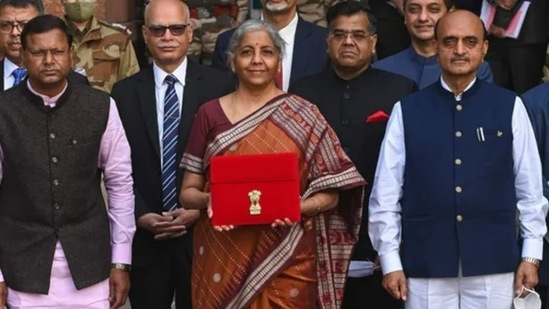
Union finance minister Nirmala Sitharaman during Budget 2022.
Budgetary projections for revenue can deviate both ways
The crux of the budgetary exercise is as follows. The government assumes a nominal GDP growth rate. It then projects tax collections assuming a certain tax-GDP ratio. Spending commitments are financed out of receipts and borrowings. Budget Estimates (BE) for tax collections do not always materialise. A basic look at centre's actual and BE numbers for gross tax revenue shows this clearly. Gross tax revenue exceeded BE numbers for 2021-22 and might exceed the BE numbers for 2022-23 as well.
Accuracy of Budget's tax-GDP ratio shows a high correlation with accuracy of tax projections
What decides whether the tax projections given in a budget will materialise or not? While correlation might not always mean causation, a comparison of tax-GDP ratio and tax collections in the last decade shows that the two are highly correlated. This means that deviation between BE and actual tax collections are likely a result of the error in estimating the tax returns from growth, rather than estimating growth per se. Two examples show why this is the case. The government announced a sharp reduction in corporation tax rates in September 2019. This means that its tax-GDP ratio calculations for this particular tax fell sharply compared to what they were when the 2019-20 Budget was made. Similarly, the imposition of additional duties on petrol-diesel after the pandemic, would have given a boost to the assumed tax-GDP ratio for union excise duties in 2020-21.
But the difference between nominal and real growth keeps changing with inflation levels
To be sure, the Budget projects nominal and not real GDP growth. The projection involves two steps: projecting the real growth rate of the economy and the inflation level for the year ahead. A basic comparison of nominal and real GDP growth shows that the difference between the two is not stable. For example, both in 2021-22 and 2022-23, nominal GDP growth is likely to exceed real GDP growth by a much bigger multiple than what was the case in the pre-pandemic years. This difference - it is referred to as the GDP deflator - is a reflection of change in wholesale price inflation (WPI).
A sharp fall in WPI could lead to a fall in nominal GDP growth in 2023-24 GDP growth
Fiscal years 2021-22 and 2022-23 have been unprecedented in terms of WPI levels if the current WPI series - it has values since April 2012 - is analysed. Quarterly WPI has been in double digits continuously from the quarter ending June 2021 to September 2022. Quarterly WPI had never crossed double-digit levels before the current series. After having stayed at such high levels, WPI has started coming down and it reached 6.5% in the quarter ending December 2022. Almost all analysts expect it to come down further, which has perhaps been factored in the first advanced estimates for GDP. A lower WPI in 2023-24 will mean a lower GDP deflator, which on the back of a lower real GDP growth - the latest World Bank forecasts expects a 0.3 percentage point reduction in it can lead to a significantly low nominal GDP growth. While a lower inflation means a better overall macroeconomic outlook, it is bound to generate headwinds for the revenue projections in the next budget.

 E-Paper