E-Paper



Number Theory: The past, present and aftermath of EWS reservation policy
In a 3-2 verdict, a five-judge constitution bench of the Supreme Court upheld the 103rd constitutional amendment, which gave a 10% reservation for Economically Weaker Sections (EWS) of social groups hitherto not entitled to reservations earlier

 Prefer HTon Google


In a 3-2 verdict, a five-judge constitution bench of the Supreme Court upheld the 103rd constitutional amendment, which gave a 10% reservation for Economically Weaker Sections (EWS) of social groups hitherto not entitled to reservations earlier. Prior to this, only Scheduled Castes (SCs), Scheduled Tribes (STs) and Other Backward Classes (OBCs) were entitled to reservations. It is entirely likely that this judgment will not be the last piece of litigation on the issue. However, it will be naïve to believe that law and constitutional jurisprudence are the only decisive factors when it comes to making policies on the issue of reservation. Here are four charts that try to explain what we know about political attitude to reservations in India.
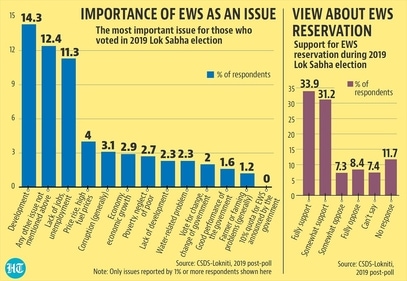
EWS reservation was hardly a game changer for the BJP in 2019, and also had very few opponents
It is important to understand the context in which the Bharatiya Janata Party (BJP)-led government announced EWS reservations in January 2019. The BJP had lost three key state elections (Rajasthan, Madhya Pradesh and Chhattisgarh) in December 2018. National elections were due later in 2019; almost all of 2018 had witnessed significant polarisation along caste-lines. In March 2018, the Supreme Court passed an order, which effectively diluted the Scheduled Castes and Scheduled Tribes (Prevention of Atrocities) Act. This triggered large-scale protests by SC-ST organisations and political parties in the opposition, which turned violent in many places. The union government, in August 2018 brought a law to set aside the Supreme Court judgment, which, in turn, generated some upper caste anger against the BJP in poll-bound states. The EWS law, just as the announcement of the PM-Kisan scheme (to tackle farmers’ anger) was the BJP’s way to do some damage control before the 2019 general elections. However, data from the 2019 CSDS-Lokniti National Election Study (NES) shows that EWS was not a very important issue on the priority list of voters. To be sure, the policy did not trigger a major backlash and almost two-thirds of the respondents supported it. This explains why parliamentary opposition to the amendment was limited, with just the Dravida Munnetra Kazhagam (DMK) and the Rashtriya Janata Dal (RJD) voting against it among major parties. The RJD later backtracked.
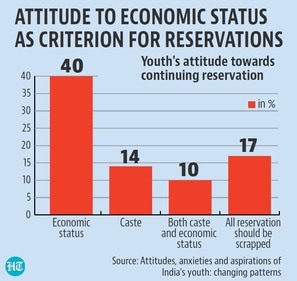
An earlier CSDS survey shows reservation on economic criterion had large support
In 2017, CSDS released a report on the attitudes, anxieties and aspirations of India’s young people. The survey was conducted in 19 states and had more than six thousand respondents of the 14-34 year age-group. The survey shows that opposition to reservations was much bigger among Hindu upper castes (52%) than Hindu OBCs (37%), Hindu STs (33%) and Hindu SCs (19%). Another interesting finding in the survey was that there was large support for using economic status as a criterion for reservation. “Many were found to be in favour of the idea having reservations only on the basis of economic status…This sentiment in favour of the economic criterion was seen among youth across all castes, and communities including those from reservation-beneficiary groups like OBCs (38%) and Dalits (41%),” the report said.
In reality, India has reservations for pretty much everyone now
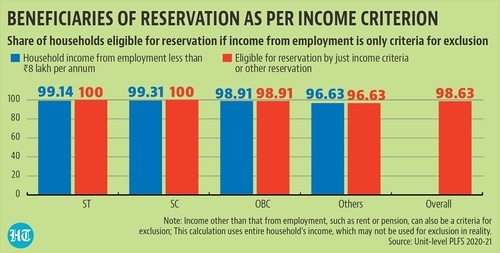
In a way, reservation policy in India has had a strange evolution. The first to benefit were SC-ST groups. OBCs came under the ambit of central government reservations first in 1990 (in jobs) and then in 2006 (in education in central and private institutions of higher learning; some states had enforced this earlier , in the early 1990s in some cases, and even earlier in some others). The 2019 amendment means upper castes, or the poor among them, are also entitled to reservation
A statistical estimation based on just one of the criterion (annual income of less than ₹8 lakh) for EWS reservations shows that a very large part of the country might be included under the prospective list of beneficiaries. While the number of likely to be somewhat smaller once other criterion are included, lack of data does not allow making such estimates.
The irony, however, is that even a near universal reservation coverage is unlikely to end the politics around it. There are two major reasons for this. One, with the number of government jobs coming down increasingly, a lot of groups want to move to a reservation category which they perceive as being less competitive due to larger quota (such as an EWS candidate wanting to move to OBC or even SC/ST category). The second, which is likely to gain momentum after the latest EWS judgment, is an effort by governments to completely do away with the 50% cap on reservations (imposed by the Supreme Court’s Indira Swahney judgment) and make it proportional to share of each social group in population.