E-Paper



The resurrection of ‘coalition of extremes’ in Bihar
The NDA triumphed over the MGB in Bihar, leveraging a coalition of Hindu upper castes and non-Yadav BCs, while Yadav representation declined significantly.

 Prefer HTon Google


The National Democratic Alliance (NDA) has vanquished the Mahagathbandhan (MGB) or Grand Alliance in Bihar. While elections are rarely a univariate phenomenon, caste is often central to politics in India, and perhaps more so in Bihar. This makes it important to look at the election results from the prism of caste in the state. HT will do this by using two databases – caste-wise database of NDA and MGB candidates in these elections and a historic caste database of Bihar’s MLAs from 1962 – prepared by the first author of this story to make this analysis. Here are key takeaways from our analysis based on these two databases.
The ‘subaltern’ engine has powered the NDA’s ‘coalition of extremes’ this time
Nitish Kumar’s political genius and his indispensability lies in the fact that he has managed to bring together Hindu upper castes, non-Yadav Backward Classes (BCs) and Extremely Backward Classes (EBCs) against what was once a formidable Muslim-Yadav or MY coalition of Lalu Yadav. This combine has worked wonders once again in these elections. This is best seen in the caste-breakup of MLAs from the two major alliances in the state. While the MGB has managed to get just 5 and 12 Muslim and Yadav MLAs elected, the number of Hindu upper caste, non-Yadav BCs and EBCs that the NDA has managed to get elected is 70, 50 and 32, respectively. The fact that the number of non-Yadav BCs and EBCs in NDA’s overall bench strength in the new assembly is significantly greater than that of upper castes shows that Nitish’s ‘coalition of extremes’ has achieved a more optimal non-upper caste composition than it could in the 2010 elections, the only one when its victory was of a similar scale as this time.
See Chart 1: Caste break-up of NDA and MGB MLAs
See Chart 2: Caste break-up of NDA MLAs in 2010 and 2025
But the EBCs and non-Yadav BCs have made gains at the cost of Yadavs rather than upper castes
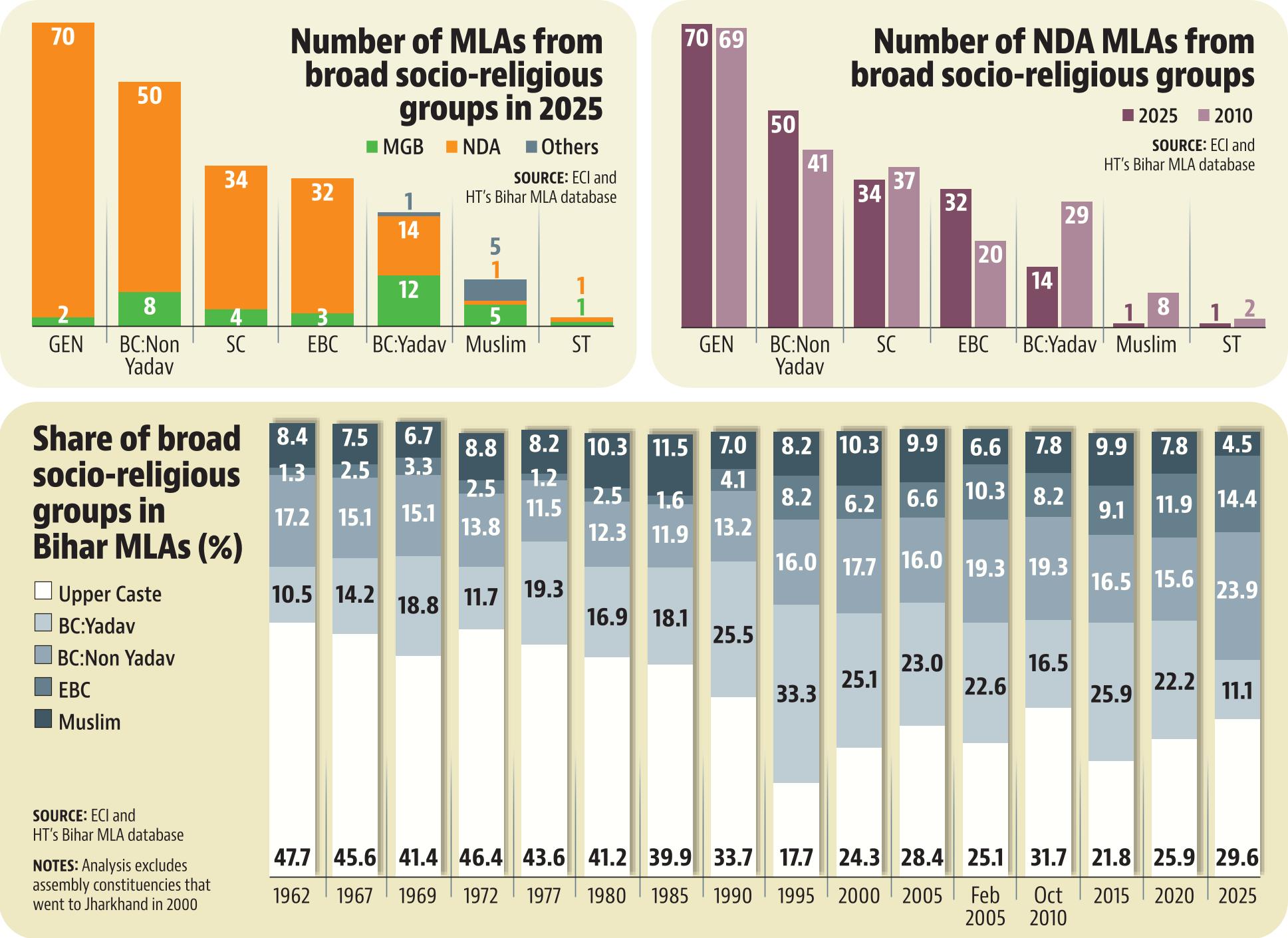
This is the most important part behind the resilience of the ‘coalition of extremes’. While the share of non-Yadav BC and EBC MLAs in Bihar assembly has reached its highest ever level this time, this increase has come at the cost of Yadavs and Muslims rather than upper castes, the other stakeholder in Nitish’s social engineering. The share of Yadav MLAs in Bihar assembly has collapsed to just 27, the second lowest since 1962, the earliest period for which HT’s caste database of Bihar MLAs has this data. What is important is that this collapse is not just because of a poor performance by the Rashtriya Janata Dal (RJD) in the state. While the RJD’s seat count of 25 in 2025 is pretty similar to what it was in 2010 (22), the share of Yadav MLAs in Bihar assembly is more than five percentage points lower this time than it was in 2010. This shows that the consolidation of Yadavs behind the RJD has triggered a larger process of their alienation in the state’s political landscape.
See Chart 3: Upper caste-Yadav-non Yadav BC-EBC-Muslim historical vote share in Bihar