
 E-Paper



These indigenous weapons give Indian Army edge in future wars
Defence minister Rajnath Singh unveiled e-governance applications, training modules and revised scales of accommodation 2022 for the armed forces.

 Prefer HTon Google


Defence minister Rajnath Singh on Tuesday inaugurated several initiatives of the armed forces including the e-governance applications, scales of accommodation (SoA 2022) and training modules. He also handed over indigenous equipment to the Indian Army at an event organised by the Military Engineering Services (MES), the construction wing of the army.
The MES under engineer-in-chief Lt. General Harpal Singh has developed several applications including the MES complaint monitoring module ARMAAN (Army Mobile Aadhaar App Network), online digital payment through SBI-CMP, software-based application WBPMP (Web-based project monitoring portal) etc.
Singh also unveiled the training modules comprising 198 illustrative videos on relevant subjects of latest construction techniques. The MES has also revised the Scale of Accommodation for ensuring contemporary specifications in future infrastructure assets.
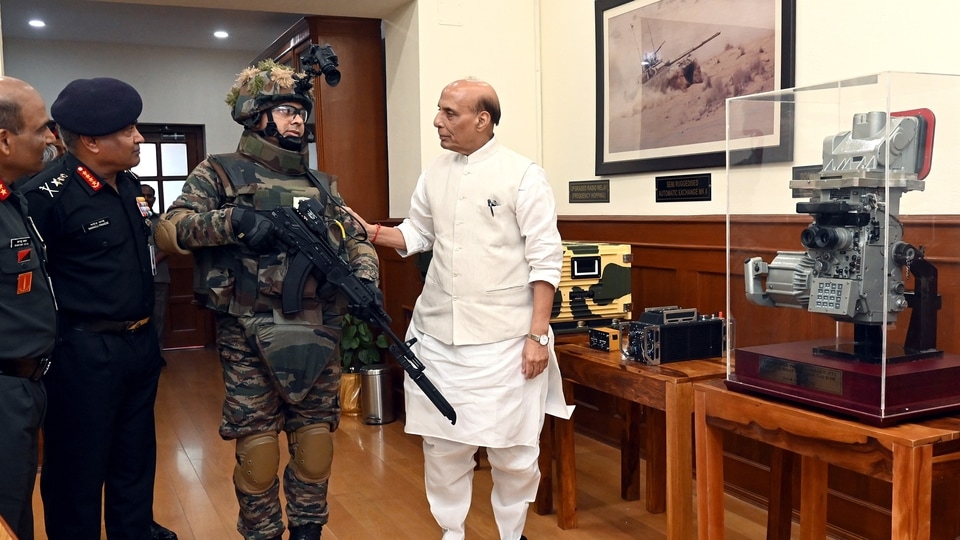
On this occasion, Rajnath Singh handed over indigenous equipment to the army which would give an edge to our soldiers in conflict situation.
1. Landing Craft Assault (LCA): The army has boats operating in the Pangong Tso Lake, but with limited capabilities. Developed by Goa-based M/s Aquarius Ship Yard Limited, the LCA is much more versatile and has overcome the limitations of launch, speed and capacity, the statement said.
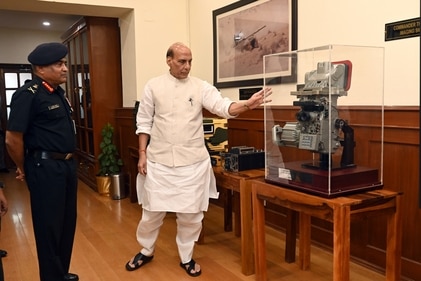
2. Commander Thermal Imaging Sight for Tank T-90: This equipment gives enhanced visibility and range to the commanders of the armoured columns. Developed by India Optel Limited, the thermal imaging sight can detect heat signatures of enemy tank and equipment and are better for detection and targeting.
3. Future Infantry Soldier as a system (F-INSAS): The future infantry soldier is equipped with three primary sub-systems including a modern state of art assault rifle along with day and night holographic and reflex sights. Based on the need, a thermal imager sight or image intensifier sight will be used. The sights are mounted on the weapon and also on helmet to enable 360degree visibility and accuracy in operational conditions.
The second sub system includes a specially-designed helmet and a bulletproof jacket It will also have modular pouches and harnesses to carry grenades, magazines, radio sets and other operational equipment.
The third sub system consists of communication and surveillance system. Each soldier will carry a radio set which is hands free and the section commander will also carry additional communication and surveillance devices for real time contact with his team.
4. Infantry Protected Mobility Vehicle (IMPV): The induction of two types of high mobility vehicles developed by M/s Tata Advance Systems Limited provide mobility and protection to the soldiers.
5. Quick Reaction Fighting Vehicle (Medium): This vehicle facilitates quick deployment of troops and will enable quicker reaction. These are tailor made vehicles with high mobility, enhanced firepower & protection. It will facilitate in creating moral ascendency in our Northern Borders.


