
 E-Paper



Cabinet clears e-bus scheme to improve mobility in cities
Union cabinet on Wednesday cleared PM-ebus Sewa to improve mobility and decarbonise public transport in tier 2 and tier 3 cities


To improve urban mobility and decarbonise public transport, the Union cabinet on Wednesday cleared the ₹57,613 crore PM-eBus Sewa for cities, giving priority to those that have no organised bus service. Ten thousand electric buses will be inducted on a public-private partnership model in 100 cities, Anurag Thakur, Union minister of information and broadcasting, said at a media briefing on Wednesday.
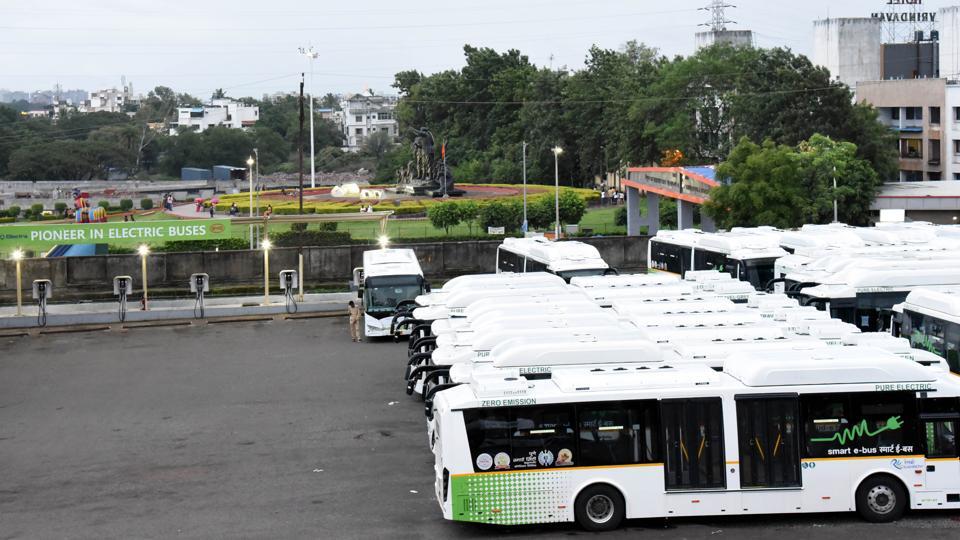
The scheme will cover cities with a population of 300,000 to four million, according to Census 2011. There are 169 cities eligible to apply. Cities will be selected through the “challenge method”, said Thakur.
The final number of cities to be covered will depend on the number of cities that apply for the competition, said Manoj Joshi, secretary, Union ministry of housing and urban affairs (MoUHA), adding that cities that have a population upwards of four million -- these are the nine biggest cities of India -- will be excluded from the scheme. These cities are already covered under the Faster Adoption and Manufacturing of Electric Vehicles scheme run by the Union ministry of heavy industries.
Thakur said the scheme will address environmental concerns as well as the current and future transport needs of Indian cities. “Buses will be allotted based on their population -- each city with less than 500,000 people will get 50 buses; those between 500,000 and two million will get 100 buses; while those with a population of two to four million will be allotted 150 buses,” said the minister.
Also, cities that are scrapping overaged buses will get new ones, he added.
The PM-eBus Sewa -- which will support bus operations for ten years -- is estimated to cost ₹57,613 crore, of which ₹20,000 crore will be provided by the central government. The scheme will support bus operations for ten years, is expected to generate 45,000 to 55,000 direct jobs, and will also provision for associated infrastructure such as upgrading bus depots and charging meters and substations for e-buses, the government said in a statement released after the cabinet meeting.
The government will also provide infrastructure upgrades to 181 cities -- which will include the 169 eligible to apply for the PM-eBus Sewa, the nine biggest cities, and Pimpri-Chinchwad, Navi Mumbai and Lakshwadeep -- as part of the Green Urban Mobility Initiatives by MoHUA. These initiatives include bus priority infrastructure, multimodal interchange facilities, national common mobility card-based automated fare collection systems and charging infrastructure. States and cities will run the bus operations and pay the bus operators. The central government will provide support with a subsidy to the extent specified in the proposed scheme, said the statement.
The plan to augment the public bus service, mainly in tier two and three cities, was announced by finance minister Nirmala Sitharaman in the Union budget 2021-22.
Urban mobility experts said PM-eBus Sewa would not just help augment the inadequate bus service in Indian cities but will also reduce air pollution caused by the transport sector. Pointing to the inadequacy, Amit Bhatt, managing director (India) of the International Council of Clean Transport (ICCT), said India has 2.3 million buses, which include 1.7 million buses and 600,000 mini-buses. But only 40,000 of these are a part of the formal city bus network. In contrast, China has an urban bus fleet of approximately 700,000. “In this context, the approval of the PM e-bus Sewa initiative stands as a potentially pivotal development, capable of instigating a transformative shift within India’s bus transport system.”
He added that this initiative targets a 25% enhancement in public transportation capacity. Yet, its significance extends beyond mere capacity improvement, as the emphasis on electric buses within the scheme bears substantial implications for public health. “This perspective finds reinforcement in ICCT research, which unequivocally demonstrates that real-world NOx emissions from even BS-VI buses exceed recommended limits by five to six times. In addition, the particulate matter emissions also surpass current limits,” said Bhatt.
Madhav Pai, CEO, WRI India, said the scheme marks “a significant milestone in improving the availability of bus services that offer equitable access to economic and social opportunities”.
“At this juncture, the support being provided to medium and smaller cities that lack robust transport systems is particularly crucial. With an estimated daily ridership of six million passengers, these buses are expected to cover six billion bus-kilometres throughout their lifecycle. Furthermore, the adoption of electric buses could potentially reduce 16.5 million tonnes of CO2 equivalent tailpipe emissions over the course of 10 years,” he said.


