
 E-Paper



‘Article 370 was unconstitutional’: Centre tells Supreme Court
The Union government told Supreme Court on Tuesday that the Article 370 was an unconstitutional provision that remained operational for decades.


New Delhi: Article 370 was an “unconstitutional” provision that remained operational for decades despite being inherently discriminatory, the Union government told the Supreme Court on Tuesday, emphasising that President had the complete authority to abrogate the provision.
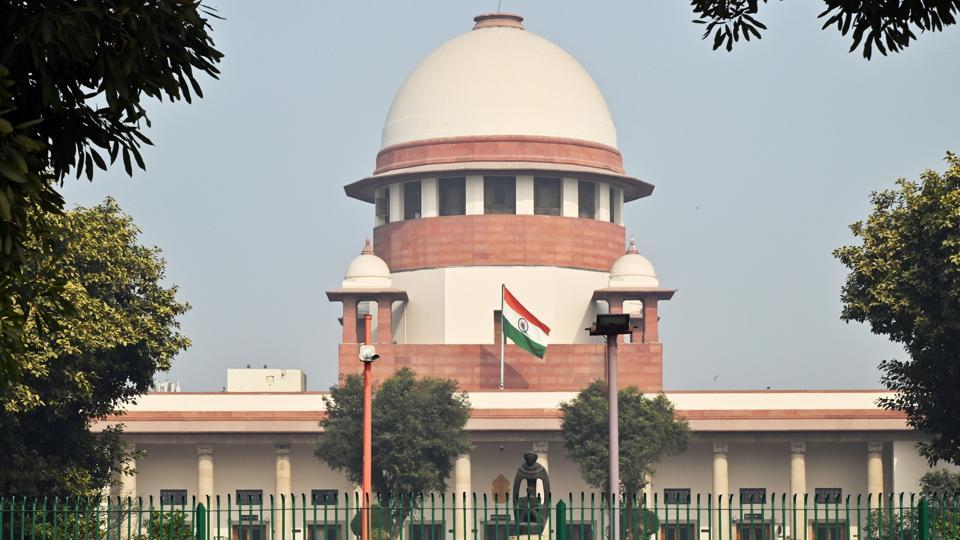
“Any interpretation that saves continuance of Article 370 will amount to an unconstitutional provision to remain in the Indian Constitution...Unconstitutional because it was inherently discriminatory,” solicitor general Tushar Mehta submitted before a Constitution bench, headed by Chief Justice of India Dhananjaya Y Chandrachud.
Defending the 2019 decision by the Centre to nullify Article 370 and restructure J&K into two Union territories on the twelfth day of the arguments in the case, the law officer maintained that Article 370 was always meant to be a temporary provision and that is why it is the only provision containing the “self-destructive” mechanism of how to abrogate it.
“Under Article 370, two authorities, namely the President and the Chief Minister of J&K, could amend or alter any other provision of the Indian Constitution. Considering the wide expanse of the power under Article 370, such a provision can never be intended to be a permanent provision. The Constitution cannot remain a floating document just for one state,” he said.
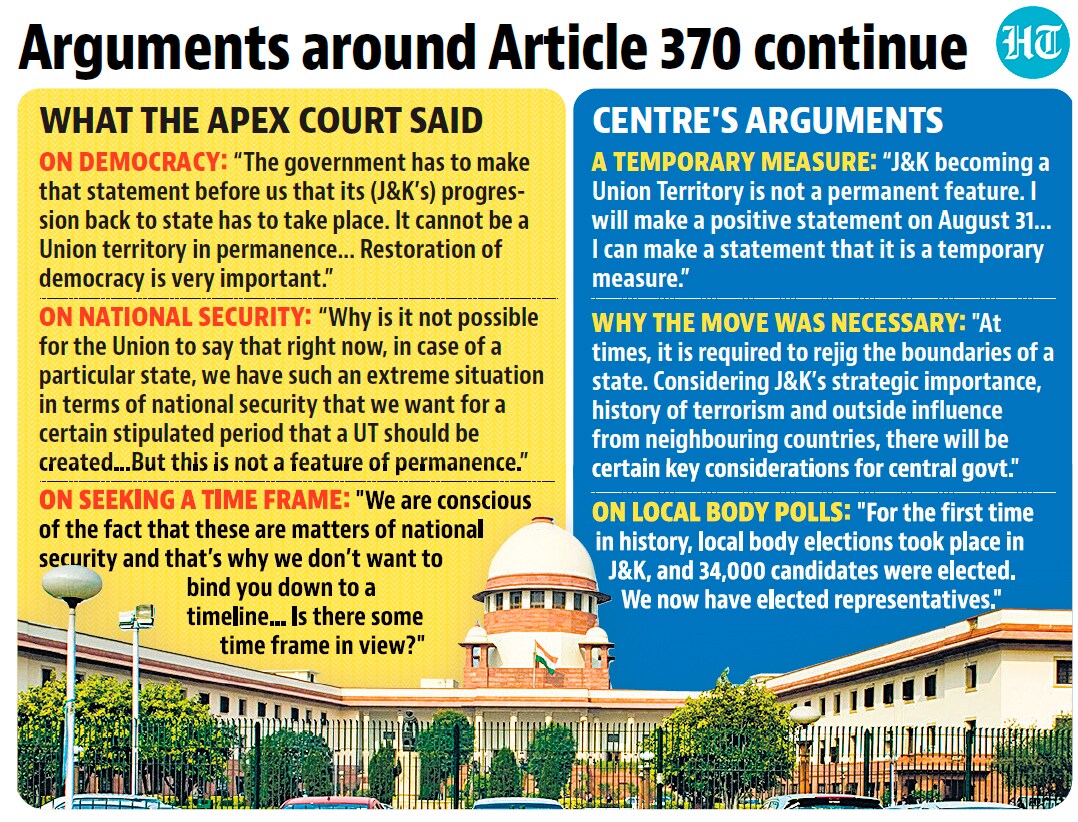
According to S-G, Article 370 is the only provision in the Constitution that laid down how it could be abrogated by the President following a recommendation of the J&K constituent assembly. “It is the only provision that has an in-built self-destructing clause, which is also a pointer that it was meant to be temporary. Additionally, we cannot have a provision to continue perpetually that allows the Indian Constitution and central laws to apply only upon the consent of the legislative assembly of a state,” Mehta said.
President, S-G said, is the sole repository of power for abrogating Article 370 after the J&K constituent assembly dissolved in 1957. “And this power was coupled with the duty to act in the interest of the people. The J&K constituent assembly was only given an option to make a recommendation regarding abrogating Article 370, but that cannot restrict the President from doing it at a later point in time. If the President’s power is taken away, it could lead to a devastating situation which was never envisaged by the Constitution makers. It would mean the President’s power is dependent upon some outside body,” Mehta contended.
The law officer maintained that the highest court of the land cannot countenance a situation where a provision in the Constitution can be made to exist by rendering the President’s power nugatory and lead to a position where even the basic structure of the Constitution can be violated.
Mehta said that the J&K Constitution cannot be equated with the Constitution of India because the former was not meant to be an instrument of governance for a sovereign.
Appreciating the S-G’s submission, the bench pointed out that Section 5 of the J&K Constitution provided that the executive and legislative power of the State extends to all matters except those with respect to which Parliament has power to make laws for the State under the provisions of the Constitution of India.
“Progressively, Parliament applied several provisions of the Indian Constitution to J&K and extended its fold. This shows that it (J&K Constitution) was always intended to be subservient to the Constitution of India. It was never intended to be equal,” said the court.
Supporting Mehta, attorney general R Venkataramani, also appearing for the Centre, said that the abrogation was necessary for the constitutional and complete integration of J&K with the Union of India.
As the hearing drew to a close on Tuesday, the bench remarked the wide chasm between absolute autonomy, as it existed in 1950, and complete integration, as it was brought about in August 2019, had been substantially bridged by what was happening in between.
“So, it was not really a migration from an absolute autonomy to absolute integration. It’s obvious that a substantial degree if integration had already taken place between 1950 and 2019. Therefore, one of the interesting points in this case is that what was done in 2019, was it a logical step forward to achieve that integration?” it said.
The court will resume its hearing on August 31.


