
 E-Paper



United by love, divided by hate amid tribals vs migrants conflict
In May 2022, Sanjib Haldar and Gayatri Padiami married under the Special Marriages Act after being in love for three years. However, their relationship was star crossed.

 Prefer HTon Google


Malkangiri: Their courtship began over furtive glances inside a car. Sanjib Haldar was 29, the driver of an SUV in Odisha’s Malkangiri, and sometime in 2019, he was dropping Gayatri Padiami’s family to Kalimela for a wedding. That’s when their eyes first met. Their villages were close by, and soon they fell in love. Padiami loved that Haldar was tall, young, a matriculate with a stable income. He promised to enrol her in a nursing school. Three years later, last month, they were married before a public notary in Malkangiri under the Special Marriages Act.
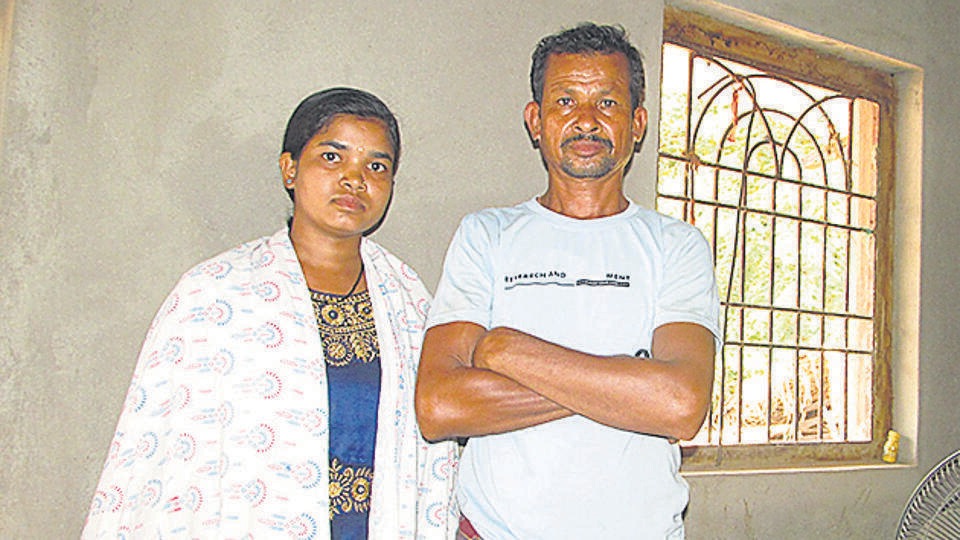
But the relationship was star crossed.
Haldar was a Bengali, a descendant of one of the 20,000 families from East Pakistan relocated to the forests of Odisha and Chhattisgarh by the government in India starting 1956, in what was then called the Dandakaranya project. Padiami is a Koya, from the indigenous adivasi community that has for long lived in Malkangiri’s forests. The two groups have now lived next to each other for more than 60 years, but the ambitious project has left behind a trail of hostility between them, its fault lines deep and clear.
Padiami’s parents did not approve of the match, and a kangaroo court assembled a week after the wedding. It allegedly forced them to separate. The next day, Haldar drank a bottle of pesticide to kill himself.
Wedding and death
Haldar and Padiami were married on May 13, 2022 at the district headquarters. Anticipating trouble, they began living with Haldar’s uncle in Malkangiri. Three days later, a group of tribals arrived at the door, and took Gayatri away on the pretext that her mother was unwell.
On May 20, a meeting was called under a banyan tree near Gayatri’s home in Boilapali village, where members of both the Koya tribal community and Bengali settlers were summoned. The tribal community believed that this was another attempt by the Bengalis to usurp their land, weaken their identity, and their customs. A visibly distressed Padiami was asked what she wanted in full public view, and under duress, reportedly told the irate crowd that she did not want to live with Haldar. The next morning, a dejected Haldar walked to his farmland with a 400ml bottle of ‘Fire’, a Paraquat Dichloride chemical and drained half the bottle. He was found frothing at the mouth a few hours later and was admitted to the district hospital. On May 23, he was dead.
Dipankar Haldar, Sanjib’s uncle, said that the family relocated to Malkangiri in 1971 under the terms of the Dandakaranya project, fleeing persecution in the Barisal district of what is now Bangladesh. “For a while, we believed that the tribals were our friends. We studied here, built a life here. But the death of my nephew has reminded us that we are still unwelcome. I hope the police will investigate the death properly,” he said.
Police officers said that they are still probing the matter, and no headway has been made in the case.
But, in Malkangiri, there are concerns beyond the immediate. The district has a strong Maoist presence, and any sense of aggrievement is fertile ground for guerilla recruitment. Malkangiri superintendent of police Nitesh Wadhwani said, “We are keeping an eye on such sensitive cases because they can be exploited by Maoists. We are acutely aware of such issues which have the potential of inflaming passions between two communities and are working towards redressing them.”
Dandakaranya Project
In 1956, rattled by the scale of the influx of Hindu Bengali migrants to West Bengal after Partition, the Union government decided to rehabilitate refugees to 65,000 sq km in the then undivided districts of Koraput in Odisha, and Bastar in Madhya Pradesh. The Dandakaranya Development Authority project was formed in 1958, with settlers arriving in Malkangiri and Umerkote divisions of Odisha, now under the Malkangiri district, and the Paralkote and Bastar divisions of Madhya Pradesh, now the Kanker district of Chhattisgarh. The villages where the Bengalis were resettled in Malkangiri were serially numbered with the prefix MV (Malkangiri village), and those in Bastar were PV (Paralkote village). To this day, these are the names that these villages carry. Haldar lived in the village MV-9, one of the 216 MVs in the district.
Under the Dandakaranya project, to begin with, seven acres of land including half an acre for homestead and gardens, was given to each Bengali family (one acre is about 43,560 square feet). It was first reduced to six acres, and in November 1977, the government decided to reduce the land allotted to migrants to five, four, and three acres in non-irrigated, semi-irrigated and perennially irrigated areas, respectively. Non-agricultural families who settled in these villages were provided with an agricultural plot of two acres and a homestead plot of 7,200 sq ft. Land pattas were conferred initially for 20 years after which they were made permanent, Malkangiri district officials said.
Bhanumati Haldar and Ramesh Haldar, for instance, both in their seventies now, fled Barisal in 1971 during the war, and stayed at a transit camp in Sambalpur for two years. They were then allotted a plot in MV-60, near Podia in Malkangiri. “I used to get ₹2 a day for harvesting grains. Though I received four acres of farmland, it was difficult to grow crops because of a lack of irrigation. There were several days when we starved. But over the years, we changed our lived by working hard, and farming land for long considered to be barren,” said Ramesh Haldar.
Most of the migrants were Namasudras, and were accorded the status of Scheduled Castes by the state government. The community was aspirational, and took to animal husbandry, dairy, poultry farming, and fish farming. The Dandakaranya project ensured that each Bengali village had two to four tube wells, a head water tank, internal and approach roads, a community centre, and at least one primary school where Bengali was introduced as a medium of instruction for the primary classes.
The people were formalised in the electoral rolls, and the award of SC certificates meant that the assembly constituency became a reserved one from 1974 to 2004. In 1985, Nadiabasi Biswas, a Bengali migrant, even became the independent MLA. In the 2019 Lok Sabha elections, district officials said that of the 600,000 voters in Malkangiri, 279,000 were Bengalis.
Except, this upward mobility and the perceived largesse towards the Bengalis alienated the indigenous tribals. It created fault lines that run deep to this day.
Seeds of conflict
In his 2019 book, “Adivasis, Migrants and the State of India”, Jagannath Ambagudia, a Tata Institute of Social Sciences (TISS) professor, wrote that the Dandakaranya project, meant to be an instrument for the rehabilitation of migrants, followed discriminatory practices against tribal communities.
“Although land and forests are considered the twin pillars of the Adivasi economy, as well as the source of their community identity, the state did not respect this symbiotic relationship…The clearing of precious forests in the Dandakaranya region for the settlement of Bengali migrants eventually deprived the Adivasi communities access to forest resources. The project considered the native Adivasis as the secondary social group competing for facilities. The differential treatment of migrants and Adivasis contributed to the income gap and placed them at different levels of economic position in the society,” he wrote.
Tribal activist and a former zila parishad chairman Gangadhar Buruda said what this meant was a feeling of alienation among tribals. “Though we are sons of the soil, we were taken for granted. The Bengali migrants were far more sophisticated than the tribals and tended to corner all benefits as they were far more educated. In a place like Malkangiri where there are no industries, the government jobs are a ticket to prosperity. Here too, the education among the Bengalis helped them take most of the jobs. Besides, the migrants could study Bengali and Hindi but to this day, tribal languages are not taught in schools,” Buruda said.
He added that until the Bengalis arrived in Malkangiri, the tribals had their own age-old customs related to ownership and capital, which were completely overrun. “The tribals largely practised community ownership of property. The accumulation of individual land or money is still an alien concept. Once capital entered and began dominating daily discourse, the tribals began to approach Bengali migrants for loans at high interest rates and conditions dictated by them. Individual ownership requires capital to maintain both savings and property, and unused to both these concepts, tribals began losing land to the Bengalis,” Buruda said.
This clash of cultures circling around land, core to tribal identity, has been a deep reason for hostility, with intermittent eruptions of violence.
Violent clashesIn August 2021, Bengali migrants of MV-93 and Bhumia tribals of Phalkaguda village clashed over a 75-acre plot of land. Ugrasen Kurami, a tribal from Phalkaguda, said, “We wanted to create a forest on 75 acres of government land. But the migrants kept tilling it and converted part of it into a community graveyard which led to a clash. Section 144 was imposed. We have now requested the district administration to demarcate the land and remove all the encroachments. We will not remain silent from here on in.”
However, Nimai Sarkar, former MLA of Malkangiri and a leading voice of the Bengali migrants, said the allegations of land-grab were a systematic attempt to defame the Bengalis. “We are hardworking people. When we came here, the land was barren and the tribals hardly grew anything. We grew everything from groundnut to paddy on our land as well as tribal land through sharecropping methods. The tribals actually benefitted from all this,” said Biswas.
In Odisha, and more prominently in neighbouring Chhattisgarh, religious beliefs have also been a core bone of contention, centered around Durga Puja. The biggest Bengali festival of the year typically has idols that show Durga killing Mahisasur, considered a symbol of evil. To tribals, particularly Gonds, however, the green Mahisasur is a king. Ghanshyam Madkami, president of the Malkangiri Zila Adivasi Mahasangh said, “In Pakhanjur, the Gondi tribals rever Mahisasur which has always caused unrest. Koyas have their Gudi Mata while other tribes have their respective Gods and Goddesses.”
This divide around land and religion also means a sense of deep suspicion when it comes to tribal-migrant marriages, such as those between Haldar and Padiami, evidenced by the May 20 kangaroo court. “In tribal households, a woman is usually not given property rights in her parental home. But in their communities, they do. Even the Supreme Court, in January 2021, said that a girl can inherit her parent’s property. So now migrants end up buying land in the names of their tribal wives leaving us with very little. How can we allow this?” asked Jara Sabar Madhi, a tribal and president of Malkangiri unit of Bahujan Samaj Party.
Back at MV-9, Purnima Haldar clutches her son’s Aadhaar card, one of the only photographs of Sanjib that she has. Two weeks have passed; there is grief and disbelief.
“My son married the love of his life. He did not care whether she was tribal or Bengali,” she said. “I did not know the amount of hate the marriage would generate.”



