
 E-Paper



Upset after Australia’s participation in Malabar Exercise, China warns of economic damage
In an editorial piece, Communist party mouthpiece China Daily chided the Australian government for ‘aggressively sending warships to China’s doorsteps’ as part of Exercise Malabar, UK Daily Mail reported.

 Prefer HTon Google


Australia’s decision to take part in Malabar Exercise has outraged China, who has warned Canberra of “economic pain” if it continues to be part of US administration “roughneck gang”.
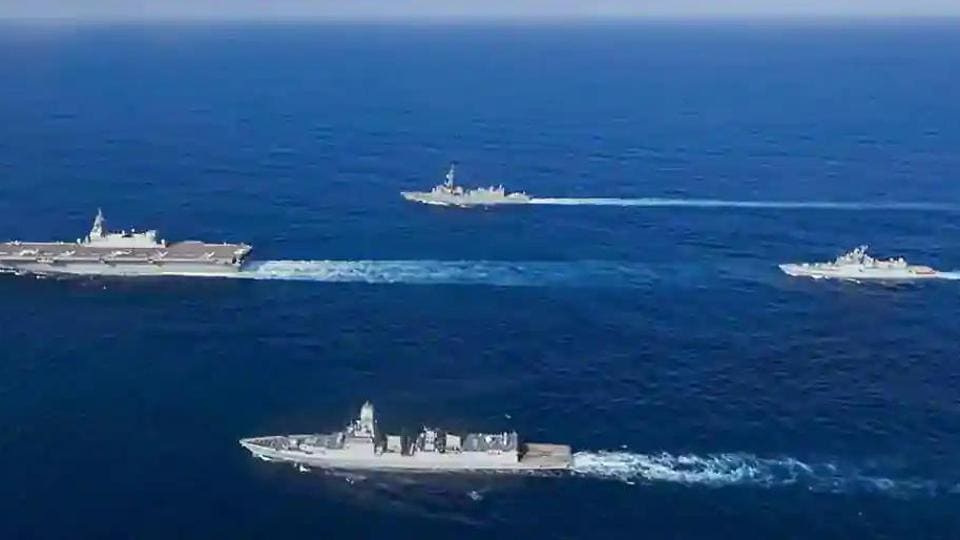
In an editorial piece, Communist party mouthpiece China Daily chided the Australian government for ‘aggressively sending warships to China’s doorsteps’ as part of Exercise Malabar, UK Daily Mail reported.
The first phase of the Malabar naval exercise has culminated recently in the Bay of Bengal with the participation by Indian Navy, United States Navy, Japan Maritime Self-Defence Force, and Royal Australian Navy.
The 24th multinational maritime naval exercise, which started on November 3, was restricted to sea phase and conducted in “zero contact” format considering Covid-19 pandemic.
“Although Australian Prime Minister Scott Morrison has declared that his government’s approach to foreign policy is defined by ‘strategic patience and consistency’, particularly regarding China, his government’s rash participation in the US administration’s attempts to contain China belies that,” the editorial said.
“Canberra should realize it will get nothing from Washington in return for its collusion in its schemes, while Australia will pay tremendously for its misjudgment,” it added.
Chinese and Australian relations have deteriorated after Canberra called in April for an investigation into the origins of the coronavirus without first consulting Beijing.
Beijing has since imposed a large anti-dumping duty on Australian barley, banned beef exports from five abattoirs and instigated anti-dumping and subsidy investigations into cheap Australian wine in China.
Another Chinese state media outlet, the Global Times recently warned Australia will pay an ‘unbearable price’ for ‘sabotaging’ bilateral relations and criticising the regime post-Covid.
Recently, it was reported that importers across Beijing are expected to brace for a possible round of sanctions on copper ore and copper concentrate as well as sugar this week.
The General Administration of Customs of China (GACC), last week, issued a notice to exporters claiming that it had found a pest in imported log timber from Queensland and has banned all log exports from the Australian state.
The Chinese customs agency further claimed that it had found contamination in barley shipments from Australian grain exporter Emerald Grain as well.
The propaganda publication accused Australia of prejudicially fueling anti-China sentiment and baselessly sanctioning Chinese companies, such as Huawei, who were shut out of the national 5G infrastructure grid on the grounds of national security.
It also warned Canberra to ‘steer clear of Washington’s brinkmanship with China before it is too late’.


