E-Paper



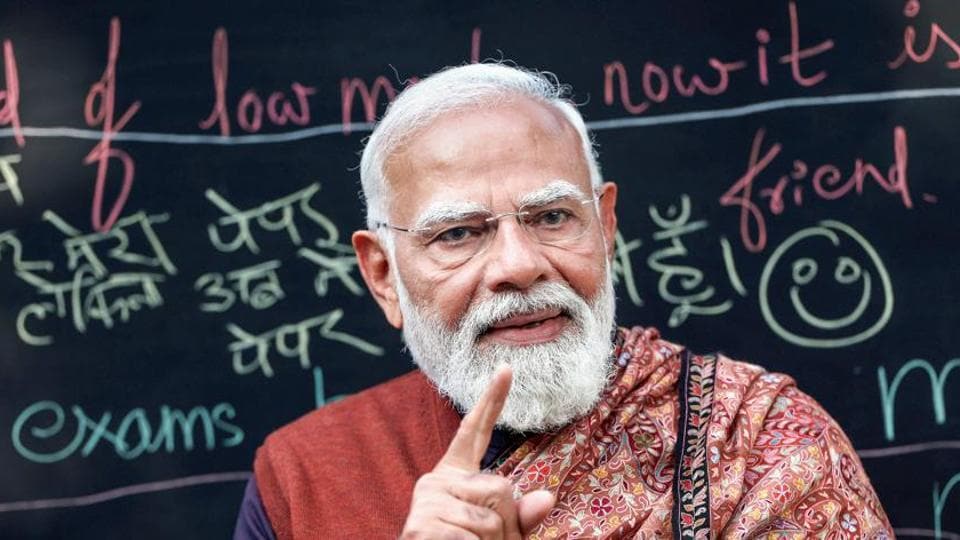
Use AI wisely to boost your wisdom, personality: PM Modi at Pariksha Pe Charcha
Addressing students ahead of board examinations, PM Modi emphasised that education should not be treated as a burden and exams are only a medium of growth

 Prefer HTon Google


Prime Minister Narendra Modi on Friday advised students to maintain balance in life, focus on all-round development and use technology including Artificial Intelligence (AI) responsibly, as he interacted with students during ninth edition of Pariksha Pe Charcha (PPC).
Welcoming students with Assam’s Gamosa, PM Modi described it as “an epitome of women empowerment for the northeast, especially Assam, as the women weave it at home with love and dedication...”
Addressing students ahead of board examinations, PM Modi emphasised that education should not be treated as a burden and exams are only a medium of growth.
“Exams should never be the ultimate goal. Education is just a medium of our development… instead of focusing on marks, everyone should focus on where they have made it in life,” he said.
Responding to students’ concerns about conflicting advice from parents and teachers, PM Modi said every learner has a unique style.
Also Read: Pariksha Pe Charcha 2026 goes pan-India as 6.76 cr participate in programme
“Have faith in and follow your pattern, keeping in mind all the suggestions that come your way,” he said, encouraging students for gradual improvement through their experiences.
On academic pressure, PM Modi said teachers should keep their pace only slightly ahead of students so that learning goals remain “within reach but not easily attainable”.
He also suggested that teachers announce upcoming lessons in advance to allow students to prepare, fostering curiosity and confidence.
He also called for balance between studies, sleep, food and recreation.
“If you lean too much to one side, you are bound to fall… everything in life needs balance,” he said, while describing gaming as a skill that can support personality development but cautioning against excessive indulgence and gambling.
Responding to a student’s query on balancing boards and competitive exams, PM Modi advised students to prioritise Class 12 board exams and focus on strong fundamentals.
He said that if the syllabus is thoroughly understood, “competitive exams will become a by-product without requiring separate effort,” likening simultaneous preparation to “playing cricket and football at the same time.”
During interaction, students also asked PM Modi about skill versus marks and managing exam stress.
PM Modi said education and skill are “twin siblings” and suggested students to prioritise holistic learning rather than preparing only for predictable exam patterns. He also advised students to learn collaboratively by teaching peers and seeking guidance from brighter classmates.
PM Modi encouraged students to back their aspirations with action and continuous learning.
Linking education to nation-building, PM Modi reiterated his vision of a “Viksit Bharat” by 2047, urging students to adopt cleanliness, develop skills and use indigenous products.
He asked youth to “use AI wisely to boost your wisdom and personality” and treat technology as a tool for genuine learning rather than mere entertainment.
PPC 2026 saw over 4.5 crore registered participants on MyGovIndia portal between December 1, 2025 to January 11, 2026 and an additional 2.26 crore individuals participated in various school-level activities from January 12 to January 23 taking the overall participation to 6.76 crore this year.
This year the interactive sessions were held with students in Devmogra in Gujarat, Coimbatore in Tamil Nadu, Raipur in Chhattisgarh, Guwahati in Assam, and at the prime minister’s official residence at 7, Lok Kalyan Marg in Delhi.
The next episode will air on February 9 at 10am.