
 E-Paper



US-Iran war: AAI denies seeking fuel stock details as fear looms over oil supply amid ‘closure’ of Strait of Hormuz
Iran claims that it has already closed the Strait of Hormuz, the world's most critical oil chokepoint, but it is not clear whether it is a complete closure.

 Prefer HTon Google


The Airports Authority of India (AAI) on Tuesday rubbished reports claiming that it had sought fuel stock details from airports as a precautionary measure amid the possible closure of the Strait of Hormuz.
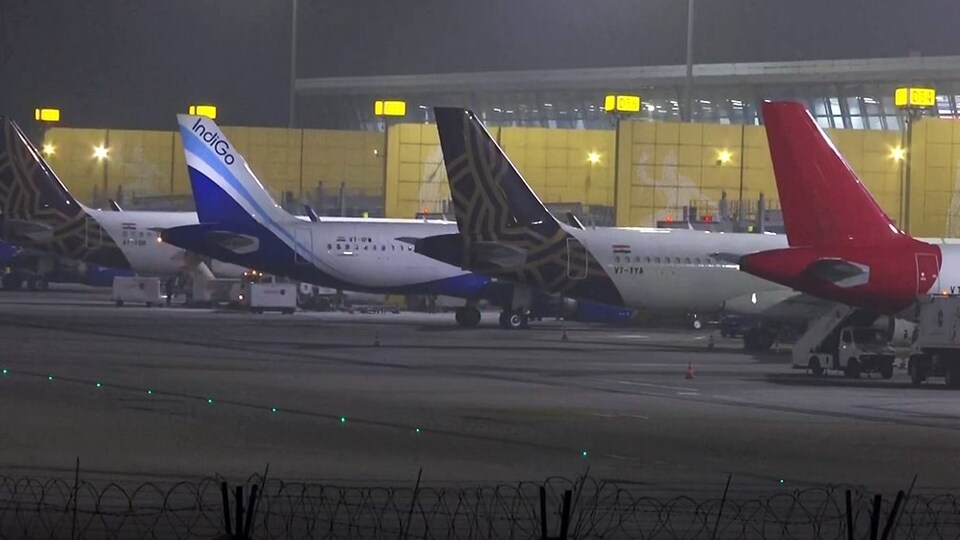
The escalating conflict between Iran and the United States has caused worries over oil trade, with Tehran claiming that it has already closed the Strait, but it is not clear whether it is a complete closure. Follow live updates on the US-Iran war
AAI issues statement, denies media reports
The Airports Authority of India denied media reports that it had sought details of Aviation Turbine Fuel stock at international airports in view of the Middle East conflict.
In a statement, AAI said, “AAI categorically denies these reports. The Authority states that it has not asked formally or informally any airport operator to furnish details regarding fuel stocks or estimated fuel requirements. The reports suggesting such communication are false and factually incorrect.”
It added, “It is further reiterated that AAI functions strictly within its defined mandate. The AAI is airport operator and navigation service provider. It does not exercise oversight over fuel inventories. AAI remains committed to the safe, secure, and efficient management of airport infrastructure.”
Strait of Hormuz
The Strait of Hormuz is the world's most critical oil chokepoint, lying between Iran and Oman, connecting the Persian Gulf to the Gulf of Oman and the Arabian Sea.
The Strait is just 33 kilometres wide at its narrowest point, with the shipping lane three kilometres wide in either direction.
Around one-fifth of the world's total oil consumption passes through the Strait of Hormuz, with members of the Organisation of the Petroleum Exporting Countries (OPEC) -- Saudi Arabia, Iran, the United Arab Emirates, Kuwait, and Iraq -- exporting the majority of their crude through the Strait, especially to Asia.
Meanwhile, India sources around 55 per cent of its crude imports from the Middle East, amounting to approximately 2.7 million barrels per day.
Track flight cancellatives and Iran war live updates
India's buffer storage is far thinner than China's, which reportedly holds up to six months' worth of crude.
While the Centre has said that the total storage capacity could last about 74 days, HT earlier reported, citing refining sources, that effective inventories may cover only 20-25 days under the current conditions. This particularly makes India exposed if shipments through the Strait of Hormuz are significantly curtailed.
The Strait of Hormuz has historically been a focal point during conflicts. During the 1980-1988 Iran-Iraq war, the two sides sought to disturb each other's exports in what was known as the 'Tanker War'.
ALSO READ | Strait of Hormuz ‘closed’: What is it and how it impacts global trade and oil prices?
In 2012, Iran threatened to block the Strait in retaliation for the US and European sanctions. Then again, in May 2019, four vessels, including two Saudi oil tankers, were attacked off the UAE coast, outside the Strait of Hormuz, prompting Iran to reiterate its threat.
Global oil prices on the rise
Oil prices gained on Tuesday as tensions in the Middle East continued to escalate. Global benchmark Brent rose to $80 per barrel, after a 7 per cent spike on Monday, Bloomberg reported.
Meanwhile, West Texas Intermediate traded at $73.
Robert Rennie, head of commodity research at Westpac Banking Corp, said the $82 to $85 region is being seen as the upper limit over the next two days as Iran targets energy infrastructure and shipping.
Flight cancellations
Several international flights to the West were delayed from Delhi's Indira Gandhi International Airport on Tuesday amid escalating tensions and airspace closures.
Delhi airport issued an advisory, asking passengers to check the latest flight status with their respective airlines before heading to the airport.
So far, 36 departures and 44 arrivals have been cancelled at the IGI airport.
In Bengaluru, 44 flights have been cancelled due to airspace restrictions, and at least 10 international flights were cancelled at Kolkata airport.


