E-Paper



Valuables in Jagannath temple’s Ratna Bhandar temporarily shifted to strong room
Justice Biswanath Rath (retd) said no snakes or secret tunnels were spotted in Ratna Bhandar as was being speculated

 Prefer HTon Google


Four days after the inner chamber of the Ratna Bhandar was opened for the first time in 46 years, an 11-member team on Thursday spent seven hours in the chamber to transfer valuables to a temporary strong room within the temple complex for its audit and inventorisation.
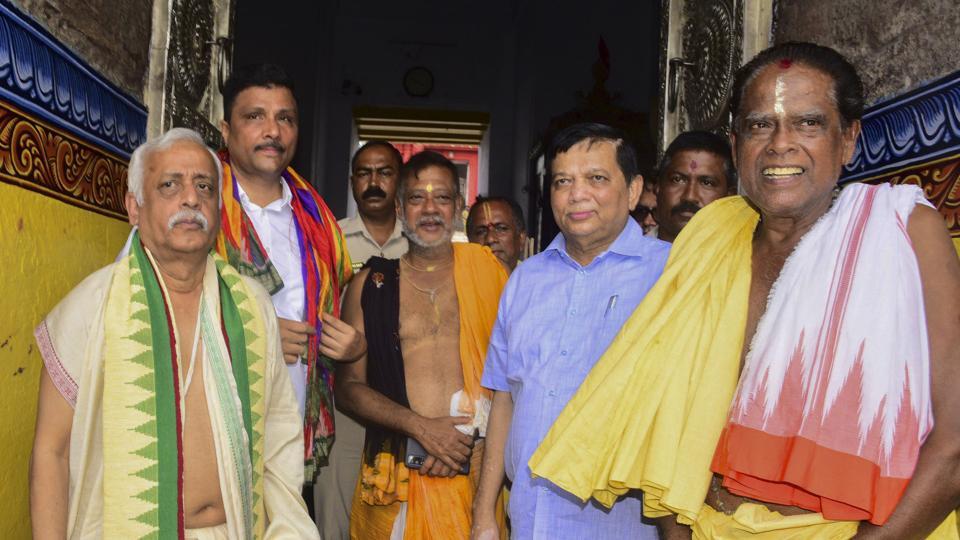
Justice Biswanath Rath (retd) who heads the high-level committee for Ratna Bhandar’s audit said gold and silver ornaments as well as other precious jewels stored in Lord Jagannath’s treasury were shifted to Khata Seja Bhandar, a structure in the temple used as temporary strong room.
“We opened the inner chamber of Ratna Bhandar at 9.51am, the auspicious time fixed as per the Hindu almanac, after offering prayer to Maa Bimala, Maa Lakshmi and Lord Loknath. The shifting process ended at 5.15pm. All valuables were kept in containers as per the SOP and shifted to the strong room. There were three wooden almirahs, one steel almirah, two wooden chests and two iron chests inside the inner chamber. All the containers have been shifted. As two iron chests could not be taken into the temporary strong room due to its large size, we transferred the valuables to other containers. The precious metals were stored in wooden boxes and almirahs at the inner chamber. All containers have been properly locked and the keys of the inner chamber will be handed over to the district treasury,” said Rath.
Rath said there were no snakes inside the Ratna Bhandar as was speculated, and the services of the Snake Helpline members were not needed.
They didn’t find a tunnel either, he said. “We never believed in such things. I appeal to the people that these are not based on facts. I also appeal to YouTubers, media and others not to spread such news. We have shifted the cupboards and we have not found any such things.”
The erstwhile king of Puri Gajapati Dibyasingh Dev, who was part of the team, said he did not find any tunnel or secret chamber. “Things will be clear after proper inspection by ASI through high-tech gadgets,” he said.
Both of them also declined to speak about the valuables inside. “We have vowed not to say anything till the government comes out with the details in its inventory,” said Rath.
Law Minister Prithviraj Harichandan said the inventory of jewels and ornaments inside the inner chamber of Ratna Bhandar may take over a month. Harichandan said the Archaeological Survey of India would start repair works in both the chambers following which the valuables would be brought back. “This inventory process would then begin inside the Ratna Bhandar and continue for a period of 30 to 40 days,” he said.
The last inventory of the Ratna Bhandar was done in 1978 and continued for 70 days. A nine-member committee headed by the then Odisha governor Bishal Dayal Sharma did the audit and inventorisation between May and July 1978.