
 E-Paper



Virat, the President’s star charger, rides into the sunset
Virat made its 13th and final appearance at the Republic Day parade as the horse of the commandant of the elite President’s Bodyguard, or PBG.


New Delhi: One of India’s best-known military horses, Virat, on Wednesday rode into the sunset after nearly two decades of presidential service -- and he couldn’t have asked for a better sendoff.
Also Read | Grandeur marks 73rd R-Day
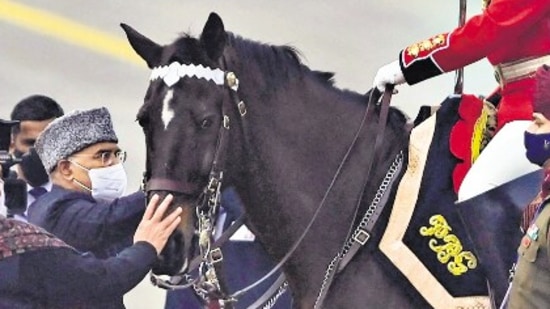
After the Republic Day parade ended, President Ram Nath Kovind, Prime Minister Narendra Modi and defence minister Rajnath Singh walked up to the charger and tenderly petted him -- the gesture an unmistakable acknowledgement of Virat’s military service, especially his role in India’s biggest ceremonial event over the years.
It was Virat’s 13th and final appearance at the Republic Day parade as the horse of the commandant of the elite President’s Bodyguard, or PBG, raised in 1773 and one of the oldest regiments of the army.
At the Republic Day parade, the President traditionally arrives at Rajpath from the Rashtrapati Bhawan escorted by PBG. On Wednesday, the horsemen escorting Kovind were led by PBG commandant Colonel Anup Tiwari, who was mounted on Virat.
Virat, a Hanoverian horse, was issued to PBG in 2003 by the army’s Remount Training School and Depot at Hempur in Uttarakhand.
“He was barely four years old then. He was among the five horses I chose for PBG. What struck me most about Virat was his height, elegance, and the way he moved. I knew he was born to serve PBG,” said Honorary Captain Sajjan Kumar (retd), who brought the charger to Rashtrapati Bhawan.
Presidential horses have to be at least 157.5 cm tall -- Virat’s height is a little over 170 cm. A horse’s height is measured to the highest point of the withers on its back. PBG horses have to be tall to complement the men from the regiment who have to have a minimum height of six feet.
Virat was honoured with the army chief’s commendation card for outstanding service on Army Day (January 15).
“It was an emotional moment to see the President and the PM bid farewell to Virat at Rajpath. He served the country like any other soldier. Virat is still physically fit and will spend his retirement at some army paddock where he will be looked after,” said Colonel Rajesh Pattu (retd), a champion rider and former commandant of 61 Cavalry, one of the world’s last remaining horse-mounted regiments.
Virat’s retirement has turned the spotlight on animals in military service in India. The army has at least 5,000 mules, 1,500 horses and 1,000 dogs.
On the edges of London’s iconic Hyde Park is a monument that pays tribute to the thousands of animals that served alongside the British and Allied forces in 20th century wars. The memorial depicts horses, dogs, mules, elephants, camels and pigeons.
India does not have an animal war memorial -- an earlier proposal to build one at the Remount and Veterinary Corps Centre and College in Meerut has not moved forward.
Recognising the contribution of animals, the army in 2017 named an officer’s mess lounge in Delhi cantonment after the longest serving army mule, Pedongi, who carried military loads in forward areas for more than 30 years.
The army’s animal transport units, equipped with mules, are assigned the responsibility of supporting some of its remotest outposts located at heights of up to 19,000 feet. Mules played a crucial role during the 1999 Kargil war with Pakistan.
Dogs also play an important role in counterterrorism operations. One such dog, Mansi, was posthumously mentioned in dispatches (the highest honour that a dog can get in military service in India) six years ago for her role in a counter-infiltration operation in north Kashmir.
Her handler, Bashir Ahmed War, was posthumously awarded the Sena Medal for gallantry. The highest award won by a dog handler is Shaurya Chakra, India’s third highest peacetime gallantry honour.
Army dogs are trained for a variety of roles such as detecting mines and explosives, tracking, assault, and search and rescue.


