E-Paper



Waves of disappointment as SC denies marriage equality
50-odd-strong club of people pushed the SC to legalise same-sex unions in a country that criminalised homosexuality with life imprisonment before September 2018

 Prefer HTon Google


Mumbai/ New Delhi Four years ago, October 17 brought bliss into Bhawna Singh’s life.
That autumn day, buoyed by the Supreme Court’s landmark verdict decriminalising homosexuality in 2018, Singh decided to solemnise her relationship with her partner, Kajal Chauhan. Battling threats of murder from homophobic parents and hostility from the authorities, the couple ran from their small-town homes and met at a temple.
“Kajal put sindoor on my head. And I fasted for her that day since it was karwa chauth,” she said.
October 17, 2023 was the anniversary of the ceremony that bound them together but simultaneously reminded them of their precarity as queer people in the absence of formal recognition. “I was really hoping we would have something to celebrate our anniversary,” Singh said.
It was not to be. The 24-year-old felt her heart sink as she struggled to follow the rapidfire English judgments this windswept morning – their location remains undisclosed given the persistent threats from their families – and only caught the word “no” repeated again and again.
“When the Navtej Johar verdict came out, we took strength from that and decided we could finally live together. Now, I feel bad for the couples who are living apart and facing violence from their families. This verdict would have left them hopeless,” said Singh.
Singh and Chauhan are part of a 50-odd-strong club of people – lawyers and actors, economists and students, therapists and businesswomen, dancers and consultants, sales executives and accountants – who pushed the top court to legalise same-sex unions in a country that criminalised homosexuality with life imprisonment before September 2018.
They asked the court to replace the words “wife” and “husband” in the 1954 Special Marriage Act with “spouse” – a tweak that could transform the lives of millions of LGBTQ+ people. If they had succeeded, it would have marked a global epoch because no other country had gone from decriminalisation of same-sex relationships to formal recognition of marriage this quickly, or without intervening steps such as civil unions or partially recognised partnerships.
They knew it was a long shot, but their stakes were high for both women, who field volleys of physical threats from relatives daily as well as mounting pressure to separate, and get married to men. “This verdict would have allowed us to escape our families’ pressure and constant demands. They would have respected us, and our relationship, had the court allowed us to marry,” said Singh, the disappointment clear in her voice.
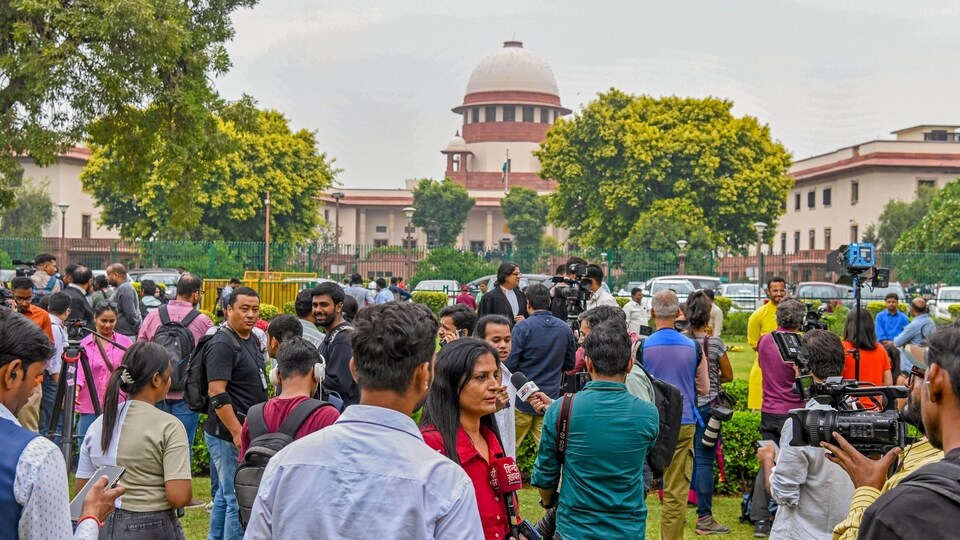
They weren’t the only ones. By noon, as the chill lifted from Delhi’s air and it became clear that the queer petitioners before the apex court were not even being granted limited recognition or rights, waves of disappointment coursed through the people huddled before the five judges, their faces ashen as the majority verdict proceeded to dash their hopes and lob the ball back to the executive.
12,000km away in icy Raleigh, Sameer Samudra felt the same jitters. In the dead of the night in North Carolina, the petitioner was glued to the phone while the judges read out the verdict on a large screen in front of him, his family hanging on his every word. For more than an hour, he was imbued with hope as Chief Justice of India DY Chandrachud and justice Sanjay Kishan Kaul accorded the petitioners adoption rights and recognised civil unions. “And then suddenly, it turned. It was a difficult roller-coaster of emotions. We felt like we were taken on a ride – we had something and suddenly we had nothing,” he said.
Samudra and his partner Amit Gokhale had approached the court after they tried to register their marriage – recognised in the US – at the Indian Embassy. “We were humiliated, first at the embassy, and then by a marriage registrar in Pune. And today, we felt like the homophobes had won,” he said.
Echoing his emotions were Supriyo Chakraborty and Abhay Dang who stood in the cramped space of the CJI’s court as the verdict was read out. The couple, who got married in Hyderabad in 2021, had a commonplace meet-cute – met on a dating app, had a first date at a café, spent hours and hours talking in the days that followed. Yet, when they decided to move into a small flat together in 2013, that was anything but commonplace. The Supreme Court had just overturned a 2009 judgment by the Delhi high court that decriminalised homosexuality, rendering them criminals overnight. “We know what that adverse verdict in 2013 did. And that’s why we were hoping for a positive outcome,” Chakraborty said, still drained. “But we were deeply disappointed. Though the court spoke about a committee, there was little that we got today.”
The petitioners had presented myriad arguments before the court – dignity, respect, respectability, financial security, equal opportunity, elderly care, parity with other countries, constitutional rights to privacy, freedom of expression and freedom of religion. And, as was the case for Singh and Chauhan, the overwhelming need for safety.
The court’s refusal left many upset. “I’m disappointed. My decision to leave India for Canada stands vindicated,” said Saattvic, a petitioner. Yet, even in that moment of despair, some saw a glimmer of an opportunity. Saattvic chose to repose hope in the Union government’s committee that will look into issues of discrimination faced by queer couples. Chayanika Shah gained satisfaction from the directions given to the police by the CJI to not harass queer couples. Chakaborty drew solace from the fact that similar stumbles were part of the arc of LGBTQ+ rights across the world. And, they were united in the belief that the community will bounce back – just as it had after 2013. “This is just a comma, not a full stop. We will get back into the fight, on the ground,” said Samudra. “But first, we’ll need a moment to cry.”