
 E-Paper



Kolkata's Chinatown filled with Mandarin election posters and muted political voices
Despite poll outreach in Mandarin, issues regarding livelihood security and cultural identity persist within the Chinese-Indian community in Kolkata's Chinatown

 Prefer HTon Google


It is not usual in India, in any state, to see political messaging in a language not commonly spoken there, let alone a foreign language. But in this Kolkata neighbourhood called Tangra — home to a small Chinese-Indian community — walls carry messages by parties in Mandarin amid the West Bengal elections, in a display of political outfits’ efforts to not leave any voter out of their campaign ambit.
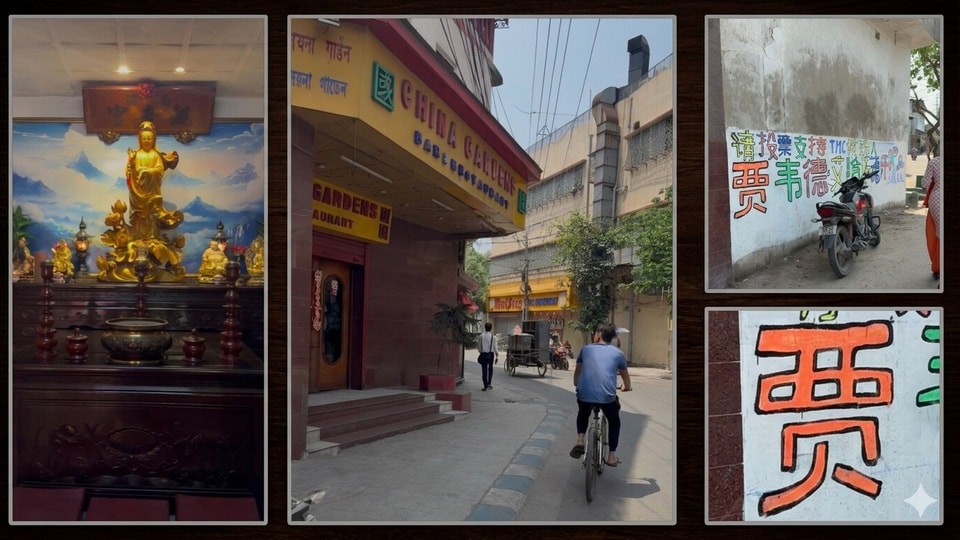
Tangra, popularly known as Kolkata's Chinatown, has red lanterns swaying above narrow lanes. Buddhist symbols are visible at eateries, entrances and along the lanes, and Asian grocery stores line streets filled with the smell of soy sauce and slow-cooked broths. A Chinese Kali temple also cannot be left unmentioned.

During the election season, however, striking visuals appear on the walls of Tangra: campaign messages written in Mandarin, an unusual sight in Indian electoral politics and a reflection of political parties attempting to reach one of the city's smallest yet historically significant communities - the Chinese-Indians.
Tangra has long stood as a symbol of migration and cultural exchange. Once dominated by tanneries run by Chinese-Indian families, particularly of Hakka Chinese origin, the neighbourhood today is better known for its restaurants and early-morning Chinese breakfast culture.
Yet behind the familiar culinary identity lies a community navigating transition and uncertainty.
Few residents were willing to speak on camera, but extended conversations during a walk through the locality revealed sentiments shaped less by partisan loyalty and more by structural concerns.
“We are not involved in politics,” said a resident of Hakka Chinese origin, who wished to remain unnamed. His son-in-law runs a restaurant there.
Also read: How Kolkata is talking about Bengal elections in addas
The area attracts particular attention from food vloggers and enthusiasts, and locals said the breakfast sellers, who wrap up operations by 8.30 am every day, are more camera-friendly.

Mandarin messaging
One long-time resident summed up his view of elections with a metaphor: “The textbook needs to change. Whoever the principal is doesn’t matter,” he said when asked whether he wanted a change in government - signalling frustration with governance systems rather than individual political leaders.
His own life mirrors Tangra's changing economy. While his son-in-law runs a restaurant catering to visitors drawn to Chinatown's food culture, he has rented out what used to be his factory space, reflecting the gradual decline of industrial activities - mostly leather tanneries - that once operated in the area.
He also spoke of everyday challenges faced by property owners. While carrying out repairs at his factory, he alleged that he faced threats from local strongmen - an experience he described as common and discouraging for residents attempting to maintain businesses or properties.
Asked again if he would want a change in government, he said, in a veiled message, that “changing the principal won’t help if the textbook doesn’t change”.
Further inside the neighbourhood, another resident raised concerns about redevelopment and relocation. According to him, compensation offered to shift businesses or properties is insufficient, and many community members feel mounting pressure that could eventually displace them from an area they have inhabited for generations.
These anxieties exist alongside visible electoral outreach. Mandarin campaign messages signal recognition of the community's presence, yet conversations suggest that symbolic inclusion does not automatically address deeper worries over livelihood security, safety, and cultural preservation.


No, the India-China standoff along the Line of Actual Control (LAC) does not affect people of Chinese origin here in any way.
“We were scared when the Galwan clash happened [about facing unwarranted sentiments from locals], but didi was very strict,” said one of the above-mentioned residents of Tangra, suggesting that the chief minister did not allow any negativity to brew in the area.

For many in Tangra, the election is not only about political outcomes but also about whether the neighbourhood's unique identity — shaped over more than a century of Chinese-Indian history in Kolkata — can endure amid economic change and urban transformation.
Voting across West Bengal will be held in two phases on April 23 and April 29, while results will be declared on May 4.


