
 E-Paper



West UP ground report: Cracks appear in rainbow alliance vote base
In UP, the Jats are counted as OBCs and can benefit from quotas in education and jobs. The BJP has been on an overdrive to win over the community that voted in large numbers for the party in the previous assembly elections as well as in the last two general elections but has been open about its anger against the party following the farmer protests

 Prefer HTon Google


Bhupesh Chaudhary a resident of Mant assembly constituency in Uttar Pradesh’s Mathura has a long list of questions for the government to answer.
“If the Bharatiya Janata Party is concerned about the Jats, why was (Haryana CM) Manohar Lal Khattar allowed to continue after the brutalities against the Jats during the 2016 protests ? Why aren’t Jats in the central OBC (other backward classes) list? Why did 700 farmers die before the government rolled back the farm laws?”
Chaudhary is from the Jat community, a sizeable vote bank of about 16.5% in Mathura alone that is being assiduously wooed by the BJP and opposition parties alike.
The reference to neighbouring Haryana’s chief minister is a reminder of the anger that a section of Jats nurse against the BJP for not accepting the demand for the inclusion of the community in the central OBC list. In 2016 the demand set off violence that rocked Haryana, with its ripples felt in Rajasthan and Uttar Pradesh. The anger resurfaced when the government in 2020 passed three new farm laws. After a 14-month long protest by farmers, the government repealed them late last year.
In UP, the Jats are counted as OBCs and can benefit from quotas in education and jobs. The BJP has been on an overdrive to win over the community that voted in large numbers for the party in the previous assembly elections as well as in the last two general elections but has been open about its anger against the party following the farmer protests. The public display of anger against BJP leaders, including ministers being greeted with black flags before the laws were repealed, may no longer be there, but the party is worried that the scars remain.
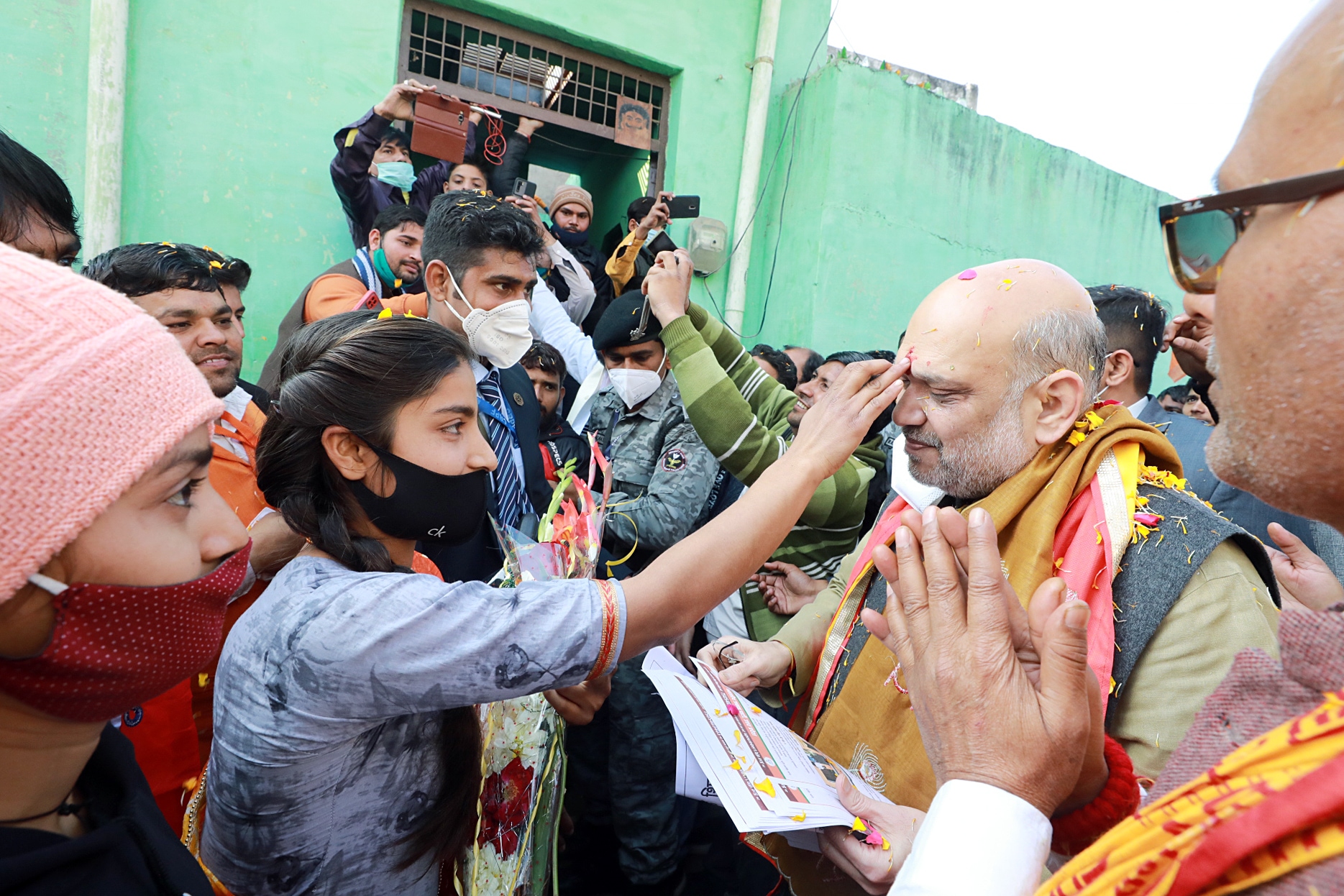
That’s one reason why senior BJP leaders including the party president JP Nadda and union home minister Amit Shah have hit the road , going door-to-door in Jat dominated areas eliciting support (to be sure, this approach has been forced upon them by Election Commission restrictions on rallies on account of the pandemic, but even then, it is rare for senior leaders to go door-to-door). Shah even held a meeting with a section of Jat leaders which was construed as an olive branch, but the mood in Mathura’s Jat dominated areas is far from affable.
“Water here has fluoride above permissible limits. Have you heard anyone talk about that?” says Chaudhary who is an agriculturist. He is disappointed that despite its tall promises, the state government has kept the focus on identity rather than on issues that affect everyday lives.
According to 2019 data provided by the Department of Drinking Water and Sanitation, Mathura is among the 60 districts in the state where the water has high fluoride levels (it leads to several problems including severe bone disease). Residents have been complaining about the quality of portable water, the supply of electricity to the farms, the paucity of fertilizers and the poor remuneration that their crop gets.
“They have kept alive the Mandir-Masjid conflict. There is frequent reference to the 2013 Muzaffarpur riots to keep the Jats and the Muslims from putting the past behind them. But here in Mathura the Jats are not falling for the anti-Muslims rhetoric and this is why despite the RLD’s alliance with the Samajwadi Party, they will vote for the combine,” says Rajendra Ferrari, a lawyer.
His reference is to the riots that happened during the rule of the previous Samajwadi Party government, which drove a wedge between the communities. There’s still a feeling among some in the Jat community here that the then ruling party took the side of the Muslims.
The SP and the Rashtriya Lok Dal, now headed by Jayant Choudhary, whose grandfather, former Prime Minister Charan Singh was the tallest Jat leader once, are fighting the election in partnership.
Ferrari says there is a growing distrust against the BJP within the community.
A group of farmers in Mant who had turned up to show support for the SP-RLD candidate Sanjay Lathar said that while the sitting legislator, Shyam Sunder Sharma now with the BSP has a record of winning eight times from Mant, this time the residents want to vote for the alliance to register their protests against the BJP.
“There is no subsidy for power consumption; prices of diesel, cooking gas and cooking oil have skyrocketed. Is the government even concerned?” asks Chaudhary.
Cracks in the rainbow coalition
Jats are not the only caste that the BJP relies on for increasing its vote share. The party has forged alliances with OBC parties such as Apna Dal and Nishad Party that represent Kurmis, Kushwahas, Nishads and several others that together are known as the non-dominant OBCs. It often refers to this diverse group as a rainbow coalition of castes. But this famed coalition is also showing signs of cracks.
In Firozabad, workers at the local granary who come from the Nishad community are not entirely enthused by the government’s policies and say their lives are no better than before. “It was [PM Narendra] Modi who gave us samman (respect) by setting up a ministry of fisheries and [CM] Yogi gave us free ration. Since our Nishad Party is part of the sarkar (government) we will have to vote for the BJP,” says Shiv Dutt, a farmer.
Prod him on what he thinks the government should have done more, he says, “I had a ber (fruit) farm and during the lockdown I lost nearly half of the produce because stray cattle are everywhere. This government claims it has goshalas (cow sheds) but all we see is cattle ruining our fields.”
An agent at the mandi(local market), a Kushwaha who does not want to be identified, says people in his community are divided and some are not averse to the BJP, but are wary that sops such as the free ration will be stopped after the elections. “There is mandee (slowdown) and this free ration is because of corona (pandemic) and elections,” he says.
Both Dutt and the Kushwaha agent however concur that in the event of it being a “kante ki takar” (close contest) the BJP’s standing as a “Hindu party” gives it the edge.
In Agra, where the district’s sizeable Dalit (scheduled caste) population sways the electoral outcome, the face of Jatav (Dalit) leader Baby Rani Maurya (of the BJP) or the list of benefits that the community has received from state and central schemes have not prevented a division over voting preference.
“The Valmikis account for 90% of sanitation workers at Agra Municipal Corporation and all you need to do is look at our working and living conditions to see how the BJP has helped us,” a sanitation worker in Ramnagar says. Valmikis were counted as the BJP’s supporters in the previous elections.
Not wishing to be identified he adds: “Even during the pandemic we got nothing except vaccines; no gloves, no masks, no insurance. If we die, there is nothing the government will do to help our children. Five years ago, their leaders came to Valmiki bastis to ask for votes and then promptly forgot us.”
While there are a few pockets of support for the BJP even in Jatav strongholds such as Katra Wazir Khan; the community seems largely in support of the BSP.
Even though the BSP is not seen as a serious contender in the elections beginning February 10, its supporters confess that they would much rather vote for their own caste instead of showing support to the SP.
The BJP for its part has been claiming that its policies such as subsidized accommodation and toilets that benefitted the marginalized communities irrespective of their caste and political affiliations has made it an option for the communities such as the Jatavs, once counted as BSP’s bedrock.
“Unemployment, hunger and the collapse of the health sector during the Covid pandemic led to each family suffering in its own way. People in rural areas were the worst affected. This time only the core voter is with BJP, the floating voter has shifted and there is no hawa wala (creating a wave) voter. The BJP is providing free ration, but most people think taking that is below their dignity but they have no choice as industries have shut down and there is no work for the daily wagers,” says RK Bharti, professor at the BR Ambedkar University, Agra.
And it may not be easy to get Dalits to be part of the consolidated Hindu vote, he adds. “Where is the Hindu Pride when it comes to appointing priests in temples or solemnising inter-caste marriages?”


