
 E-Paper



When 425k cusecs of water in Musi river wreaked havoc in Hyderabad’s worst-ever flood
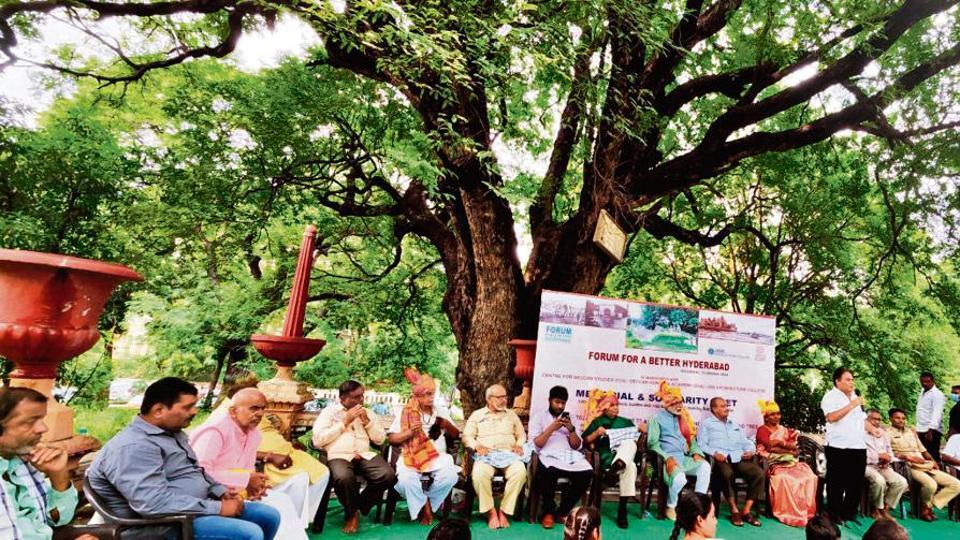
The memorial meet on Wednesday was organised in front of the famous “tamarind tree” at the park on the premises of Osmania General Hospital, which was not built then.

 Prefer HTon Google


Hyderabad
As Hyderabad has been witnessing heavy rains for the last two days inundating several low-lying areas, historians and heritage lovers of the city remembered how the city witnessed an unprecedented deluge on this day in 1908, which claimed over 20,000 lives, orphaned many children and rendered more than 80,000 people homeless.
Historian and managing trustee of Deccan Heritage Trust Md Safiullah said the September 28, 1908 floods to the Musi river, on the banks of which Hyderabad was built, were the worst-ever in its history.
“There was an unprecedented flow of 425,000 cusecs of water in the river, raising its level to more than 20 feet above the inhabited area on both sides, drowning the houses and properties at a distance of more than a kilometre,” Safiullah told HT, quoting the records available then.
Forum for Better Hyderabad chairman M Vedakumar, who organised a memorial and solidarity meet on Wednesday to pay homage to the victims of 1908 floods, said the massive floods to the Musi river left a trail of destruction on either side and completely wiped out more than 18,000 human settlements.
“The deluge was so vast that water inundated even the British Residency, which is now University College for Women at Koti, located a kilometre away,” Vedakumar said, recalling the version of old timers.
The memorial meet on Wednesday was organised in front of the famous “tamarind tree” at the park on the premises of Osmania General Hospital, which was not built then. “This tree, which still stands tall and wide, saved the lives of 150 people who took refuge atop it,” Vedakumar said.
Another historian and convenor of Indian National Trust for Art and Cultural Heritage (INTACH), P Anuradha Reddy, recalled the famous Hyderabadi poet Amjad Hussain, also known as Amjad Hyderabadi, who wrote a poem – “Qayamat-e-Soghra” (The Minor Doomsday) -- detailing his experience of the 1908 floods to the Musi.
“Amjad was one of those 150 people, who saved their lives by hanging on to the branches of the tamarind tree. But his mother, wife and daughter, who had slipped from his hands, got washed away in floods,” Anuradha Reddy said, recalling his verse: “Itni Dar’ya May Bhi Na Duba Amjad Dub’nay Valo Ko Bus Ek Chul’lu Kafi Hai” (Amjad could not get drowned even in such a deluge, but for those who drowned, even a handful of water is enough).
Vedakumar said then Sixth Nizam Mir Mahabub Ali Khan Pasha had thrown open all his major palaces to provide shelter to the homeless, organised kitchens and offered free food to the affected people for several days.
There were reports that the Nizam, on the advice of his astrologers, had even sported dhoti and wore “jandhyam” like a Brahmin and offered prayers at Musi to appease the river.
Anuradha Reddy said on the request of the Nizam, then famous irrigation engineer Sir Mokshagundam Vishweshwaraya came down to Hyderabad to study the deluge and provide a permanent solution to the floods to Musi river.
“It was Vishweshwaraya, who designed the twin reservoirs – Osman Sagar and Himayat Sagar -- to provide the flood protection to the city, besides constructing a drainage system,” she said.
Quoting from Vishweshwaraya’s autobiography – “Memoirs of my Working-Life,” Anuradha Reddy pointed out that the rainfall recorded at Shamshabad, one of the principal rain-gauge stations in the catchment area on September 28, 1908, was 12.8 inches in 24 hours, which is about 440 mm.
“This rainfall due to a cloudburst resulted in the most destructive flood that had been witnessed in Hyderabad city for over three-quarters of a century ,” the engineer, who was later awarded Bharat Ratna, said in the book.
He said more than the rainfall, it was the breach of 221 smaller tanks in the catchment area of Musi river that caused the deluge, wreaking havoc with Hyderabad.
Thanks to the two reservoirs, the Musi river has not witnessed floods of that magnitude in the last 114 years. “But there have been heavy rains regularly and the city still continues to witness heavy water logging and inundation of low-lying areas. The city is growing and the population is increasing, but the successive governments have not been able to improve the drainage system in tune with the growing needs of the city,” Vedakumar added.


