E-Paper



Delhi draft e-rickshaw policy proposes 2.5 lakh vehicle cap, ownership limits, stricter rules
Delhi’s draft e-rickshaw policy proposes a cap of 2.5 lakh vehicles, limits on ownership, mandatory compliance certificates and stricter penalties for violations.

 Prefer HTon Google


The Delhi government has proposed capping the number of e-rickshaws in the capital at 2.5 lakh, restricting individual ownership to five vehicles and requiring digital compliance certificates under a draft policy issued for public consultation on Sunday. The general public and stakeholders have been invited to submit their feedback within the next 30 days.
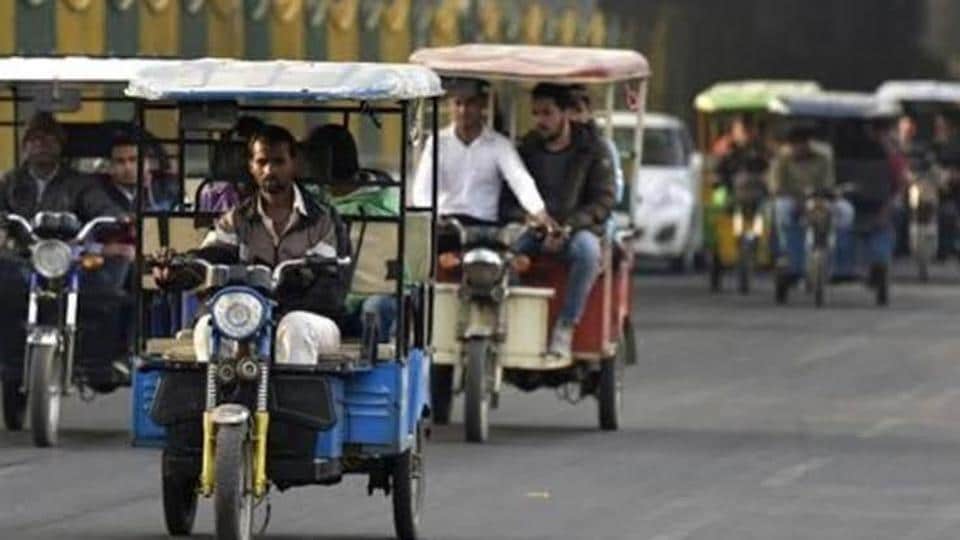
The proposed Delhi E-Rickshaw (Registration and Operation) Scheme, 2026, also seeks to mandate aggregator licences for fleet operators with 25 or more vehicles and introduce stricter penalties for violations**.**
The proposed city-wide cap of 2.5 lakh e-rickshaws with valid E-Rickshaw Compliance Certificates (ECCs) would take effect after a 90-day window for existing vehicles to regularise their compliance. The draft states that no fresh certificates would be issued beyond the limit unless the government revises it, citing concerns over traffic congestion, road safety, pollution and the unregulated growth of e-rickshaws.
“No e-rickshaw shall operate in the NCT of Delhi unless it is registered in accordance with Section 39 of the Act and is in possession of a valid ECC under this scheme,” the policy states.
The draft also seeks to restrict vehicle ownership. An individual owner must be a Delhi resident and cannot own more than five e-rickshaws under the scheme. Companies, firms, cooperatives and other permitted entities would be subject to a separate ceiling of 100 vehicles. Entities operating fleets of 25 or more e-rickshaws would also be required to obtain an aggregator licence, the draft policy states.
“Having regard to the serious concerns relating to traffic congestion, road safety hazards, air and noise pollution, and the excessive and unregulated proliferation of e-rickshaws, the Government of NCT of Delhi hereby fixes a city-wide fleet cap of two lakh fifty thousand (2,50,000) E-Rickshaws/E-Rickshaw Compliance Certificates (ECCs) for e-rickshaws operating in NCT of Delhi. No registration/ECC shall be issued beyond this limit,” the draft policy states.
Under the proposed framework, registration alone would not be sufficient to operate an e-rickshaw. Each vehicle would need a valid ECC linked to its registration, owner, authorised driver and relevant compliance documents, including a fitness certificate and insurance. The certificate would remain valid for two years, subject to suspension or cancellation.
Owners of existing registered e-rickshaws would be given 90 days from the notification of the scheme to obtain the required certificate, unless the deadline is extended. The proposed rules also require drivers to hold a valid e-rickshaw driving licence and a Public Service Vehicle (PSV) badge. A driver or driving licence cannot be linked to multiple valid ECCs simultaneously.
The draft introduces additional provisions on battery safety and environmental compliance. E-rickshaws would have to comply with applicable battery standards, and used batteries would need to be disposed of through authorised recyclers. “All e-rickshaws seeking registration and ECC under this Scheme shall mandatorily be equipped with battery technology as may be notified by the MoRTH from time to time. All used batteries shall be disposed of exclusively through authorised recyclers,” it adds.
Road safety and traffic management also feature prominently in the proposals. E-rickshaws would be required to follow notified road restrictions, park without obstructing traffic or pedestrians, display the owner’s contact details and carry prescribed reflective markings and high-security registration plates. Bull bars and frontal crash guards would be prohibited.
Passenger-related provisions include a maximum of four passengers, excluding the driver, and a luggage limit of 40 kg. Standing passengers and passengers occupying the driver’s seat would not be permitted. Drivers would also be required to assist elderly and disabled passengers and report incidents involving harassment of women passengers to the police.
The draft proposes stringent action against violations, including impounding vehicles operating without the required registration or compliance certification. It also provides for the crushing and auction of certain impounded vehicles under prescribed government guidelines.
“Any e-rickshaw found operating without registration after the notification of this Scheme shall be immediately impounded by the enforcement authority. An unregistered e-rickshaw shall not be released under any circumstances after impounding. Such vehicles shall be crushed and auctioned ...the battery of an impounded unregistered e-rickshaw shall not be released under any circumstances and shall be auctioned,” it adds.
The Transport Department has invited public comments on the draft within 30 days of publication.