
 E-Paper



Who is Sheikh Hasina, Bangladesh's ex-PM who left country amid protests?
Daughter of Bangladesh's founding father Sheikh Mujibur Rahman, Sheikh Hasina has been the longest-serving prime minister in the country’s history.

 Prefer HTon Google


Amid violent protests in the country, Bangladesh Prime Minister Sheikh Hasina resigned on Monday and left the capital Dhaka. According to HT, her chopper had arrived in Tripura's capital Agartala a while ago.
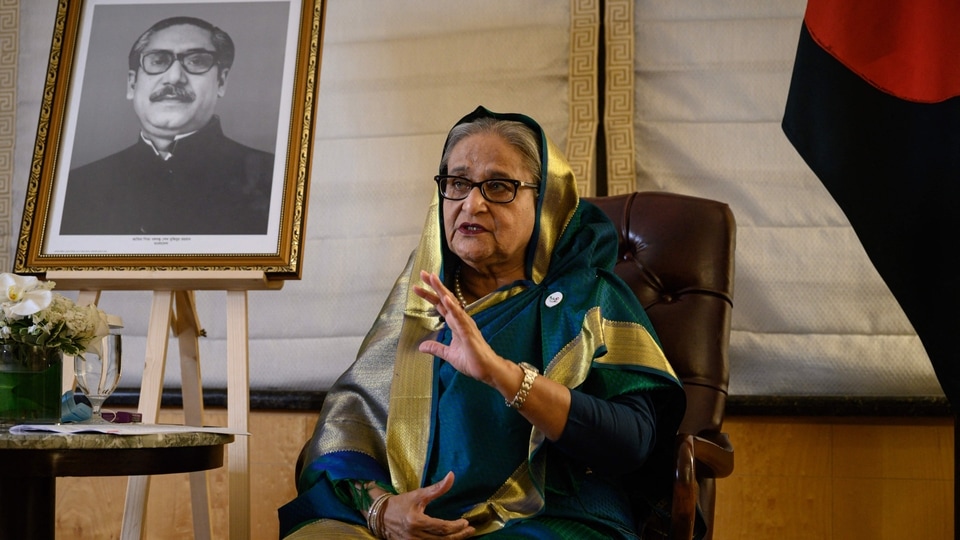
The 76-year-old politician served as prime minister from June 1996 to July 2001 and again from January 2009 to August 2024. Daughter of Bangladesh's founding father Sheikh Mujibur Rahman, Hasina has been the longest-serving prime minister in the country’s history with close to three decades in office combined.
In the late 1960s at the University of Dhaka, she was active in politics and served as her father’s political liaison while the Pakistani government imprisoned him.
In 1971, she and other family members were briefly detained for their involvement in an uprising during the liberation war that led to Bangladesh’s independence.
Howeever, in August 1975, then president Sheikh Mujibur Rahman, along with his wife and three sons were assassinated at their home by military officers.
At the time of the attack, Hasina was abroad and spent the following six years in exile. During her time away, she was elected to lead the Awami League, the political party founded by her father, which had become the largest political organisation in Bangladesh.
Read: India ‘strongly advises’ its nationals to avoid violence-hit Bangladesh
Upon her return to Bangladesh in 1981, Hasina emerged as a vocal champion of democracy and faced multiple instances of house arrest. She became the leader of the opposition in Bangladesh and denounced the violence of military rule.
In December 1990, Lieutenant General Hussain Mohammad Ershad, the last military leader of Bangladesh, resigned after Hasina issued an ultimatum that received widespread public backing.
As the leader of the opposition, Hasina accused Khaleda Zia's Bangladesh Nationalist Party (BNP) of electoral fraud and chose to boycott Parliament that led to widespread protests and political unrest in the country.
Also read: How and why did Sheikh Hasina flee Bangladesh? 10 points
Zia eventually resigned, leading to the establishment of a caretaker government. Following the June 1996 elections, Hasina became prime minister. During her first term, the country saw economic growth and a decrease in poverty, but political instability persisted. Her term ended in July 2001 after an electoral defeat to Zia. This was the first time a Bangladeshi prime minister completed a full five-year term since the country's independence.
Amid the 2006–2008 political crisis, Hasina was arrested on extortion charges but won the 2008 elections after her release. She was re-elected in 2014 for a third term in a controversial election boycotted by the BNP and criticised by international observers.
She was lauded in 2017, Hasina received praise for providing sanctuary and assistance to nearly a million Rohingya refugees fleeing violence in Myanmar.
Her fourth term followed the 2018 election, which was plagued by violence and broadly condemned as fraudulent. The recent unrest in Bangladesh began when students protested against the government job quota system and challenged Sheikh Hasina and her ruling Awami League party. In response, the military had imposed an indefinite curfew and authorities have severed internet access to manage the situation.


